Author: Automotive expert specializing in Chinese vehicles, with hands-on experience in diagnostics, maintenance, and real-world operation of ICE, hybrid, and electric models.
avtomir.site Editorial Team · Updated July 2026
Haval Jolion, one of Great Wall Motors’ most popular crossovers, offers impressive value and features. Still, like any modern vehicle, it can occasionally display trouble codes — either on the dashboard or read via an OBD-II scanner. These codes help pinpoint faults and guide the repair process.
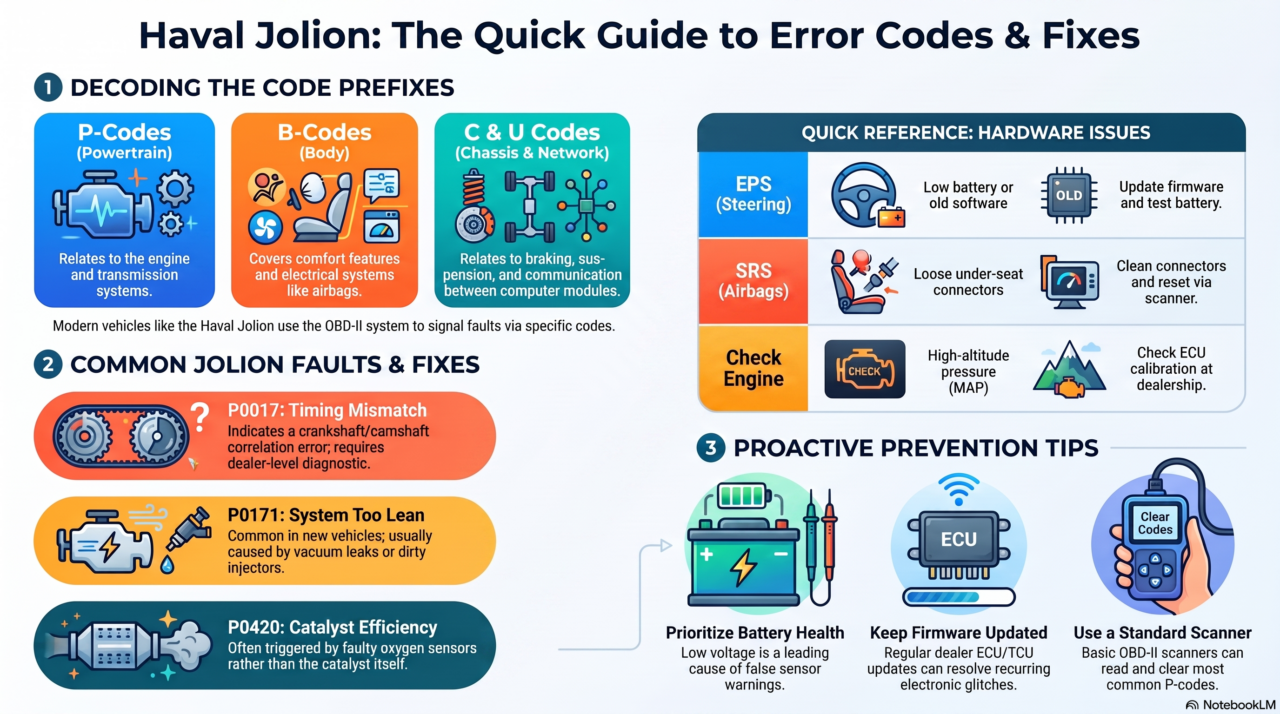
On-Board Diagnostics II (OBD-II) is a standardized system used in vehicles since 1996 to detect malfunctions in engines, transmissions, and other critical systems. Codes start with a letter indicating the system:
P – Powertrain (engine/transmission)
B – Body (comfort/electrical)
C – Chassis (braking/suspension)
U – Network (communication between modules)
📋 Common Haval Jolion Trouble Codes
Below are error codes frequently discussed in Haval Jolion owner communities, along with descriptions, likely causes, and recommended actions:
Code
Meaning
Likely cause
Fix
P0017
Crankshaft/Camshaft Position Correlation (Bank 1, Sensor B)
Timing mismatch between crankshaft and camshaft position sensors — one of the more frequently reported check-engine triggers on the Jolion.
Inspect the timing chain and related sensors. Best handled with a dealer-level diagnostic rather than DIY, since it can involve timing components.
P0100
Mass Air Flow (MAF) Sensor Circuit Malfunction
Dirty or damaged MAF sensor.
Clean the sensor with MAF-specific cleaner, or replace it if cleaning doesn’t resolve the fault.
Vacuum leaks or clogged fuel injectors. Owner reports also mention this appearing on essentially new vehicles during the initial break-in period.
Inspect the intake system for leaks and service the fuel injectors. If a dealer clears the code without finding a root cause, expect it to return — insist on a proper leak/injector check.
Check spark plugs and coils first (swapping coils between cylinders is a good diagnostic step), then verify fuel pressure. If the cause isn’t obvious, an endoscope inspection can help avoid guessing.
Test both oxygen sensors before assuming the converter needs replacing; inspect the exhaust system for leaks.
P0700
Transmission Control System Malfunction
General TCM fault flag, usually accompanied by a more specific stored code.
A full transmission diagnostic scan is needed to find the underlying code driving this flag.
U0100
Lost Communication with Engine Control Module (ECM)
CAN bus wiring issues, a weak ground connection, or (rarely) a failed ECM.
Check the wiring harness and ground connections before assuming the ECM itself has failed.
B1402(mfr-specific)
Airbag (SRS) System Malfunction
Loose connector or a faulty impact sensor.
SRS-specific diagnostics are needed; do not attempt DIY repairs on airbag wiring without proper training.
C0035
Left Front Wheel Speed Sensor Circuit (SAE-standard)
Damaged or contaminated wheel speed sensor or wiring — can appear on the Jolion and many other vehicles.
Inspect and clean or replace the affected wheel speed sensor and check the tone ring for damage.
A second digit of “0” generally means the code is part of the SAE-standardized set shared across manufacturers; a “1” (e.g. B1xxx, C1xxx) usually indicates a manufacturer-specific code, so the exact meaning can vary — always confirm with a dealer-level scanner if in doubt.
⚠️ Haval Jolion-Specific Issues
1. Electric Power Steering (EPS) Warning
Some owners report EPS failure warnings, especially after long drives or during cold starts. A restart sometimes clears it temporarily, but recurring warnings may point to:
EPS control unit malfunction
Low or unstable battery voltage
Outdated software
🔧 Fix: Have the firmware checked/updated at a dealership and test the battery’s health, especially if the warning correlates with heat or long highway stretches.
2. Check Engine Light in High-Altitude/High-Pressure Regions
Drivers in regions with different atmospheric pressure have reported Check Engine lights linked to MAP (manifold absolute pressure) sensor readings, particularly on AWD versions.
🔧 Fix: Have the ECU calibration checked at a dealership and inspect the intake system for leaks.
🚗 Special Deals & Discounts
Latest prices on vehicles, spare parts and dealer promotions.
Airbag (SRS) warning lights often correspond to manufacturer-specific B-codes. Likely causes include loose connectors under the seats, a faulty impact sensor, or an SRS control unit fault.
🔧 Fix: Clean connectors, inspect wiring, and have the code read and reset via a proper scanner.
🧰 How to Read and Clear Error Codes
Method 1: OBD-II Scanner
Connect the scanner to the OBD-II port (usually under the dashboard, near the steering column).
Turn the ignition to “ON” (engine off).
Read the codes and note the descriptions and freeze-frame data.
Clear the code only after resolving the underlying issue.
📱 Tip: Budget Bluetooth scanners like the ELM327 work well with apps such as Torque, Car Scanner, or OBD Auto Doctor for reading most P-codes.
Method 2: Dealer Diagnostics
Official Haval service centers use proprietary tools that can read both standard and manufacturer-specific codes — this is generally the only reliable way to interpret B- and C-codes with certainty.
💡 How to Prevent Error Codes
Follow the scheduled maintenance plan. Use approved oil, filters, and fluids.
Maintain battery health. Low voltage often leads to sensor malfunctions and false warnings.
Avoid unauthorized aftermarket electronic parts.
Keep firmware updated via dealer ECU/TCU updates.
Don’t overload the vehicle. Excessive load can trigger sensor faults.
What Real Jolion Owners Report
The reports below are paraphrased from public Haval Jolion build logs and forum posts on Drive2.ru (Russian-language), linked below for the original context. These are individual anecdotal experiences, not statistics — treat them as illustrative, not a substitute for your own diagnosis.
Haval Jolion 1.5, 2024 model — owner’s build log
Within the first month of ownership, a P0171 (“system too lean”) code appeared. At the dealership, the technician cleared the code without identifying a root cause and said the issue was resolved — but it returned after roughly 20 km of driving. The owner’s log notes that the dealership’s warranty department was unavailable over the holiday period, delaying a proper fix. Source: Drive2.ru
Haval Jolion 1.5, 2021 model — owner’s build log (“Uncertain start, part 2”)
Troubleshooting a rough/uncertain engine start, the owner had already replaced the fuel pump with no improvement. In the forum discussion, other members pointed out that misfires and sensor issues are normally logged by the car’s system rather than needing to be guessed at, and suggested checking rail pressure, reading stored codes, and using an endoscope before replacing more parts — noting that a failing ignition coil can cause rough idle and hesitation on acceleration without necessarily throwing an obvious code. Source: Drive2.ru
❓ Frequently Asked Questions
Q1: What should I do if my Check Engine Light comes on in my Haval Jolion?
Use an OBD-II scanner to read the trouble code first — it will point you to the specific system involved. If you don’t have a scanner, visit a mechanic or a Haval service center for diagnosis. Don’t ignore the light, as it can indicate a developing issue.
Q2: Can I clear a trouble code myself without fixing the issue?
You can, but it’s not recommended. Clearing a code only turns off the warning light — as seen in real owner reports above, the fault typically reappears once the underlying cause resurfaces, and continuing to drive with it unresolved can lead to more costly damage.
Q3: Where is the OBD-II port located in the Haval Jolion?
In most Haval Jolion models, the OBD-II port is under the dashboard, typically to the left of the steering column or near the fuse box.
Q4: Is it normal for the EPS warning to appear after a long drive?
Occasional EPS warnings after long drives or cold starts have been reported by some owners. A restart sometimes clears it, but persistent warnings may point to the EPS control unit, battery voltage, or outdated software — best checked at a dealership.
Q5: How can I prevent common Haval Jolion error codes?
Follow the scheduled maintenance plan, keep the battery healthy, avoid unapproved aftermarket electronic parts, keep firmware updated at the dealership, and avoid overloading the vehicle.
📚 Sources
This article is based on the OBD-II/SAE J2012 diagnostic standard, general Haval technical documentation, and publicly available owner forum reports.
OBD-II / SAE J2012 standard — code structure and standard definitions (P0xxx, U0xxx, C0xxx).
General Haval Jolion service information — publicly available technical descriptions of P0017, P0100, P0171, P0300, P0420, P0700, U0100.
Owner forum reports (Russian-language) — Drive2.ru build logs on P0171 and misfire diagnostics, linked directly in the “What Real Jolion Owners Report” section above.
Manufacturer-specific codes (B1xxx, C1xxx) can vary by model year and market — always confirm the exact definition with a dealer-level scanner. Repair approaches above are general guidance, not a substitute for a proper diagnosis.
🔧 Need car repair or diagnostics?
Discounts on maintenance, diagnostics, and spare parts for Chinese cars at official dealers and trusted services.