Author: Automotive expert specializing in Chinese vehicles, with hands-on experience in diagnostics, maintenance, and real-world operation of ICE, hybrid, and electric models.
avtomir.site Editorial Team · Reviewed and updated July 2026
The Chery Omoda 5 (sold in some markets as the Omoda C5, or badged Chery C5/O5/E5 depending on the region) is a compact crossover that relaunched Chery in several markets from 2022 onward, aiming squarely at the Hyundai Kona, Toyota Corolla Cross, GWM Haval Jolion, and MG ZS. It combines an unusually bold design and a long, well‑publicised warranty with sharp pricing. It has also sold well enough to attract a real body of ownership feedback — from Euro NCAP and ANCAP test data, official recall filings, dealer‑network reviews, and long‑term owner posts on Drom.ru and Drive2.ru — and that feedback points to a fairly consistent set of weak spots.
This guide summarises what is actually documented: a confirmed safety recall, a known CVT calibration issue that Chery itself has addressed with software updates, and a handful of recurring electronics and build‑quality complaints. Figures without a solid public source (unverifiable “percentage of owners affected” statistics, invented review scores) have deliberately been left out — where we can’t confirm a number, we say so.
The Omoda 5 measures roughly 4,400 mm long, 1,830 mm wide and 1,588 mm tall on a 2,630 mm wheelbase. The launch engine is a 1.5‑litre turbo‑petrol four‑cylinder producing 108–115 kW and 210–230 Nm depending on market, paired with a CVT and front‑wheel drive; a 1.6‑litre turbo (up to 137–145 kW) with a seven‑speed dual‑clutch transmission and, in some markets, all‑wheel drive, is offered on higher trims. Official combined fuel consumption is quoted around 6.8–7.4 L/100 km, though independent reviewers in several markets have measured 9–12 L/100 km in mixed real‑world driving. Boot space is quoted anywhere from roughly 300 to 360 litres with the rear seats up (figures vary by market homologation), expanding past 1,000 litres with the seats folded.
Confirmed safety recall: brake pipe union bolt
This is the single most serious documented issue, so it comes first. In 2025, Chery issued an official recall covering 5,901 Omoda 5 units built between 2022 and 2023. The cause was a manufacturing defect in which the bolt securing the brake pipe union may not have been tightened sufficiently, which could allow brake fluid to leak and reduce braking performance. Chery’s own notice states this could increase the risk of an accident causing serious injury or death, and it has been treated by regulators as a genuine safety recall rather than a routine bulletin.
What to do: if you own or are buying a 2022–2023 Omoda 5, check the vehicle’s VIN against the recall list through your national vehicle‑recall database or your local Chery dealer before driving it extensively. The inspection and any rectification are free of charge under the recall.
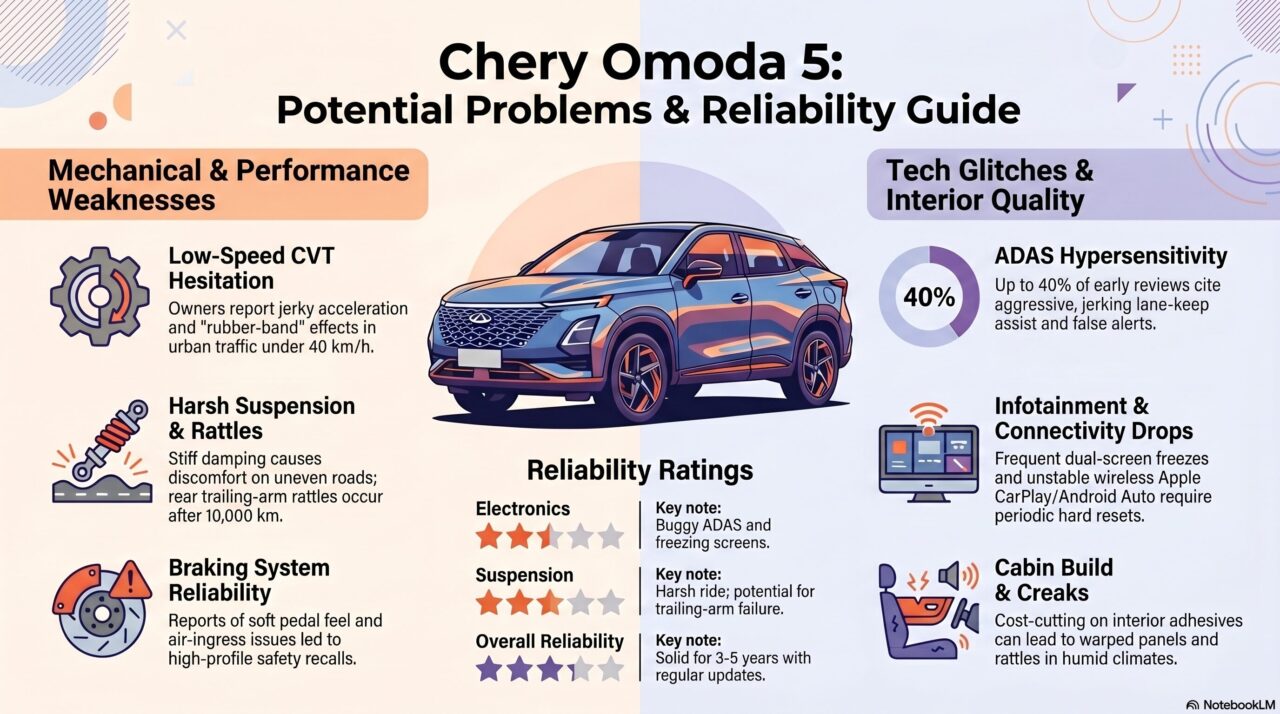
CVT hesitation and low‑speed jerkiness
The most frequently reported drivability complaint — echoed by multiple independent reviewers and owner posts — is that the CVT hesitates briefly when pulling away from a stop, before delivering power in a slightly abrupt surge. This is consistent with early tuning of the transmission’s control logic rather than a hardware fault in most cases. Some long‑term owners posting on Drom.ru describe unrelated CVT failures at moderate mileage on sister models (Omoda S5, Omoda C5), which suggests the transmission family is not entirely trouble‑free, though these appear to be a minority of cases rather than a universal pattern.
Chery has addressed part of this with software recalibrations through dealers. If you experience persistent jerkiness, a dealer‑level software check is the first step before assuming a mechanical fault.
Driver‑assistance systems: real, but partly resolved
At launch, both Euro NCAP and ANCAP flagged that the Omoda 5’s lane‑keep assist and emergency lane‑keeping systems were overly aggressive or, after a software revision, failed to intervene in some test scenarios. Chery pushed a lane‑support‑system software update to Australian‑spec cars in April 2023, and ANCAP’s own retest afterwards noted the updated system still did not respond correctly in a small number of emergency lane‑keeping scenarios, which is why the car’s overall safety‑assist score differs slightly between Euro NCAP (88%) and ANCAP (83%) despite both awarding five stars overall.
In everyday driving, this translates into owner complaints about false lane‑departure warnings, intrusive speed‑sign recognition, and frequent driver‑attention chimes — common complaints across most Chinese-brand SUVs of this era, and one that Chery has continued to refine through OTA and dealer updates rather than a single fix.
Infotainment and electronics
Independent reviewers and owner complaints (including a documented case involving repeated Bluetooth/Apple CarPlay disconnection and a temporary loss of throttle response, resolved only after several dealer visits) point to intermittent software‑related glitches in the twin‑screen infotainment and body‑control systems: touchscreen freezes requiring a restart, rear‑view camera faults that Drom.ru contributors describe as a recurring issue across the wider Chery/Omoda/Jaecoo family and typically resolved under warranty, and occasional loss of communication between the body‑control module and features like central locking or exterior lighting. These issues appear to be software‑driven rather than wiring faults in most reported cases, and dealer firmware updates have resolved a portion of them.
Suspension, interior fit, and minor wear items
Owner reviews are mixed on ride quality: several long‑term Drom.ru posts report no rattles or squeaks after a year of use, while others note interior trim creaks emerging with mileage, and Russian‑market reports note a known weak point where the steering‑wheel leather can wear or the 12V battery can fail within the first year (typically covered by a shorter battery warranty). One detailed Russian‑language technical review also flags thin‑gauge wiring to ignition coils and injectors as an underlying reason some electrical faults appear earlier than expected on high‑mileage examples (Russian‑language source).
Safety ratings in context
Category
Euro NCAP (2022)
ANCAP (2023, updated software)
Adult occupant protection
87%
87%
Child occupant protection
87%
88%
Vulnerable road user protection
68%
68%
Safety assist
88%
83%
ANCAP’s technical report also notes a specific structural concern: hard elements beneath the dashboard were identified as a potential source of knee‑injury risk for occupants sized differently from the test dummies. Both agencies nonetheless awarded a five‑star overall rating.
Owner experiences
The accounts below are paraphrased summaries of publicly posted owner reviews found on Drom.ru (Russian‑language), presented for general context. They are individual experiences, not a scientific sample, and may not reflect your own vehicle or market. Read the original posts via the links in the Sources section.
One Omoda C5 owner with roughly two years and 20,000 km of use, running the base 1.5 CVT trim, reported no rattles, no significant electronics faults, and average fuel consumption of about 8 L/100 km, with only a single voice‑assistant glitch that was resolved via a software update during scheduled service (Drom.ru, Russian‑language).
Another long‑form Drom.ru piece summarising several owners’ experiences on the Omoda C5 lists warranty‑covered rear‑view‑camera failures as a recurring issue across the Chery‑family lineup, along with early battery failures and steering‑wheel leather wear within the first year of ownership (Drom.ru, Russian‑language).
A separate owner review on a related Chery‑platform Omoda S5 (sharing the same 1.5T/CVT powertrain family) described a full CVT failure at around 40,000 km despite regular servicing — a useful reminder that while most reports are positive, transmission failures are not unheard of on the wider platform (Drom.ru, Russian‑language).
A documented complaint filed by a 2024 Omoda 5 owner (roughly 7,000 km) described recurring Bluetooth/Apple CarPlay disconnections and an episode of throttle‑response loss while driving, requiring five dealer visits over several months before resolution.
Maintenance pointers
Recall check first: verify your VIN against the brake‑pipe‑union recall before anything else, especially on 2022–2023 build cars.
Software updates: ask your dealer to confirm the latest CVT and lane‑support‑system software is installed; several reported jerkiness and ADAS complaints trace back to pre‑update calibration.
Battery and 12V health: given reported early failures, it’s worth having battery condition checked at each service, particularly before winter.
Camera and sensor checks: rear‑view camera faults are a known warranty item across the Chery/Omoda range — don’t hesitate to have it inspected if the image degrades or drops out.
Real‑world fuel use: budget for consumption above the official 6.8–7.4 L/100 km figure; most independent tests land in the 9–12 L/100 km range in mixed driving.
Conclusion
The Omoda 5’s core weak points are well documented rather than speculative: a genuine, government‑logged brake‑hardware recall, an ADAS calibration history that both Euro NCAP and ANCAP have scrutinised, and a cluster of software‑driven infotainment and body‑electronics glitches that dealer updates have progressively reduced. Mechanically, the CVT and turbo engine appear broadly sound in most owner accounts, with occasional but not epidemic transmission failures reported on sister models sharing the same drivetrain. As with most young model lines, checking build date against the recall list, confirming the latest software is installed, and keeping a service record are the most effective ways to avoid the issues covered here.
Frequently Asked Questions
Is there an active recall on the Chery Omoda 5?
Yes. Chery recalled 5,901 Omoda 5 units built in 2022–2023 over a brake pipe union bolt that may not have been tightened sufficiently, which could allow brake fluid to leak and reduce braking performance. The inspection and any repair are free through Chery dealers; owners should check their VIN against the official recall list.
Why does the CVT hesitate when pulling away?
This is a widely reported characteristic of the early transmission calibration, most noticeable from a standstill. Chery has issued dealer‑level software recalibrations that reduce the effect for many owners. Persistent or worsening hesitation should still be checked by a dealer rather than assumed to be normal.
Is the lane‑keep assist too aggressive?
At launch, both Euro NCAP and ANCAP identified issues with the lane‑support system, and a software update was pushed to address it. A retest by ANCAP after the update found the system still failed to respond correctly in a small number of emergency lane‑keeping scenarios, which is reflected in a slightly lower ANCAP safety‑assist score than the Euro NCAP result. In everyday use, owners can typically adjust or reduce ADAS sensitivity through the vehicle’s menu.
Does the infotainment system freeze or lose connectivity?
Some owners report intermittent touchscreen freezes and Bluetooth/Apple CarPlay dropouts, in at least one documented case requiring multiple dealer visits to resolve. These appear to be software issues rather than hardware defects in most cases, and firmware updates have resolved a portion of them. Using a wired connection is a reasonable workaround if wireless pairing proves unreliable.
What is real‑world fuel consumption like?
Official combined figures sit around 6.8–7.4 L/100 km, but independent reviewers in several markets have measured anywhere from 9 to over 12 L/100 km depending on driving style and conditions. Owner‑reported figures on lighter, more consistent driving are sometimes closer to 8 L/100 km.
What safety rating does the Omoda 5 have?
The Omoda 5 holds a five‑star Euro NCAP rating (2022) and a five‑star ANCAP rating (2023). Both note a dashboard structure that carries some knee‑injury risk for occupants of different sizes than the test dummies, though this did not lower the overall star rating.
Are rear‑view camera failures common?
Owner reports on Russian‑language forums describe rear‑view camera failures as a recurring, warranty‑covered issue across the wider Chery/Omoda/Jaecoo model family, though not every owner experiences it. If your camera image degrades or drops out, it’s typically replaced free of charge under warranty.
Is the Omoda 5’s CVT prone to failure?
Most owner accounts describe normal CVT operation aside from the low‑speed hesitation noted above. However, at least one documented owner review of a related Omoda S5 (same engine/CVT family) reported a full transmission failure at around 40,000 km despite regular servicing, so it is not a risk‑free component. Following the recommended service interval and having any unusual noise or slipping checked promptly is the best mitigation.
Sources
This article draws on official recall filings, independent safety‑rating bodies, automotive‑press road tests, and publicly posted owner reviews.
Reviewed against current sources as of July 2026. Specifications vary by market and model year; always confirm against your local Chery/Omoda distributor’s homologated figures.
🔧 Need car repair or diagnostics?
Discounts on maintenance, diagnostics, and spare parts for Chinese cars at official dealers and trusted services.