Author: Automotive expert specializing in Chinese vehicles, with hands-on experience in diagnostics, maintenance, and real-world operation of ICE, hybrid, and electric models.
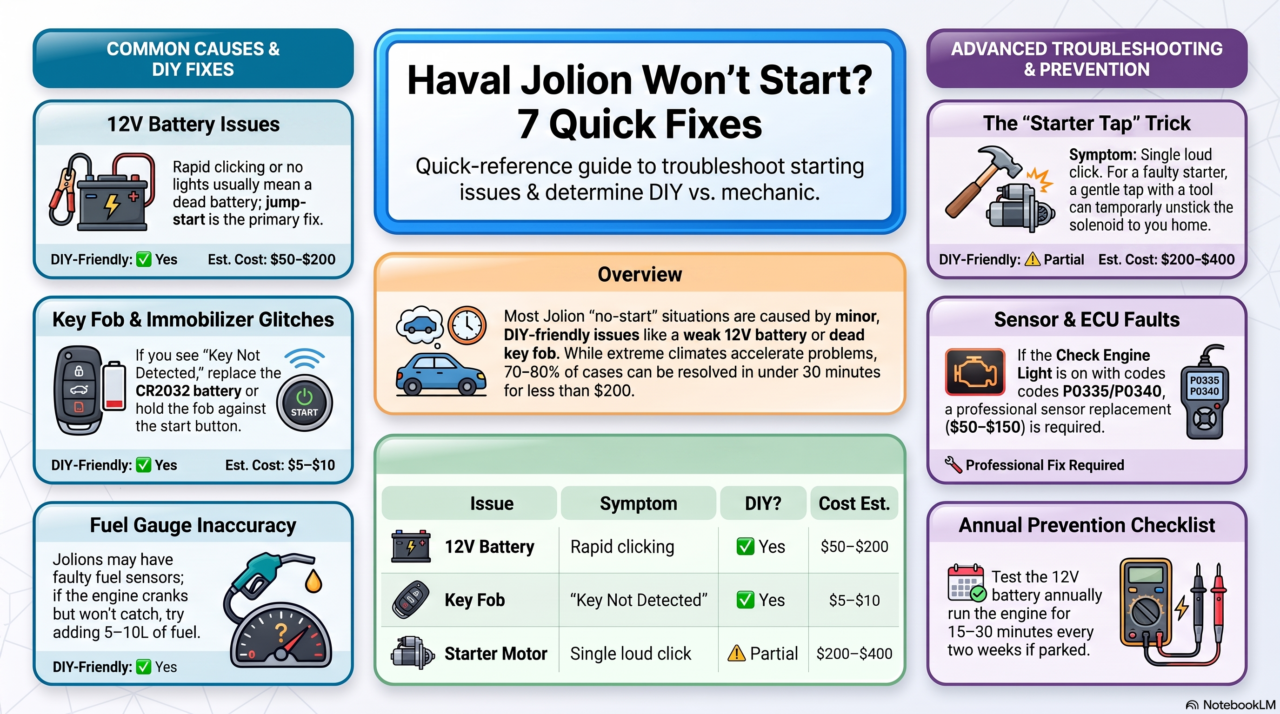
In 2025–2026 across South Africa, Australia, New Zealand, UAE, and other English-speaking markets, Haval Jolion (including HEV hybrids) most commonly fails to start due to **12V battery issues** (50–60% of cases — drain after short trips, extreme heat/cold), **key fob/immobilizer** (20–30% — dead CR2032, “Key Not Detected”), starter motor, crankshaft/camshaft sensors, fuel delivery, or rare ECU glitches. Hybrids are especially prone to 12V drain in heat (software updates often fix under warranty). Most issues are cheap & DIY-friendly ($10–200 fix), resolved in 5–30 minutes. With basic prevention (annual battery test, CR2032 every 12–18 months, weekly runs if parked), starting reliability is excellent.
🔋 Cause & Repair
Green zone: 12V battery dead (jump-start + test 12.6V OFF / 13.7–14.7V ON) or key fob CR2032 (hold-to-button trick) — 70–80% of cases, fix in 5–30 min, $10–200 (perfect for hot/cold climates like SA/UAE).
Yellow zone: Starter motor (tap or replace $200–400), CKP/CMP sensors (OBD codes P0335/P0340, $50–150), fuel/relay issues — less common, but fixable (typical after 40–70k km).
Red zone: ECU/immobilizer glitch or ignored issue — total failure, expensive repair/towing (avoid by dealer software update — often free under warranty).
🌡️ Climate Factor 2026
Problem acceleration: Extreme heat (+45°C in UAE/SA summer) or cold drains 12V in 1–2 weeks idle, key fob dies faster, hybrids lose 12V in EV mode without petrol engine.
Solution: Upgrade to AGM/EFB battery for extremes (test yearly), trickle charger for long idle, run engine 15–30 min every 1–2 weeks, hold fob to button, dealer software update (free for hybrid “malfunction” under warranty).
💡 Quick Fix Hacks When It Won’t Start:
First check 12V battery (jump-start + multimeter 12.6V off / 13.7–14.7V running). “Key Not Detected”? Replace CR2032 in fob ($5–10) or hold fob directly against start button (backup sensor). Clicking sound? Tap starter lightly or check relay/fuse. Use OBD2 scanner (Torque/Car Scanner app) for codes like P0335/P0340 (sensors). For hybrids — verify 12V, get free software update at dealer. Don’t leave car idle >2 weeks — 12V drain is critical. In 2025–2026 most no-start cases are DIY fixes for $50–200, no tow needed. Prevention (yearly battery test + weekly runs) avoids 90% of problems.
The Haval Jolion, known for its bold design and value-packed features, has quickly become one of the most popular compact SUVs in markets like South Africa, Australia, and the Middle East. Built by Great Wall Motors, this Chinese crossover combines smart technology with efficiency, making it an attractive choice for modern drivers.But even well-built cars like the Jolion can occasionally run into problems — and one of the most frustrating is when it refuses to start. Whether you’re stuck in your garage or stranded in a parking lot, knowing the common causes and how to troubleshoot the issue can save time, money, and stress.In this comprehensive guide, we break down the 7 most common reasons your Haval Jolion won’t start, plus offer practical do-it-yourself fixes, essential professional advice, and preventative tips to keep your vehicle reliable.
A rapid clicking sound when you turn the key or press the start button.
No crank, meaning the engine does not turn over at all, and no start.
Why it happens:
Car batteries naturally degrade over time, typically lasting between three to five years. Extreme temperatures, especially very cold weather, can significantly reduce battery efficiency. Short trips that don’t allow the alternator enough time to fully recharge the battery, or inadvertently leaving lights or other accessories on when the engine is off, can also completely drain the battery.
What to do:
Jump-start the car: Use a set of reliable jumper cables and another vehicle, or a portable jump starter power bank. Ensure correct polarity when connecting.
Recharge the battery: If the car successfully starts after a jump, drive it for at least 20 to 30 minutes at a steady speed to allow the alternator to sufficiently recharge the battery.
Check battery voltage: With the engine off, a healthy 12-volt car battery should show a voltage reading of 12.6 volts or higher. When the engine is running, the voltage should be between 13.7 and 14.7 volts, indicating the alternator is charging properly.
Replace the battery: If the problem recurs shortly after recharging, or if the battery fails voltage tests, it is likely time to replace the battery.
Pro Tip: The Haval Jolion typically uses a standard 12V AGM (Absorbent Glass Mat) or EFB (Enhanced Flooded Battery) depending on the specific trim level and manufacturing year. Always consult your owner’s manual for the exact battery specifications and recommended type.
🔧 2. Faulty Starter Motor
Symptoms:
You hear a single, distinct click or a series of rapid clicking noises when attempting to start the car.
Dashboard lights illuminate brightly, but the engine does not crank or turn over.
Why it happens:
The starter motor is an electric motor that engages the engine’s flywheel to initiate combustion. Over time, the internal components of the starter motor can wear out, or the starter solenoid — an electromagnetic switch — can become stuck. This prevents the starter motor from turning the engine.
🚗 Special Deals & Discounts
Latest prices on vehicles, spare parts and dealer promotions.
Gentle tap: Locate the starter motor (usually attached to the engine block near the transmission) and gently tap it with a metal tool, such as the handle of a hammer or a wrench. This can sometimes temporarily unstick internal contacts or the solenoid.
Drive to workshop: If the car starts after tapping, drive it directly to a qualified workshop for a thorough inspection and likely replacement of the starter motor. This is a temporary fix.
Replacement: If tapping does not work, you will almost certainly need a replacement starter motor.
Cost: Starter motor replacement for a Haval Jolion typically ranges from $200 to $400, which includes both the cost of the part and professional labor.
🔧 3. Key Fob Issues or Immobilizer Fault
Symptoms:
A “Key Not Detected” warning message appears on the dashboard display.
The ignition system does not respond at all, even when you press the start button.
All other lights and electronic components within the vehicle appear to be working perfectly fine.
Why it happens:
Modern keyless entry and start systems rely on a continuous and strong signal transmission between the key fob and the vehicle’s immobilizer system. If the key fob battery is dead or extremely weak, there is significant radio interference, or if there is a software glitch within the car’s immobilizer system, the vehicle will not recognize the key and therefore will not allow the engine to start.
What to do:
Replace key fob battery: The most common culprit is a dead battery inside the key fob. Most Haval Jolion key fobs use a standard CR2032 coin cell battery. Replacing it is usually a simple DIY task.
Use backup key or specific placement: Many key fobs have a hidden physical key blade that can be used to manually unlock the door. Additionally, for starting, try holding the key fob directly against or very close to the start button, as some vehicles have a backup sensor designed for weak fob batteries.
Professional assistance: If replacing the battery and using the backup methods do not work, a software reset or key reprogramming may be necessary. This typically requires specialized diagnostic equipment available at a Haval dealership or a qualified automotive locksmith.
🔧 4. No Fuel or Faulty Fuel Gauge
Symptoms:
The engine cranks over normally but does not catch or start.
The fuel gauge reads very low, empty, or provides an inaccurate reading compared to the actual fuel level.
The vehicle may have suddenly stalled just before refusing to restart.
Why it happens:
The most straightforward reason is simply an empty fuel tank. However, a less obvious but surprisingly common issue in some batches of Haval Jolions can be a faulty fuel level sensor within the fuel tank itself. This sensor sends information to the fuel gauge on your dashboard, and if it’s malfunctioning, it can lead to inaccurate readings, causing you to run out of fuel unexpectedly even if the gauge shows some fuel remaining.
What to do:
Add fuel: The immediate step is to add at least 5 to 10 liters of fresh fuel to the tank and then attempt to start the car again.
Inspect fuel level sender: If adding fuel resolves the issue but your fuel gauge was showing an incorrect reading, it is advisable to have the fuel level sender unit or the instrument cluster itself inspected by a mechanic.
Tip: Frequently running your vehicle with a very low fuel level can put additional strain on the fuel pump and may lead to premature damage or failure of this crucial component.
🔧 5. Fuel Pump or Relay Failure
Symptoms:
Your Haval Jolion cranks persistently but fails to start.
You do not hear a soft, distinct humming or buzzing sound coming from the rear seat area or fuel tank when the ignition is turned to the “ON” position (before starting the engine). This hum is the fuel pump priming.
The engine may misfire or stall intermittently shortly after starting, indicating inconsistent fuel delivery.
Why it happens:
The fuel pump is responsible for delivering fuel under pressure from the fuel tank to the engine’s fuel injectors. If the fuel pump itself is failing or has completely stopped working, it won’t be able to supply the necessary fuel pressure for combustion. Alternatively, a faulty fuel pump relay or damaged wiring to the pump can interrupt the electrical power supply to the pump, preventing it from operating even if the pump itself is healthy.
What to do:
Listen for pump prime: Turn the ignition key to the “ON” position (without starting the engine) and listen carefully near the rear seat or trunk area. A faint hum indicates the fuel pump is priming. No sound strongly suggests an issue with the pump or its electrical supply.
Check fuse and relay: Locate the fuse box (typically under the hood and sometimes within the cabin). Consult your vehicle’s fuse diagram to identify and inspect the fuel pump fuse and relay for any signs of being blown or damaged.
Replace fuel pump: If the fuse and relay are good, and there’s no prime sound, the fuel pump itself likely needs replacement. This component is usually located inside the fuel tank, which can make it a more involved repair.
🔧 6. Crankshaft or Camshaft Sensor Malfunction
Symptoms:
The engine takes an unusually long time to crank before it finally starts, or it may crank continuously without starting.
Your Haval Jolion might start, but then quickly stall shortly after.
Diagnostic trouble codes such as P0335 (Crankshaft Position Sensor A Circuit Malfunction) or P0340 (Camshaft Position Sensor Circuit Malfunction) are present when scanned.
Why it happens:
The crankshaft and camshaft position sensors are critical components that monitor the rotational speed and position of the engine’s crankshaft and camshafts, respectively. They send this vital information to the Engine Control Unit (ECU). When these sensors fail, the ECU cannot accurately determine the precise timing for fuel injection and ignition spark, leading to starting problems, stalling, or poor engine performance.
What to do:
Use an OBD2 scanner: The most effective first step is to use an OBD2 (On-Board Diagnostics II) scanner to retrieve any stored error codes from your vehicle’s ECU. This will confirm if a sensor malfunction is the cause.
Replace the faulty sensor: Once identified, the faulty sensor will need to be replaced. Many Haval Jolion owners have reported crankshaft sensor failures occurring within the 30,000 to 60,000 kilometer range.
Cost: Sensor replacements typically cost between $50 and $150, depending on the specific sensor and the labor involved for installation.
🔧 7. Blown Fuse or ECU Fault
Symptoms:
Absolutely no response from the engine when attempting to start the vehicle.
Certain critical electrical components essential for starting, such as the fuel injectors, ignition coils, or the engine control module itself, do not appear to be receiving power.
In severe cases, there might be a total loss of power to major vehicle systems.
Why it happens:
A blown fuse can interrupt the electrical circuit for vital components necessary for starting the vehicle, such as those related to the ignition system, fuel delivery, or the engine control unit (ECU). A fuse acts as a safety device, blowing to prevent more extensive electrical damage from overcurrent. In much rarer cases, the Engine Control Unit (ECU) — the vehicle’s central computer that manages engine functions — might itself be damaged or malfunction, leading to a complete failure to start.
What to do:
Inspect fuse boxes: Locate the fuse boxes, which are typically found under the hood and sometimes inside the cabin (e.g., under the dashboard or in the glove compartment). Refer to your vehicle’s fuse diagram (usually found on the fuse box cover or in the owner’s manual) to identify fuses related to ignition, fuel pump, and engine control. Visually inspect each relevant fuse for a broken filament.
Replace blown fuse: If you find a blown fuse, replace it with a new fuse of the exact same amperage rating. Never use a fuse with a higher amperage, as this can cause severe electrical damage.
ECU diagnostic scan: If after checking all relevant fuses the problem persists, and other issues have been ruled out, a diagnostic scan of the ECU is mandatory. ECU replacement is a very expensive repair and should only be considered after all other potential issues have been thoroughly ruled out by a qualified professional.
✅ When to DIY vs. Call a Mechanic
Knowing when to tackle a problem yourself and when to seek professional help can save you time, frustration, and potentially costly mistakes. Here’s a quick guide for common Haval Jolion non-starting issues:
🔋 Dead Battery
✅ DIY: Absolutely, jump-starting or replacing a car battery is a common and straightforward do-it-yourself task that most drivers can perform with basic tools and knowledge.
🛡 Mechanic: Not necessary unless you suspect an underlying charging system issue (like a faulty alternator) that is causing the battery to repeatedly drain.
🔧 Starter Motor Faulty
⚠ DIY: Possible if you have experience with automotive repairs, access to the necessary tools, and a reliable repair manual. It can be a moderately complex job.
🛡 Mechanic: Recommended for most drivers. A professional mechanic can accurately diagnose the issue and perform the replacement efficiently and safely.
🔑 Key Fob Not Working
✅ DIY: Yes, replacing the battery inside your key fob or using the physical spare key is a simple and quick fix that anyone can do.
🛡 Mechanic: Only needed if the key fob requires reprogramming or if there’s a more complex immobilizer system fault that a simple battery change doesn’t resolve.
⛽ Empty Fuel Tank
✅ DIY: Yes, simply adding more fuel to the tank is the easiest solution.
🛡 Mechanic: Not needed unless you suspect a faulty fuel gauge or a more serious fuel delivery problem after adding fuel.
🚗 Fuel Pump Replacement
⚠ DIY: Maybe — this is an advanced do-it-yourself job that often requires accessing the fuel tank, which can be tricky and potentially hazardous if not done correctly.
🛡 Mechanic: Recommended for most users due to the complexity and safety considerations involved. A professional will have the right equipment and expertise.
🧠 Sensor or ECU Fault
❌ DIY: No — diagnosing and repairing sensor or ECU (Engine Control Unit) faults typically requires specialized diagnostic tools (like advanced OBD2 scanners) and a high level of technical skill.
🛡 Mechanic: Definitely — professional diagnosis and repair are crucial for these types of issues to ensure correct identification of the problem and proper component replacement or programming.
🔄 Prevention: Keep Your Jolion Starting Strong
Proactive maintenance can significantly reduce your chances of experiencing a no-start situation with your Haval Jolion. Follow these preventative tips:
✅ Test your battery every 12 months: Have your battery’s health and charge level checked annually, especially before winter. Most auto parts stores offer this service for free.
✅ Avoid driving with a nearly empty tank: Keep your fuel tank at least a quarter full. This helps prevent the fuel pump from overheating and extends its lifespan, as fuel acts as a coolant for the pump.
✅ Service your car every 10,000–15,000 km: Adhere to your Haval Jolion’s recommended service schedule. Regular maintenance checks can identify potential issues before they lead to breakdowns.
✅ Scan for codes if check engine light appears: Do not ignore the Check Engine Light. Use an OBD2 scanner or visit a mechanic to read the diagnostic codes and address the underlying problem promptly.
✅ Don’t ignore slow starting or irregular idling: These can be early warning signs of issues with your battery, starter, fuel system, or sensors. Addressing them early can prevent a complete no-start scenario.
🗓️ Preventive Maintenance Schedule
Task
Frequency
Why it matters
12V battery load test
Every 12 months
Catches weak cells before they cause a no-start
Key fob battery (CR2032)
Every 12–18 months
Prevents “Key Not Detected” failures
Run engine if parked
15–30 min every 1–2 weeks
Stops deep 12V discharge, critical for hybrids
General service
Every 10,000–15,000 km
Flags starter, sensor, and fuel-system wear early
Fuel level
Keep above 1/4 tank
Fuel cools the pump; low levels shorten pump life
OBD2 scan
As soon as CEL appears
Identifies CKP/CMP or ECU issues before a stall
🧰 Tools That Help
Having a few essential tools on hand can make diagnosing and fixing starting problems much easier:
🔌 OBD2 Scanner: An indispensable tool for reading engine diagnostic trouble codes, helping you pinpoint sensor or ECU related issues.
🔋 Battery Tester: A simple device to check your car battery’s charge level and overall health, indicating when it might be nearing the end of its life.
🔧 Multimeter: Useful for testing voltage, continuity, and resistance in various electrical circuits, helping to diagnose issues with fuses, relays, and wiring.
🧊 Portable Jump Starter: A lifesaver for emergencies, allowing you to jump-start your vehicle without needing another car, perfect for roadside assistance.
Watch the Video Guide
See the full video explaining the most common reasons why a Haval Jolion won’t start and how to fix them.
FAQ
Is the Haval Jolion generally reliable when it comes to starting issues?
Yes, the Jolion is considered reliable overall, but like any vehicle, it can experience starting problems due to battery, fuel, or electrical issues. Most are minor and preventable with regular maintenance.
Can a dead key fob battery prevent the Jolion from starting?
Absolutely. The Jolion uses a smart key system; if the fob battery is dead, the push-button start may not recognize the key. Replace the battery (usually CR2032) or hold the fob against the start button as a backup.
What should I do if the dashboard lights come on but the engine doesn’t crank?
This often points to a weak battery, faulty starter, or poor connections. Check battery terminals for corrosion, try jump-starting, and if that fails, have the starter motor tested.
Does extreme weather affect the Jolion’s ability to start?
Yes, very cold or hot temperatures can drain the battery faster or thicken engine oil. Use a block heater in winter, park in shade in summer, and ensure your battery is rated for your climate.
Will a clogged fuel filter cause a no-start condition?
In severe cases, yes. If fuel can’t reach the engine, it won’t start. Replace the fuel filter every 30,000–50,000 km or sooner if using poor-quality fuel.
Are there any known recalls related to starting issues on the Haval Jolion?
As of now, no widespread recalls specifically for starting problems. Always check your VIN on the official Haval website or with your dealer for any open campaigns.
Can I jump-start a Jolion with a hybrid powertrain safely?
Yes, but follow the owner’s manual exactly—connect to the designated jump points under the hood, not directly to the hybrid battery. Incorrect jump-starting can damage electronics.
How often should I replace the battery in a Haval Jolion?
Typically every 3–5 years, depending on climate and driving habits. Have it load-tested annually during servicing.
What does it mean if I hear a rapid clicking sound when trying to start?
This is classic low battery voltage. The starter solenoid is trying to engage but doesn’t have enough power. Charge or replace the battery.
Is it safe to leave the Jolion unused for weeks without starting issues?
For short periods (1–2 weeks), yes. Beyond that, use a trickle charger or disconnect the battery to prevent deep discharge. Also start and run the engine for 15 minutes every two weeks.
What Real Owners Are Reporting
The comments below are paraphrased from public owner questions and reviews found on ProductReview.com.au and other automotive forums. They are not verbatim quotes, and we link directly to the original threads so you can read the full context yourself.
On ProductReview.com.au, a buyer of a new 2022 Jolion Lux described the car sputtering repeatedly when trying to start it within the first week of ownership, eventually getting stuck in gear and dying completely; roadside assistance attributed it to the transmission rather than the battery, and the car needed towing twice within ten days.
In the same ProductReview.com.au listing, another owner reported the touchscreen going completely black while the climate controls kept working, suggesting an isolated electronics fault rather than a full no-start condition.
On the Haval H6/Jolion Q&A board, an owner identified as Colin U. described experiencing eight flat batteries on their Jolion within 18 months, even with the car locked and unused, and other users suggested this points to background power draw from the car’s connected/cloud systems rather than a simple aging-battery issue.
A separate question on the Haval H6 Ultra Hybrid Q&A board came from a Jolion Hybrid owner asking whether leaving accessories on and draining the 12V battery could damage the car’s lithium hybrid battery, after their car failed to start on the first few attempts — a good illustration of why hybrids need extra care with the small 12V battery.
On the Gari.pk Jolion forum, an owner in a hot climate asked why their Jolion wouldn’t start after being parked overnight, which the forum attributed to typical temperature-related battery drain rather than a mechanical fault.
Final Thoughts
If your Haval Jolion won’t start, don’t immediately assume the worst. In many cases, the issue is a relatively minor and easily fixable problem like a dead battery, a discharged key fob battery, or a blown fuse. Start by systematically checking the most common causes and ruling out each possibility logically.
And remember, if you are unsure about any diagnosis or repair, or if the problem seems complex, it is always best to seek professional help — especially for intricate engine or electrical issues. Staying informed, remaining calm, and taking a methodical approach will help you get your Haval Jolion back on the road in no time.
Related Haval Jolion Articles
Looking for more information about Haval Jolion ownership, maintenance, troubleshooting, and vehicle settings? Explore our detailed guides, comparisons, and repair articles below:
Understanding your vehicle’s maintenance requirements, common issues, and advanced settings can help improve reliability, reduce ownership costs, and enhance your overall Haval Jolion driving experience.
🔧 Need car repair or diagnostics?
Discounts on maintenance, diagnostics, and spare parts for Chinese cars at official dealers and trusted services.