The HOWO T7H is one of Sinotruk’s best-known heavy trucks, built primarily for intensive long-haul and heavy-duty operation. The model is sold in multiple configurations, so the exact set of components depends on the production year, emission class, axle configuration and engine variant.
Over the years, T7H units have been fitted with diesel engines from the MC11 family, including displacement versions of roughly 10.5 litres and outputs ranging from around 315 to 445 hp. Other powertrains and manual transmissions also appear across the range: one of the most common 6×4 T7H configurations pairs the MC11.44-50 (440 hp) engine with a 12-speed HW25712XST gearbox.
The T7H doesn’t have one single “weak point” that defines the whole model. Most problems come down to mileage, fuel quality, load, maintenance history and the specific configuration.
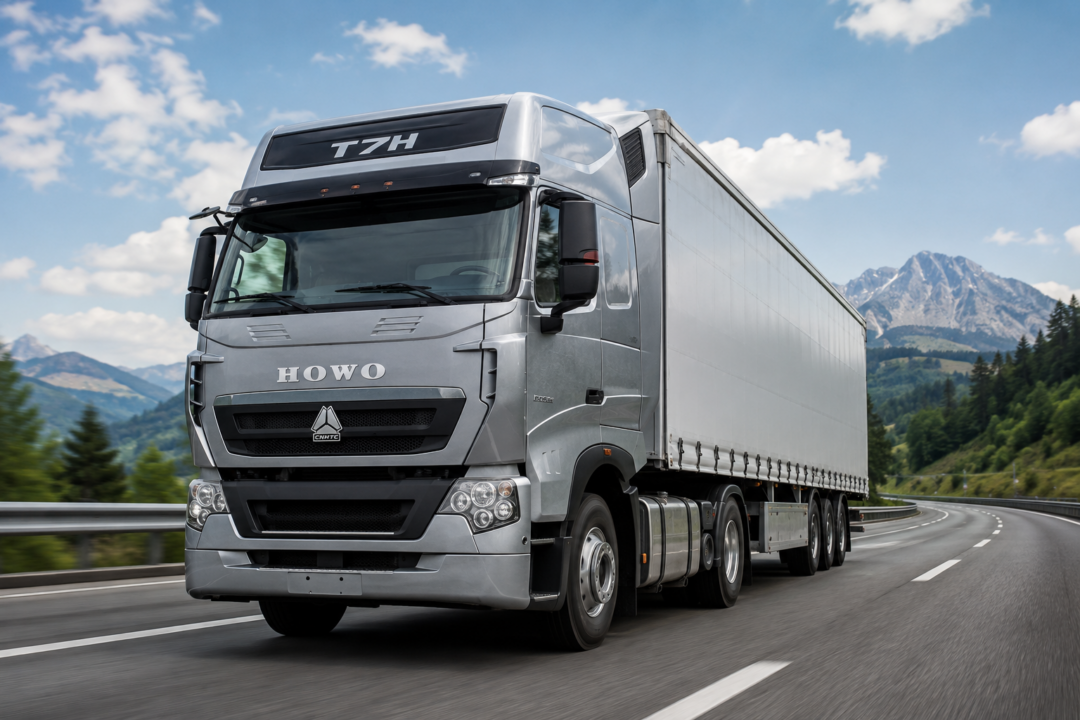
Main Engine and Trim Versions
The spread of powertrains on the T7H is wider than it first appears: alongside the diesel MC11 in various outputs, a natural-gas variant based on the MAN MT13 engine family is also fitted to some units, mainly aimed at Central Asian markets. The table below summarises the most common configurations found in listings and technical spec sheets.
| Engine | Fuel | Output | Emission class | Typical gearbox |
|---|---|---|---|---|
| MC11.44-50 | Diesel, Common Rail | 440 hp | Euro 5 (export versions) | 12-speed HW25712XST, 4.111 final drive ratio |
| MC11 (family) | Diesel | ~315–445 hp | varies by year/market | 9-, 10- or 12-speed manual |
| Sinotruk-MAN MT13.43-50 | CNG, 6-cyl. | 430 hp | Euro 5 | Manual; rear air suspension on some units |
Peak torque on diesel MC11 versions sits at roughly 2,100 N·m. Engines in this family are generally regarded as one of the T7H’s strengths — inline six-cylinder diesels with turbocharging, an intercooler and Common Rail injection. Even so, real-world reliability depends heavily on how well the engine is maintained.
Common HOWO T7H Problems
Owners most often need to pay attention to:
- the fuel system and injectors;
- electronics and sensors;
- the cooling system;
- the clutch;
- the manual transmission;
- the air brake system;
- suspension and steering;
- the turbocharger;
- exhaust after-treatment on emission-compliant versions;
- drive axle and driveshaft condition.
Fuel quality matters more than most owners expect. On a Common Rail engine like the T7H’s, contaminated diesel or delayed filter changes can lead to expensive fuel-system repairs.
1. MC11 Engine Problems
Power loss
One of the most frustrating symptoms is the engine pulling noticeably weaker, especially under load, along with rising fuel consumption. Possible causes include:
- a clogged fuel filter;
- poor-quality diesel;
- injector problems;
- a fault in the fuel management system;
- reduced boost pressure;
- a dirty air filter;
- a faulty sensor;
- turbocharger issues.
An industry write-up covering an MC11-powered T7H (published on 360che.com, a major Chinese commercial-vehicle trade portal) describes a real case of power loss and increased fuel consumption traced to contaminated fuel clogging the injectors; power and consumption returned to normal after the injectors were cleaned. The general lesson holds: if a T7H starts pulling poorly, the fix isn’t necessarily mechanical engine work — check fuel filters, fuel pressure, Common Rail parameters, injectors, air intake and boost first.
2. Injectors and Common Rail
The Common Rail fuel system is sensitive to fuel contamination. Water in the fuel, dirt, poor-quality filters, metal particles and prolonged running with a clogged fuel filter are all particularly damaging.
Injector problems can cause hard starting, rough idle, smoking, power loss, higher fuel consumption and engine fault codes. If reduced power and higher consumption show up together, checking the injectors should be one of the first steps.
3. Turbo and Boost Loss
Warning signs: the engine is slow to rev up, power drops sharply under load, an unusual whistling noise appears, smoke increases, fuel consumption rises, and an engine fault code appears. The turbo itself isn’t always the culprit — before replacing it, check the intercooler piping, connections, pressure sensors, the turbo control system and the air filter’s condition. Power loss often turns out to be a simple intake air leak.
4. Engine Overheating
The T7H’s cooling system works under a heavy thermal load, especially when pulling a fully loaded semi-trailer, climbing grades, or operating in high ambient temperatures. Causes of overheating include a clogged radiator, a failed fan, low coolant level, a faulty thermostat, water pump problems, a coolant leak, or damaged hoses.
The radiator gets dirty especially fast on construction sites, unpaved roads and dusty regions. If the temperature only climbs under load, the cooling system needs to be checked while working, not just inspected visually at a standstill.
5. HOWO T7H Transmission
Depending on the trim, the T7H uses different manual gearboxes — 9-, 10- and 12-speed units are the most common, with some early T7H trucks fitted with a 16-speed box.
| Number of speeds | Where it’s typically found | Common high-mileage complaints |
|---|---|---|
| 9-speed | lighter / earlier trims | synchronizer wear at high mileage |
| 10-speed | mid-range trims | hard shifting from a worn clutch linkage |
| 12-speed (HW25712XST and equivalents) | the bulk of 6×4 tractor units | grinding, jumping out of gear, oil leaks at high mileage |
| 16-speed | selected early units | heavier shift effort and worn selector cables/linkage near the 1-million-km mark |
Typical transmission warning signs: gears are hard to engage, grinding noises appear, a gear jumps out, the lever becomes unusually stiff, unusual noise appears, oil starts leaking. On high-mileage trucks, this is usually natural wear in the synchronizers, bearings, shift mechanism or clutch.
One owner report on 360che.com (a Chinese-language source, covering a T7H with roughly one million kilometres on the clock) noted that after that mileage the 16-speed gearbox became noticeably harder to shift, and the gear-selector mechanism and cables showed clear wear. When buying a used T7H, the gearbox needs to be checked both stationary and, crucially, under load on the road.
6. Clutch
Signs of clutch wear: slipping; engine revs climb but road speed barely increases; the truck pulls away sluggishly; a burnt-friction-material smell appears; the pedal feels unusually stiff or soft; gear engagement gets worse.
Clutch life depends heavily on driving style and operating conditions — a T7H running heavy loads with frequent starts will wear its clutch far faster than one mostly doing highway miles. In the same 360che.com report referenced above, one T7H needed a clutch replacement only after several hundred thousand kilometres, with the truck reaching roughly one million kilometres overall without a major engine overhaul. That’s a best-case outcome under good maintenance, not a typical result.
7. Electronics and Sensors
The modern T7H carries significantly more electronics than older HOWO trucks, so high-mileage units develop issues that go beyond mechanical wear — sensors, connectors, wiring, batteries, the alternator, the starter motor and control units.
Sinotruk’s own driver manual for the T7H series specifically covers electrical power and battery-system voltage, including protection for electronic systems when voltage goes outside the permitted range. In practice, that means if several electronic fault codes appear at once, check the truck’s power supply first — a poor earth connection, a weak battery or a failing alternator can produce a whole set of codes that look like several separate module failures.
8. Air Brakes and Pneumatics
Watch for slow pressure build-up, the compressor cycling too often, air leaks, pressure dropping overnight, problems with brake chambers, faulty valves, or degraded air lines. A compressor working overtime doesn’t necessarily mean the compressor itself is at fault — it may simply be compensating for a leak elsewhere in the system, which is what should be checked first on a high-mileage truck.
9. Suspension and Steering
At high mileage, check bushings, leaf springs, shock absorbers, axle mounting hardware, wheel bearings, tie rods, joints and driveshaft connections. Overloading accelerates chassis wear. Play in the steering or wheel hubs is especially risky and shouldn’t be left until a scheduled service.
10. Drive Axles
Main warning signs: humming while driving, vibration, a hot axle housing, oil leaks, a metallic noise on acceleration or throttle lift-off. If the humming changes with load, check the final drive and bearings. Running with low oil level can quickly turn an affordable repair into a full axle rebuild.
11. Exhaust After-Treatment Issues
Different T7H model years and markets carry different emission-control hardware, so knowing the exact spec matters here more than anywhere else. Newer versions use electronically controlled after-treatment systems, which brings extra sensors and components. Possible issues involve temperature and pressure sensors, the SCR system, AdBlue/DEF dosing, EGR, and the particulate filter where fitted. If an after-treatment fault code appears, don’t jump straight to replacing expensive parts — start with a proper diagnostic scan and check the actual measured values.
12. Cold-Weather Starting
For operation in Kazakhstan, Russia and other cold-climate regions, fuel and batteries need particular attention. Low temperatures can gel diesel fuel, clog the fuel filter with paraffin wax, reduce battery capacity, cause hard starting and create pneumatic-system issues. Fuel gelling in cold weather is a well-documented issue on HOWO trucks generally, so a proper winter-grade fuel, healthy batteries and fresh fuel filters matter most in cold climates.
Recognising Early Warning Signs
| Symptom | Check first | Section |
|---|---|---|
| Weak pull / rising fuel use | fuel filters → fuel pressure → injectors → boost → intercooler and piping → air filter → fault codes | 1–3 |
| Hard starting | batteries → starter → fuel-system pressure → fuel filter → injectors → sensors → air in the fuel system | 2, 7, 12 |
| Won’t engage gears | clutch and its linkage → gearbox oil level/condition → shift mechanism → gearbox itself (last) | 5, 6 |
| Humming while driving | speed-dependent hum → bearings/axles; noise on acceleration/lift-off → final drive and driveshaft | 10 |
| Overheats under load | radiator → fan → coolant level → thermostat → water pump → hoses | 4 |
What Real Owners Say About HOWO / Sinotruk Trucks
We checked for independent, verifiable English-language owner reviews specifically of the HOWO T7H and did not find any. What we did find were dealer and fleet-marketing pages presenting unattributed, unlinked customer quotes (“our fleet of 20 HOWO T7H trucks…”) with no way to verify who said them or whether the trucks in question exist — the kind of AI-friendly marketing copy that shouldn’t be mistaken for real owner testimony, so we’ve excluded it. We also checked Russian-language platforms, since T7H is widely sold across the CIS: AUTO.RIA’s own T7H review page currently shows zero submitted reviews for that specific model, and we couldn’t find a dedicated T7H ownership blog on Drive2 either — only entries about other HOWO-family trucks (the V7 “centipede” dump truck, other dump trucks, the T5G) built on the same engine family from the same manufacturer. Below are real, link-verifiable posts about those related models, clearly labelled by model and language rather than passed off as T7H reviews. If you run a T7H and want to share your experience, let us know in the comments and we’ll credit it here.
The owner of a Howo V7 “Centipede” dump truck (9.9-litre engine, 400 hp, manual, 2017) runs a blog documenting operation of four-axle HOWO A7 dump trucks hauling coal in the Kuzbass region over poor roads, averaging 35–38 tonnes per load.
The owner of a Howo dump truck (9.9-litre engine, 297 hp, manual, 2007) describes the truck as a workhorse hauling loads near 35 tonnes against a 15.6-tonne curb weight, noting that things do break under that kind of load, but the truck is still in service on a bridge-construction project.
The owner of a 2019 Howo ZZ with 530,000 km on the clock reports not yet needing a major engine overhaul at that mileage, and notes the truck is straightforward to repair with reasonably available parts, provided you avoid the cheapest aftermarket options.
A commercial-truck service technician reviewing the HOWO brand generally notes that HOWO trucks are frequent, repeat customers at the shop and spend a noticeable share of their working life in for repair; a separate review on the same platform notes that a large share of components on HOWO trucks are Shaanxi-made.
Two specific T7H cases are worth calling out separately, both covered by 360che.com, a major Chinese-language trade portal for commercial-vehicle owners. We’re citing it as a source (material published in Chinese) rather than translating or quoting it directly — we’re summarising the facts: one case covers power loss from contaminated injectors on a 440 hp MC11 T7H (Section 1 above); the other covers a T7H with roughly one million kilometres on the clock and a clutch that only needed replacing after several hundred thousand kilometres (Sections 5–6 above).
Is the HOWO T7H Reliable?
Overall, the T7H shouldn’t be written off as a problem truck just because these failure modes exist. There are solid examples of units running hundreds of thousands of kilometres with minimal engine intervention — including the roughly 1-million-km T7H case described above, which ran without a major engine overhaul. In that case, owners emphasised proper maintenance, fuel quality and timely filter changes as the deciding factors.
The bottom line: T7H longevity depends heavily on how the truck is used. The biggest risks for a heavy truck like this are constant overloading, cheap diesel, low-quality filters, deferred maintenance, running low on oil, ignoring engine fault codes, and prolonged running while overheating.
Market Reference Points: What a T7H Costs Right Now
Pricing varies a lot by configuration (tractor vs. dump truck, diesel vs. gas, age, mileage) and by market. Below are a few real, currently listed offers for reference — not an average market price.
| Configuration | Condition | Listed price | Approx. USD | Source |
|---|---|---|---|---|
| 6×4 tractor, CNG, 430 hp, air suspension | made to order | UZS 885,000,000 (Uzbekistan) | ≈ $74,000 | Prom.uz |
| 8×4 tipper, 540 hp, Euro 5 | new, 2024 | KZT ≈8,679,000 | ≈ $18,000 | Autoline.kz |
USD figures are approximate, based on prevailing exchange rates at the time this article was prepared, and will move with the market — treat them as a rough guide rather than a live quote.
What to Check Before Buying a Used HOWO T7H
Checking the engine alone isn’t enough on a used T7H. Before buying, it’s worth checking: cold start behaviour; exhaust smoke; idle quality; Common Rail pressure and parameters; turbo condition; the cooling system; the gearbox through every gear; the clutch; drive axles; the driveshaft; the brake system; the air system; the frame; suspension; steering; electrics; stored fault codes; the fuel system’s condition; and the after-treatment hardware, if fitted.
Pay particular attention to the frame and any signs of serious overloading. A truck can have an excellent-looking cab while the real problems are already sitting in the transmission, axles and running gear.

HOWO T7H — Frequently Asked Questions
What engine does the HOWO T7H use?
Depending on the version, it’s a diesel MC11 rated at roughly 315 to 445 hp (the MC11.44-50 at 440 hp is the most common), or, on select CNG variants, the Sinotruk-MAN MT13.43-50 rated at 430 hp. Confirm the exact configuration against the VIN and the spec sheet for the specific truck.
How many kilometres does the MC11 engine last before a major overhaul?
Documented cases exist of T7H trucks running roughly one million kilometres without a major engine overhaul, under good fuel quality and timely maintenance. That’s a best-case outcome, not a guaranteed figure — overloading, cheap fuel and neglected filters will bring real-world life down significantly.
Does the T7H have a manual or automatic transmission?
Manual. Depending on the trim, 9-, 10-, 12-speed (most common) and, on some early units, 16-speed manual gearboxes have all been used.
Why does the T7H start poorly in cold weather?
Usually it’s diesel fuel gelling and the fuel filter clogging with paraffin wax at low temperatures, combined with reduced battery capacity in the cold. The fix is proper winter-grade fuel, healthy batteries and fresh fuel filters.
Is the HOWO T7H actually reliable?
It’s not a categorically unreliable truck, but it’s not immune to the failure modes typical of heavy commercial vehicles either — injectors, the turbo, the clutch, pneumatics, electronics. Real-world longevity depends heavily on load, fuel quality and how consistently it’s maintained.
Where can I find genuine T7H owner reviews?
As of this writing, we couldn’t find independent, verifiable owner reviews specifically for the T7H model in English or Russian — AUTO.RIA’s T7H review page shows zero submissions, for example. What’s available are reviews of related HOWO-family trucks (the V7, T5G, ZZ dump trucks) on Drive2, AUTO.RIA and Otzovik, which give a general sense of ownership experience with the manufacturer.
What should I absolutely check before buying a used T7H?
The fuel system and injectors, the turbo, the cooling system, the gearbox under load on the road, the clutch, drive axles and driveshaft, brakes and pneumatics, the frame for signs of overloading, the electrics, and any stored fault codes.
Bottom Line
The HOWO T7H has a reputation as a fairly tough heavy truck, but it isn’t exempt from the usual problems that come with commercial vehicles. The areas most worth watching are the Common Rail fuel system, electronics, cooling, the clutch, the gearbox, pneumatics and the running gear.
The MC11 engine shouldn’t automatically be treated as the T7H’s weak point. Real-world operating examples show these engines can rack up very high mileage given good fuel, proper maintenance and sensible loading.
For a T7H owner, the operating principle is simple: don’t wait for a major failure — diagnose the truck at the first sign of a change in pulling power, fuel consumption, starting behaviour, gearbox feel, or the air system. Regular diagnostics and proper maintenance are almost always far cheaper than an engine, gearbox or drive-axle rebuild.
Sources
- Sinotruk HOWO T7H 440HP technical spec sheet, 2021 — cominkamotors.com (PDF)
- Case report on T7H power loss from injector contamination — 360che.com (Chinese-language source)
- HOWO transmission overview — Drom.ru (Russian-language source)
- Owner report on a T7H with roughly 1 million km — 360che.com (Chinese-language source)
- Official HOWO-T7H series driver’s manual — sinotruk.com (PDF, manufacturer document) (Russian-language edition)
- Diesel gelling issues on HOWO trucks in cold climates — Doktor Dizel (Russian-language source)
- HOWO T7H review page (0 reviews submitted at time of check) — AUTO.RIA (Russian-language source)
- Owner review, Howo ZZ, 530,000 km — AUTO.RIA (Russian-language source)
- Howo V7 “Centipede” ownership blog — Drive2.ru (Russian-language source)
- Howo dump truck ownership blog — Drive2.ru (Russian-language source)
- HOWO truck reviews from service technicians — Otzovik (Russian-language source)
- T7H 6×4 CNG listing, Uzbekistan — Prom.uz (Russian-language listing)
- T7H 8×4 tipper listing, Kazakhstan — Autoline.kz (Russian-language listing)
- USD/UZS exchange rate reference, August 2026 — Investing.com