Over the last five to seven years, the Foton Auman has become one of the most popular Chinese-built trucks on the roads of Kazakhstan, Russia, Uzbekistan, and neighboring CIS markets. A price well below European equivalents, a modern cab, and the use of established third-party components (Cummins, ZF, Bosch) have made it a common choice for mid-size and large fleets, as well as independent operators.
Many operators across Kazakhstan — from Almaty and Astana to Shymkent and the regions — choose the Auman for its balance of price and capability: the tractor and chassis versions handle long-haul freight, construction hauling, and regional logistics reasonably well. But like any commercial vehicle, particularly one working rough roads, routine overloading, and a demanding climate, the Auman develops predictable “age-related” issues. By around 200,000 km, the typical problem areas are already showing up — worth knowing in advance, both to price the risk on a used purchase and to plan a realistic maintenance budget.
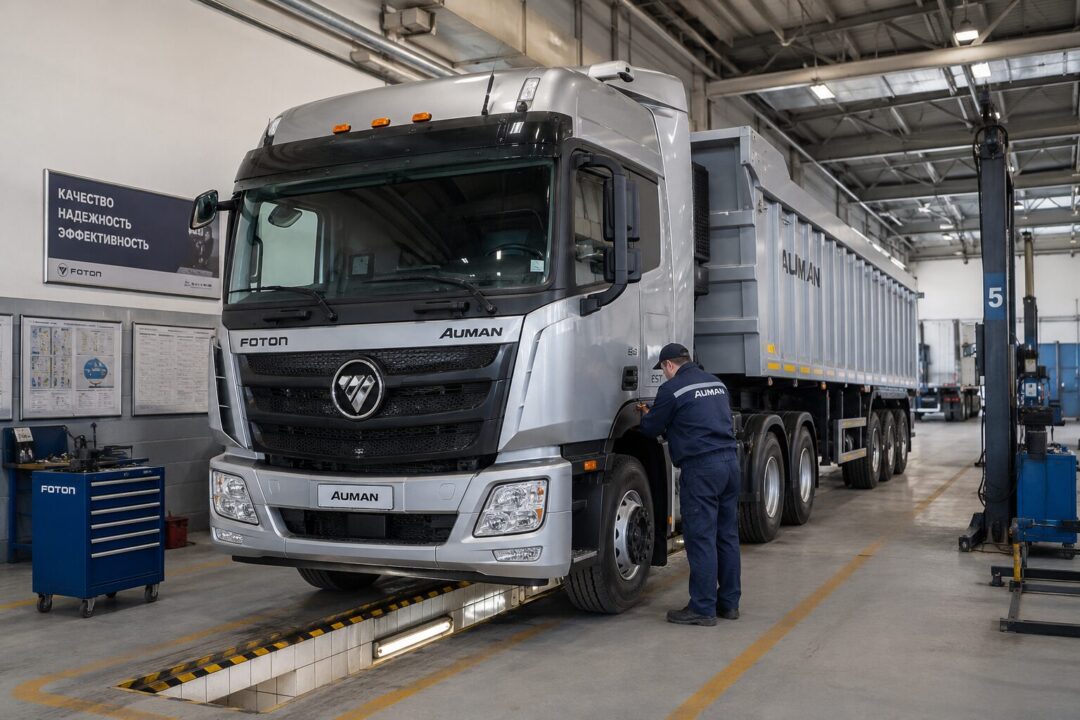
What’s the Real-World Service Life of a Foton Auman?
With timely maintenance and decent-quality fluids and fuel, most Auman-series trucks show a solid service life across their major components:
By 200,000 km, most major components are roughly at the midpoint of their expected life. That’s not a critical mileage in itself, but it’s usually when the first meaningful repair bills start showing up. Actual longevity depends heavily on operating conditions: diesel quality, load discipline, on-schedule oil and filter changes, and driving style.
Cummins Engine Problems
The Auman is most commonly fitted with Cummins ISF, ISD, or ISG engines (depending on generation and output — roughly 280 to 470+ hp).
Oil Seepage
One of the most common age-related issues. Past 150,000-200,000 km, light seepage tends to show up around the valve cover, the front crankshaft seal, turbo lines, and the oil cooler. In Kazakhstan’s conditions — dust plus sharp temperature swings — this tends to progress faster than it would in a milder climate. It rarely causes catastrophic oil loss on its own, but it does call for regular level checks and periodic seal replacement (labor typically runs from roughly 15,000 to 40,000 KZT, depending on the shop).
Injector and Fuel System Wear
By around 200,000 km, typical symptoms include:
- harder cold starts;
- unstable idle;
- higher fuel consumption (up 2-4 L/100 km);
- black or blue-grey exhaust smoke.
A diagnostic check plus injector cleaning or reconditioning every 100,000-150,000 km is generally recommended — especially relevant given that fuel quality in parts of Kazakhstan isn’t always consistent.
Turbocharger
Warning signs: a whistling noise, reduced power delivery, higher oil consumption, and boost-related fault codes. Overloading and poor-quality oil shorten its life considerably. Turbo repair or replacement is one of the most frequent jobs at this mileage.
SCR and AdBlue System
This is arguably the most troublesome system on the modern Auman. Past roughly 150,000-250,000 km, common issues include:
- NOx sensor faults;
- urea pump failure;
- clogged AdBlue injector;
- AdBlue crystallization (particularly in winter).
Symptoms: a Check Engine light, derated power (down to 40-60% of normal), and higher fuel consumption. Many CIS owners resort to disabling SCR in software to sidestep the AdBlue headaches, but that carries legal and environmental consequences. In Kazakhstan, winter AdBlue problems are especially noticeable because of the cold.
Disabling SCR in software removes the AdBlue headaches, but it creates real exposure on international routes where emissions compliance gets checked. Weigh how the truck is actually used before going that route.
Typical Fault Codes and Cummins Maintenance (ISF / ISD / ISG)
| Category | Example Codes | Symptoms | Recommended Action |
|---|---|---|---|
| Fuel system | P2290, P2291, P2292, P2293 | Hard starting, unstable idle, power loss | Check fuel pressure, test injectors, replace filter |
| Injectors | P0201–P0206 (cylinder-specific) | Black/grey smoke, higher consumption, vibration | Injector testing, cleaning/replacement, check wiring |
| EGR | P0401, P0402, P0404, P0405 | Power loss, smoke, rough idle | Clean EGR valve, check position sensors |
| SCR / AdBlue | P20EE, P20EF, P228D, P2463 | Derate, Check Engine, crystallization | Check NOx sensors, urea pump, AdBlue injector |
| Turbocharger | P0299, P0234 | Whistling, boost loss, higher oil consumption | Check turbo geometry, seals, oil lines |
| Oil pressure | P0520, P0521 | Dash warning, engine knock | Check sensor, oil level/quality, oil pump |
Oil Change Intervals and Recommended Oil Types
Cummins recommends the following service intervals and specifications:
| Parameter | Recommendation |
|---|---|
| Oil change interval (normal use) | 15,000 – 25,000 km |
| Severe-duty interval | 10,000 – 15,000 km (dust, overload, cold) |
| Oil specification | Cummins CES 20081 |
| Recommended viscosity | 5W-40 (year-round), 10W-40 (warm climates) |
| Oil type | Semi-synthetic or full synthetic, Low SAPS for SCR-equipped engines |
| Oil filter | Replace with every oil change |
| Fuel filter | Replace every 15,000 – 20,000 km |
| Air filter | Inspect every 10,000 km, replace as needed |
ZF Transmission Maintenance: Manual and Automated (TraXon)
Manual ZF Transmissions
| Parameter | Recommendation |
|---|---|
| Oil change interval | Every 60,000 – 80,000 km |
| Oil type | ZF TE-ML 02B, 120S; viscosity 75W-90 or 80W-90 |
| Filter | Usually none; level check is mandatory |
| Special requirements | Regularly check linkages and synchronizer condition |
| Typical issues | Notchy shifting, worn synchronizers |
ZF TraXon Automated Transmissions
| Parameter | Recommendation |
|---|---|
| Oil change interval | Every 100,000 km or 5 years, whichever comes first |
| Filter change interval | Every 100,000 km, with the oil |
| Oil type | ZF Lifeguardgear 8 or equivalent per ZF 120S spec |
| Programming | Requires adaptation and diagnostics via ZF Diagnostic Tool |
| Special requirements | Controller software updates, clutch calibration |
| Typical issues | Shift delays, clutch faults, electronics glitches |
The ZF TraXon transmission really does need to be serviced at a shop with ZF licensing and the right diagnostic equipment. A non-specialist oil change, or skipping the adaptation step, can accelerate clutch wear and trigger transmission faults.
Transmission Problems
Most Auman trucks run either a manual or an automated ZF gearbox (including TraXon).
Notchy Shifting
Worn synchronizers, contaminated oil, and play in the linkages are the classic culprits by 200,000 km. Changing the oil on schedule (every 60,000-80,000 km) meaningfully extends the gearbox’s life.
Clutch Wear
In city-cycle work or with frequent overloading, a clutch can be worn out by as early as 150,000-180,000 km. Signs: slipping, vibration, jerky engagement, a burning smell. Replacing the clutch kit is one of the most predictable jobs at this mileage.
Pneumatic System
The air system works hard under constant load and temperature swings.
Air leaks — through fittings, lines, reservoirs, and brake chambers — are common. They get worse in winter as seals stiffen with cold and the system works harder.
The air dryer needs a cartridge change every 40,000-60,000 km. Skip that and moisture works its way into the lines, causing corrosion and frozen lines in winter — a real risk given Kazakhstan’s temperature swings.
Chassis and Suspension
On Kazakh and Russian roads, the chassis takes the brunt of it — loads here are simply higher than on a European motorway:
- Leaf springs, bushings, sway-bar links, and spring pins — wear quickly, producing the characteristic clunks and looser steering feel.
- Shock absorbers — lose damping, the cab starts to sway, and high-speed handling suffers.
- Wheel hub bearings — particularly vulnerable under chronic overload: symptoms include humming, hub heat, and vibration. Left unaddressed, this can turn into an expensive full hub rebuild.
Electrical System
The typical age-related electrical gremlins here are fairly standard for commercial trucks:
- corroded connectors in areas exposed to temperature swings and moisture;
- chafed wiring where it’s routed along the frame, especially at vibration points;
- poor grounding, which shows up as erratic sensor and electronics behavior;
- intermittent ABS/ESP faults.
In winter, road salt and higher humidity noticeably increase electrical gremlins. Many owners see ABS acting up even on relatively low-mileage trucks — usually traced to corroded connectors rather than an actual system fault.
Cab and Interior
Build quality on the current-generation Auman is noticeably better than on earlier “Chinese truck” generations, but after 4-6 years of hard use you’ll typically see:
- creaks and rattles from interior trim;
- driver’s seat sag (especially above roughly 90 kg / ~200 lb);
- worn door seals — the cab holds heat less well in winter;
- play in door latches and locking mechanisms.
The cab can run cold in winter, especially on earlier versions — the standalone heater sometimes struggles below about -20°C (-4°F), which matters across most of Kazakhstan from November through March.

What Repair Costs to Expect Past 200,000 km
Below are rough average repair costs based on 2025-2026 pricing in Kazakhstan and Russia:
| Job | Cost (RUB) | Cost (KZT) |
|---|---|---|
| Injector service/cleaning (full set) | 50,000 – 120,000 ₽ | 280,000 – 650,000 ₸ |
| Clutch replacement | 80,000 – 150,000 ₽ | 450,000 – 800,000 ₸ |
| Turbo repair/replacement | 40,000 – 150,000 ₽ | 220,000 – 800,000 ₸ |
| NOx sensor / AdBlue pump | 25,000 – 70,000 ₽ | 140,000 – 380,000 ₸ |
| Pneumatic system repair | 10,000 – 50,000 ₽ | 55,000 – 270,000 ₸ |
| Leaf springs/bushings replacement | 30,000 – 80,000 ₽ | 170,000 – 430,000 ₸ |
| Full service + diagnostics | 30,000 – 60,000 ₽ | 160,000 – 320,000 ₸ |
Total upkeep costs on a truck in the 200,000-300,000 km range can run roughly 300,000-700,000 RUB a year, depending on usage intensity, region, and the condition of the individual truck. At the exchange rate as of early August 2026 (roughly 1 USD ≈ 470 KZT), that maps to very roughly $1,700-$4,000 — treat this only as a rough guide, since exchange rates move.
Should 200,000 km Worry You?
Not if the truck has a clean, transparent service history. A well-maintained Foton Auman with 200,000 km on it is often a better buy than a “younger” truck with a murky past and hidden problems. The key is a proper pre-purchase inspection of the engine, transmission, air system, and SCR.
What Owners and Fleets Report
The notes below summarize patterns that come up repeatedly in service-shop experience and owner discussion around the Auman in Kazakhstan and the CIS. They’re presented as general, aggregated observations rather than attributed to specific individuals, since we don’t have verified, linkable first-person posts to cite for this market segment.
Summary of Common Problem Areas
| Problem | How Often Reported | Typical Mileage of Onset |
|---|---|---|
| Oil seepage | High | 150,000 – 200,000 km |
| Injector wear | High | 180,000 – 220,000 km |
| AdBlue/SCR issues | Moderate | 190,000 – 250,000 km |
| Clutch wear | High | 150,000 – 200,000 km |
| Pneumatic system leaks | Moderate | 180,000 – 250,000 km |
| Suspension issues | Very high | 120,000 – 180,000 km |
| Electrical (ABS, sensors) | Moderate | 100,000 – 150,000 km |
Frequently Asked Questions
- The Cummins ISG and ISF, provided the truck runs on decent-quality fuel and the right oil spec, with strict adherence to service intervals. The Cummins engine family was designed for heavy-duty use and, well cared for, can realistically clear a million kilometers or more.
- Under normal operation, roughly in the 250,000-400,000 km range. Chronic overload and poor-quality oil bring that forward significantly. Early signs — a faint whistle, a slight loss of pull — usually show up well before outright failure, giving time to plan a repair.
- Yes, provided it has a transparent service history and passes a full inspection. 200,000 km is roughly the midpoint of the truck’s life, not the end of it. Many fleets run these trucks successfully out to 500,000-700,000 km and beyond. A well-cared-for truck with a clear history can be a better buy than a “younger” one with an unknown past.
- Common-rail fuel system work (injectors, pump), the turbocharger, a full SCR/AdBlue system repair, and chassis components once wear is advanced. The ZF TraXon transmission deserves a separate mention — it needs specialized equipment to service and costs considerably more to repair than a manual gearbox.
Bottom Line
The Foton Auman is a solid mid-pack performer among Chinese-built trucks. Maintained properly, it can run out its service life economically and reliably. The key to longevity is simple: don’t cut corners on fluids, keep to the service schedule, and don’t run it overloaded.
If you’re looking at an Auman with roughly 200,000 km on the clock, budget for a full pre-purchase inspection with a shop equipped to diagnose Cummins and ZF components properly. It’ll cost far less than what it can save you.
📚 Sources and Technical Background
This article draws on manufacturer service documentation, general service-shop practice for Foton Auman trucks, and operating experience with commercial vehicles in Kazakhstan and the CIS. Information reflects conditions as of 2026. We haven’t linked individual articles below because this section reflects aggregated technical documentation and general service practice rather than single citable news pieces — where a claim traces to one specific source, that’s noted inline in the relevant section above.
- Cummins service documentation — maintenance guidance for the ISF, ISD, and ISG engines, oil specification CES 20081, and typical fault codes.
- ZF technical documentation — TE-ML oil specifications, servicing manual gearboxes and the TraXon automated transmission, and controller programming requirements.
- Foton Motor manufacturer materials — technical specifications, trim levels, and Cummins/ZF powertrain data.
- Service-shop and fleet experience — repair and maintenance patterns for Foton Auman trucks past 200,000 km in Kazakhstan, Russia, and Uzbekistan.
- Owner and carrier discussion — Drive2.ru and Auto.ru (Russian-language forums), plus professional carrier communities on Telegram.
- Emissions regulation — SCR/AdBlue operating requirements and current environmental regulations in the Republic of Kazakhstan.
Repair and parts costs vary by region, exchange rate, and vehicle trim. Service intervals should be adjusted for overloading, fuel quality, and climate. Last updated: 2026.