Author: Automotive expert specializing in Chinese vehicles, with hands-on experience in diagnostics, maintenance, and real-world operation of ICE, hybrid, and electric models.
avtomir.site Editorial Team · Updated July 2026
The Chery Tiggo 4 is a popular crossover from Chinese automaker Chery, combining stylish design, solid reliability and an attractive price point. To keep it running well, it’s important to follow the recommended maintenance schedule. This guide covers how often to service the Chery Tiggo 4, what each stage of maintenance includes, and tips to extend the vehicle’s lifespan.
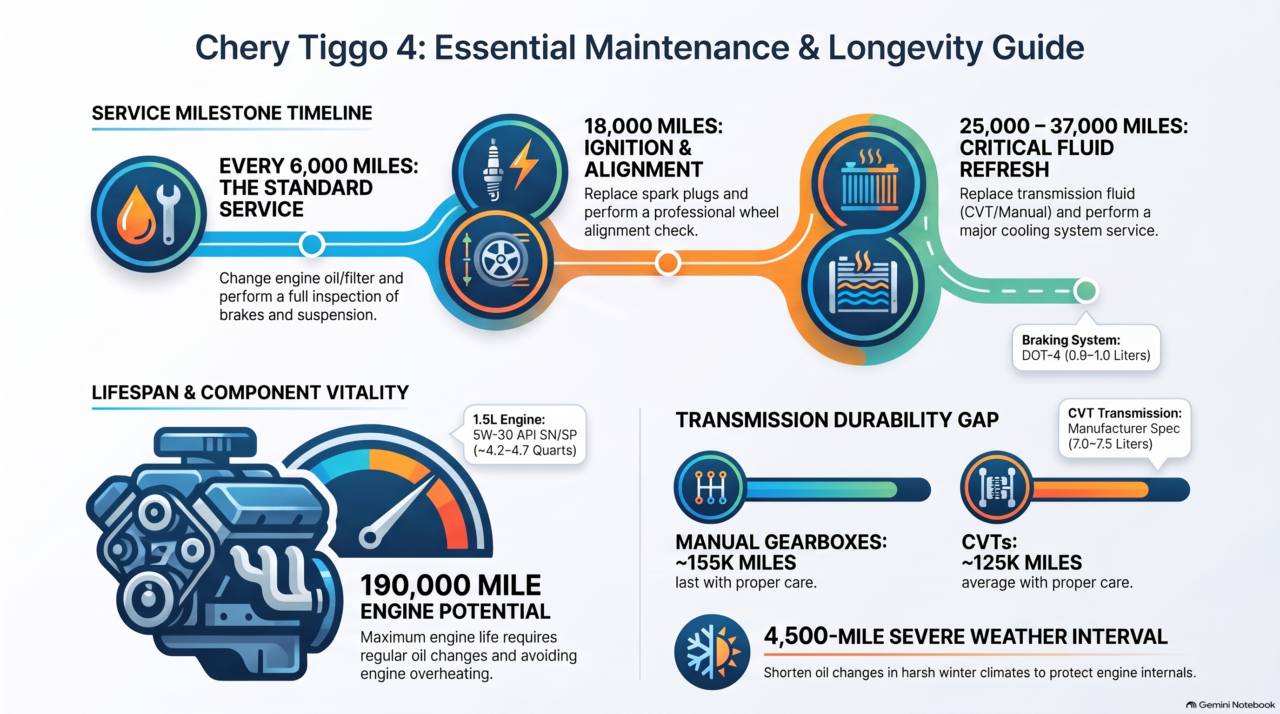
Engine oil capacity~4.0–4.7 quarts (5W-30, approximate — check your specific engine)
CVT fluid changeEvery 25,000–30,000 miles
Service interval6,000 miles (10,000 km) or once a year
Spark plugsReplace roughly every ~18,000 miles
💡Tip: in regions with harsh continental winters, many owners and independent shops recommend shortening the oil-change interval — for example, to around 4,500 miles instead of the standard interval.
How Often Should the Chery Tiggo 4 Be Serviced?
The manufacturer recommends maintenance roughly every 6,000 miles (10,000 km) or once a year, whichever comes first. Under harder conditions — off-road driving, extreme temperature swings — it’s worth shortening that interval.
Main Stages of Maintenance
Tiggo 4 maintenance is generally broken into an initial check, the first two scheduled services, and ongoing servicing beyond that.
Initial Check (roughly 1,200–3,000 miles or 2–3 months)
Diagnostic check of the engine and transmission
Cooling system leak check
Fluid level checks
Brake pad inspection and a scan for stored fault codes
First Scheduled Service (~6,000 miles or 1 year)
Engine oil and oil filter change
Air filter replacement (if needed)
Brake pad and rotor inspection
Suspension, steering and undercarriage inspection
Fluid level checks and top-offs
Second Scheduled Service (~12,000 miles or 2 years)
Service costs vary significantly by country, labor rates, and whether you use a dealer or independent shop — treat any specific price figure as a rough regional estimate rather than a global benchmark, and get a quote from a local shop before budgeting.
Expected Component Lifespan
Engine
Roughly 150,000–190,000 miles with regular maintenance. The main causes of premature wear are delayed oil changes, overheating, and poor fuel quality.
Transmission (Manual and CVT)
Manual gearbox — roughly 125,000–155,000 miles; CVT — roughly 90,000–125,000 miles with timely fluid changes (every 25,000–37,000 miles) and no harsh acceleration or braking.
Suspension
Roughly 60,000–90,000 miles, heavily dependent on road quality.
⚠️ Volumes, part numbers and exact intervals below are approximate and can vary by model year, engine, and market. Always confirm the exact part number against your vehicle’s VIN with an authorized dealer or parts supplier before buying — don’t rely on this table alone.
~4.4–4.7 qt; many owners shorten the interval for city driving
CVT
Manufacturer-specified CVT fluid (confirm exact spec with your dealer)
Full fluid change ~7–7.5 L; interval roughly 25,000–30,000 miles
Manual transmission
GL-4 75W-90
~2.0 L; interval depends on usage
Coolant
G12++/G13 or manufacturer spec
~6–9 L, every 3 years or ~37,000 miles
Brake fluid
DOT-4
~0.9–1.0 L, every 2 years
Diagnosing Common Codes: P0420, P0500, P0700
These codes don’t always mean an expensive part needs replacing. Start by checking wiring, connectors, related codes, and live sensor data before assuming the worst.
P0420 — Catalyst Efficiency Below Threshold
This code means the catalytic converter isn’t performing efficiently — but the cause isn’t always the converter itself.
Scan for all stored codes and address related ones first.
Check the exhaust system for leaks.
Review live data from the upstream and downstream oxygen sensors.
Check the injectors, oxygen sensors, and look for misfires.
If the code persists after these checks, evaluate the converter itself.
P0500 — Vehicle Speed Sensor Malfunction
Often the issue is oxidized connectors or damaged wiring rather than the sensor itself.
Check whether the speedometer works and look for related ABS/ESP codes.
Log live scanner data while driving and compare it to actual speed.
Inspect the sensor, wiring and connectors for moisture and corrosion.
Check power, ground, and signal wire continuity.
P0700 — Transmission Control System Malfunction
This is a general flag indicating an active fault in the transmission control module, not a specific fault on its own.
Scan the TCM specifically for additional stored codes.
Check transmission fluid level and condition.
Inspect connectors and wiring harnesses for moisture, corrosion or damage.
Clear codes after the repair and take a confirmation test drive.
What to Replace On Schedule vs. What Can Wait
On schedule: oil and oil filter; air and cabin filters; spark plugs (~every 18,000 miles); brake fluid (every 2 years); coolant (~every 37,000 miles).
Condition-based: the fuel filter can often go longer without symptoms; the timing belt should be judged by actual wear rather than strictly by the calendar.
Tips for Saving on Maintenance
Buying parts yourself is sometimes cheaper than a dealer’s bundled parts-and-labor price — compare before committing.
A trusted independent shop can be a good option once the factory warranty no longer applies.
Keep every service logged — it matters for resale value.
Flushing the radiator and A/C system annually isn’t strictly required by the schedule, but can extend the life of both systems.
What Real Owners Say
While preparing this version of the article, we weren’t able to find enough independently verifiable owner build-log links for the Tiggo 4 / Tiggo 4 Pro to responsibly paraphrase with sourcing — unlike some other guides in this catalog where such links checked out. If you have links to genuine owner discussions on forums worth citing here, let us know and this section can be expanded properly.
FAQ — Chery Tiggo 4 Maintenance
How often should the Chery Tiggo 4 be serviced?
Roughly every 6,000 miles (10,000 km) or once a year, whichever comes first. Shorten the interval under harder driving conditions.
What’s included in the first scheduled service?
Engine oil and filter change, inspection of the undercarriage, brakes and steering, and topping off fluids.
Does the transmission fluid need changing?
Yes — roughly every 25,000–37,000 miles for either the manual gearbox or the CVT, to extend the unit’s lifespan.
When should the timing belt be replaced?
There’s no single hard rule; it’s typically inspected after around 37,000 miles and replaced based on actual condition rather than strictly by mileage.
What’s the expected engine lifespan on a Chery Tiggo 4?
Roughly 150,000–190,000 miles with regular maintenance.
Is the initial check-up necessary?
It’s not strictly mandatory, but it’s a good idea to catch any issues after the break-in period.
Get it scanned as soon as possible — catching an issue early usually avoids a more expensive repair down the line.
Conclusion
Following the maintenance schedule, driving conservatively, and using quality parts and fluids all help extend the life of a Chery Tiggo 4 and its major components.
📚 Sources
General Chery Tiggo 4 / Tiggo 4 Pro service documentation.
Publicly available service-cost references — used only as a rough guide to relative cost by service stage.
Exact intervals, fluid capacities and part numbers vary by model year, engine and market — figures above are approximate. Check your owner’s manual and confirm part numbers by VIN with an authorized dealer.
🔧 Need car repair or diagnostics?
Discounts on maintenance, diagnostics, and spare parts for Chinese cars at official dealers and trusted services.