Author: Automotive expert specializing in Chinese vehicles, with hands-on experience in diagnostics, maintenance, and real-world operation of ICE, hybrid, and electric models.
avtomir.site Editorial Team · updated August 2, 2026
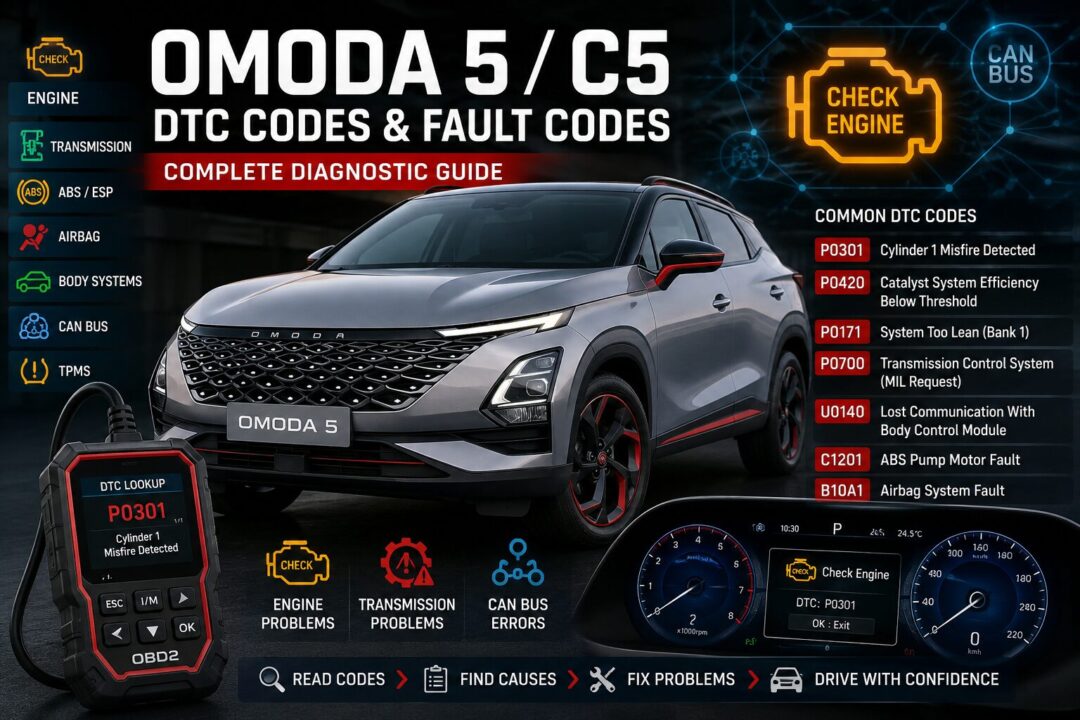
The Omoda 5 — badged Omoda C5 in some markets, including its home platform in China and across the CIS — is Chery’s compact SUV built around a light-blade design language and a fully digital cockpit. Depending on the market, it’s offered with a 1.5-litre turbo engine (roughly 145–156 hp, 108–115 kW, paired with a CVT) or a 1.6-litre turbo engine (typically 186–197 hp, mated to a 7-speed dual-clutch transmission or, on some builds, an AWD system). The car runs on a modern platform with more than 20 electronic control units linked over a CAN bus, and its OBD-II self-diagnostic system constantly monitors the engine, transmission, safety electronics, and auxiliary systems. When something falls outside normal parameters, the control unit stores a Diagnostic Trouble Code (DTC) and may light up the Check Engine indicator.
This guide covers the most common Omoda 5/C5 fault codes, what they mean, likely causes — and real cases reported by owners, with direct links to the original posts.
Symptoms: rough idle vibration, loss of power, a Check Engine light that flashes rather than stays solid.
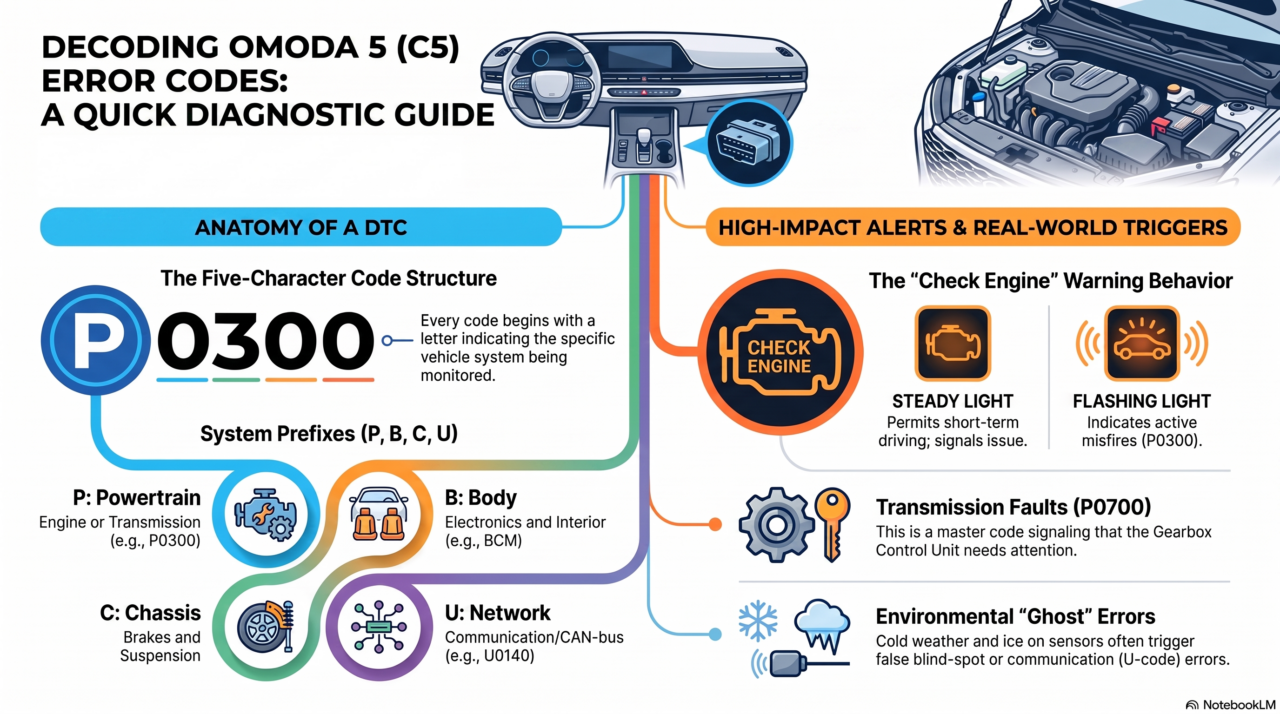
ImportantA flashing (not solid) Check Engine light with P0300 signals an active misfire that can damage the catalytic converter. In that state, avoid hard acceleration and get the car checked as soon as possible.
P0301–P0304 — Cylinder-specific misfire
Code
Meaning
P0301
Misfire, cylinder 1
P0302
Misfire, cylinder 2
P0303
Misfire, cylinder 3
P0304
Misfire, cylinder 4
In most cases the cause is the spark plug or ignition coil for that specific cylinder — start diagnosis there before moving on to injectors or a compression test.
Causes: degraded or contaminated engine oil, a faulty VVT oil control valve, or a slack timing chain.
P000B00 — Camshaft B slow response (Bank 1)
Often appears alongside P000A00. In practice, workshops report it turning up most often on cars run on low-quality oil or with service intervals stretched beyond the maker’s schedule.
PreventionBoth codes are closely tied to oil condition — sticking to the recommended service interval and oil specification lowers the odds of either one appearing.
Electronic throttle body codes
Code
Meaning
P2100
Electronic throttle control circuit malfunction
P2103
Short circuit in the throttle control circuit
P2106
Throttle actuator not performing correctly
P2118
Throttle actuator overheating or overload
P1555
Electrical fault in the throttle actuator
Symptoms: the car stops responding to throttle input normally, drops into limp mode, and power is deliberately restricted by the electronics as a safety measure.
EVAP system codes
The EVAP system captures fuel vapour from the tank and routes it back to the engine to be burned instead of venting it to the atmosphere.
Code
Meaning
P0447
Vent valve stuck closed
P0451
EVAP pressure sensor signal out of range
P0452
EVAP pressure sensor signal too low
P0453
EVAP pressure sensor signal too high
P0498
Vent valve control circuit signal too low
P0499
Vent valve control circuit signal too high
Symptoms: a fuel smell near the filler neck or under the bonnet, a lit Check Engine light, and occasionally difficulty refuelling if the valve fails to vent excess tank pressure.
Cooling system codes
P2183 — Engine coolant temperature sensor 2 circuit range/performance
Causes: a failed sensor, a corroded or loose connector, or damaged wiring.
Symptoms: inaccurate temperature readings on the dash, higher fuel use (the ECU can default to a “safe” fuel map), and harder cold starts.
One Omoda C5 1.5 owner described a similar scenario: the engine temperature warning lit up red right after startup, while the temperature gauge itself stayed in the normal (blue) range. Turning the engine off and back on cleared the light, and a scan showed no stored codes at all. Another owner in the same thread reported the identical symptom and said the dealer replaced the suspect part under warranty without any pushback, even though their scan tool hadn’t flagged a code either.
Likely causes: a faulty relay, a blown fuse, or a failed A/C compressor.
CAN bus and body electronics codes
The Omoda 5 has more than 20 control units talking to each other over a CAN bus, so wiring, grounding, or supply-voltage problems often show up as communication faults rather than as a failure of one specific component.
Code
Meaning
U0140
Lost communication with the Body Control Module (BCM)
U0151
Lost communication with the airbag control module
U0155
Lost communication with the instrument cluster
U0214
Lost communication with the keyless entry module
Causes: low battery voltage, a poor body ground connection, physical damage to the CAN wiring, or a software glitch after a firmware update.
In cold weather, Omoda C5 owners frequently report false electronics faults caused by ice forming around the front or rear bumper sensors — the blind-spot radar in particular. In one DRIVE2 thread, an owner in St. Petersburg described how a blind-spot radar fault cleared on its own after a technician simply cleaned dirt and sand off the sensors that had built up over the winter. In a separate thread, several owners described a dashboard warning that lingered for a couple of days after icing, then disappeared either after a light tap on the sensor housing or a few hours in a warm parking garage — the ice inside the sensor cracked and melted, restoring the connection.
Worth knowingNot every dashboard warning means a serious component failure. Based on owner reports, a share of U-series codes on the Omoda 5 in real-world use trace back to temporary causes — ice on sensors, a voltage dip during remote start, or electrical noise. That said, if a fault keeps coming back, it’s worth a dealer visit: owners generally describe warranty claims on the electronics being handled without much friction.
Tyre pressure monitoring (TPMS) warnings
This is a separate category of alert that isn’t technically a P/B/C/U DTC, but owners commonly mistake it for a “real” Check Engine fault — the tyre pressure monitoring system warning. It triggers when pressure drops in one or more wheels and shows an icon on the dash or infotainment screen.
One Omoda C5 owner reported the pressure warning appearing first on a single wheel, then on three wheels a few minutes later, even though a hand gauge showed roughly 2.3–2.6 bar rather than the recommended pressure. The warnings didn’t clear on their own over several days; topping up all four tyres to the correct pressure resolved it.
This code is a general flag: the engine control unit has received a fault signal from the Transmission Control Unit (TCU). On its own it doesn’t point to a specific cause — proper diagnosis requires pulling the actual codes stored in the TCU, not just the engine ECU.
Symptoms: jerky or delayed response when pulling away or changing drive modes, the transmission dropping into limp mode (restricted revs and gear ratio), and a transmission warning light on the dash.
One telling case involved the CVT on a 1.5-litre Omoda C5: the owner, based in Russia’s Krasnodar region, woke up one morning to find the car simply wouldn’t move. Disconnecting and reconnecting the battery terminals brought it back to life, but the transmission warning stayed lit on the dash even though the car still drove normally. The CVT unit was ultimately replaced outright, and the warnings disappeared for good afterward.
Not every transmission warning means a failure, though. An Omoda C5 owner with an aftermarket Starline remote-start alarm reported a CVT fault lighting up whenever the car was started remotely through the app, with the engine stalling as soon as the brake pedal was pressed. It turned out the transmission itself was fine: bypassing the factory immobiliser during a remote start means not every module on the CAN bus wakes up at the same moment, so the ECU briefly loses the expected signal from the TCU. Both the dealer and Starline’s own support confirmed this is expected behaviour for that alarm setup, not a transmission fault.
Worth checking firstBefore assuming the worst about a transmission warning, think back to any recent electrical work — an alarm install, a battery disconnect, a firmware update. Based on owner reports, some of these warnings are temporary and unrelated to an actual CVT failure, but only a TCU scan can confirm that either way.
Reading and clearing codes on the Omoda 5
Both general-purpose and professional scanners work with the Omoda 5/C5:
an ELM327 Bluetooth/Wi-Fi adapter paired with an app such as Car Scanner — for basic code reading and live data;
Launch X431;
ThinkDiag;
Autel MaxiAP;
dealer-level Chery/Omoda diagnostic equipment — needed to access specific modules like the TCU or BCM, and for post-repair adaptation procedures.
The OBD-II diagnostic port on the Omoda 5/C5 is located under the steering column, on the driver’s side.
Can you clear codes yourself?
Yes — once the underlying fault has been fixed, a scanner can clear the stored code. But if the root cause hasn’t actually been addressed, the code will almost certainly come back within a few drive cycles. Clearing a code without fixing what triggered it just switches the Check Engine light off temporarily; it doesn’t solve anything.
Bottom line
Most Omoda 5/C5 fault codes trace back to the engine management system, sensors, the electronic throttle body, or one of the many control units on the CAN bus. P0300, P0171, P0420, P2100, and P0700 are among the ones that show up most often and are worth investigating promptly. That said, real-world owner reports make clear that not every warning light points to a serious failure — some trace back to iced-over sensors, quirks in how the CAN bus behaves during remote starts, or other temporary glitches that clear on their own. Regular servicing, decent fuel, and acting promptly on a Check Engine light go a long way toward avoiding most of these issues — and the repair bills that come with ignoring them.
Frequently asked questions
It signals random misfires — not tied to one specific cylinder — most commonly caused by spark plugs, ignition coils, or fuel injectors.
If the car is otherwise running normally and the light is solid (not flashing), short-term driving until you can get it scanned is usually fine. A flashing light is a different story — it signals active misfires that can damage the catalytic converter, so you should stop as soon as it’s safe and get the car looked at, or have it towed.
A basic ELM327 adapter paired with an app like Car Scanner covers general code reading. For deeper diagnostics — including the TCU and BCM — you’ll need something more capable, such as a Launch X431, ThinkDiag, Autel MaxiAP, or genuine Chery/Omoda dealer equipment.
Most often it’s low battery voltage, a poor body ground, or CAN bus interference. Based on owner reports, in cold climates similar symptoms can also come from ice forming around the bumper-mounted sensors.
Yes — once the fault is fixed, clear the stored code with a scanner and take the car for a test drive to confirm the code doesn’t return.
Owner accounts in this article are short, anonymised paraphrases of real posts on the Russian-language platform DRIVE2, not verbatim translations. Follow the links to read the original discussions in full (Russian).
🔧 Need car repair or diagnostics?
Discounts on maintenance, diagnostics, and spare parts for Chinese cars at official dealers and trusted services.