Author: Automotive expert specializing in Chinese vehicles, with hands-on experience in diagnostics, maintenance, and real-world operation of ICE, hybrid, and electric models.
If your JAC J7 jerks or hesitates during acceleration — the car surges, momentarily loses power, or jolts when you press the throttle — the cause can sit with the engine just as easily as with the transmission (CVT). Sometimes it’s something as simple as a fouled spark plug or a dirty throttle body; other times the jerking really does point to the gearbox. This guide walks through the diagnostic logic step by step, with tables you can use for self-checks and real-world cases reported by JAC J7 owners.
JAC J7 1.5T CVT — key specifications
Parameter
Value
Engine
1.5 L turbocharged inline-4 (HFC4GB2.4E)
Power / torque (export/global-market tune)
148–150 hp, 210 Nm
Power (CIS-market tune — Russia/Kazakhstan)
136 hp — factory-detuned for that market; see note below
Transmission
CVT (automatic); a 6-speed manual is also offered on some trims/markets
Drive layout
Front-wheel drive (FWD)
0–100 km/h
≈10.5 sec (export-market tune)
Top speed
170 km/h
Curb weight
≈1,440 kg
Body style
Compact sedan / 5-door liftback, depending on market naming
Warranty (varies by market)
5 years, bumper-to-bumper in Mexico; 5 years / 150,000 km in Russia/Kazakhstan
A note on power figures. The JAC J7’s 1.5T engine is sold with two distinct outputs depending on the market: export markets such as Mexico, the UAE, and Saudi Arabia list 148–150 hp and 210 Nm, while the same engine is factory-detuned to 136 hp for the Russia/Kazakhstan (CIS) market. If you’re comparing owner reports or spec sheets across regions, keep this difference in mind — it isn’t a typo, and it can also affect how the CVT is programmed to respond to throttle input.
Jerking only when the engine is cold, disappears once warm
Spark plugs/coils, cold-start fuel mixture
Plugs, coils, cold-start parameters
Jerking appears specifically after warm-up
Heat-sensitive sensor fault, CVT fluid temperature
Temperature sensors, mixture parameters, CVT fluid
Jerking at low speed (10–20 mph) with stable engine RPM
CVT: fluid level/condition, adaptation, firmware
CVT fluid level, transmission parameters, software version
Engine RPM fluctuates erratically at the moment of the jerk
Engine problem, not the transmission
Misfires, spark plugs, coils, injectors
1. Spark plugs and ignition coils
One of the first things worth checking if a JAC J7 has started jerking on acceleration is the ignition system.
A failing spark plug or coil can cause one cylinder to misfire intermittently. At idle the problem may be barely noticeable, but it shows up much more clearly once the engine is under load during acceleration.
Typical symptoms: jerking when you press the accelerator; rough idle; power loss/hesitation; increased fuel consumption; a Check Engine light; jerking that gets worse under hard acceleration.
What to do
Don’t jump straight to replacing every coil. Start by pulling the codes and checking for misfire counts per cylinder. If diagnostics point to a specific cylinder, check that plug and coil — including swapping coils between cylinders to see whether the fault follows the coil. If it does, you’ve essentially found the cause.
2. Clogged fuel injectors
Another possible cause is uneven fuel atomization. If an injector is clogged, the amount of fuel reaching the cylinder can deviate from what’s needed. At light loads the engine can often compensate, but the problem becomes obvious under acceleration.
Drivers may notice jerking, hesitation on acceleration, an unstable idle, reduced power, and higher fuel consumption. Flushing the injectors “just in case” isn’t a great diagnostic shortcut — check fuel trims, fuel pressure, and stored codes first.
🚗 Special Deals & Discounts
Latest prices on vehicles, spare parts and dealer promotions.
If the JAC J7 drives normally at a steady pace but starts jerking under hard acceleration, check the fuel system. A sudden load increase demands more fuel, and if system pressure drops, the engine can end up starved.
Possible causes: a clogged filter, a failing fuel pump, a faulty pressure regulator, contamination in the fuel system, or a sensor fault. The telltale sign is that the car struggles specifically when you press the accelerator hard.
4. Throttle body
A dirty throttle body can also cause an unstable throttle response: delayed response to the pedal, jerking under gentle acceleration, unstable idle, hesitation from a stop, uneven acceleration.
After cleaning the throttle body, some vehicles need a relearn/adaptation procedure — simply removing it, cleaning it, and reinstalling it isn’t always enough.
5. Accelerator pedal position sensor
The JAC J7 uses electronic throttle control, so problems can originate in the throttle-management system rather than the engine itself. If the pedal signal reaches the control unit inconsistently, the car can respond to pedal input with jerks: delayed response, sudden RPM spikes, hesitation on throttle input, uneven acceleration.
Diagnosing this requires checking live pedal and throttle-position data with a scan tool.
6. Intake air leaks
A loss of intake-system sealing can throw off the air-fuel mixture. Causes include a damaged hose, a loose connection, a crack in the intake tract, vacuum-line problems, or a leaking crankcase ventilation system.
With an intake leak, the engine can run unevenly, especially during transient conditions and acceleration. This is better diagnosed with smoke-test equipment and live sensor data than by visual inspection alone.
7. Turbocharger issues
Since the J7 uses a turbocharged 1.5T engine, the boost system can also be the culprit. With a turbo problem, the car may drive fine at light load but show power loss, jerking, uneven acceleration, or a sudden feeling that the engine has stopped pulling once boost pressure rises.
Check not just the turbo itself but also the piping, connections, boost pressure, wastegate/actuator components, pressure sensors, and any air leaks.
8. The JAC J7’s CVT
If the engine runs smoothly but the JAC J7 jerks specifically during acceleration, the transmission deserves close attention. CVT-equipped J7s behave differently from a conventional automatic: engine RPM can climb fairly quickly while road speed increases without the familiar feel of gear changes.
But if smooth acceleration is replaced by pronounced jolts and jerks, the transmission needs to be diagnosed. Possible causes: incorrect fluid level, degraded transmission fluid, hydraulic-circuit problems, sensor faults, control-unit errors, belt/pulley wear, or adaptation/software issues (including an outdated CVT firmware version).
What JAC J7 owners actually report. The cases below are paraphrased (not translated verbatim) from Drive2.ru, a Russian-language car-owner community, in threads specifically about the JAC J7 — 2023 model year, 1.5T, 136 hp (CIS-market tune), CVT. These are not official statements from the manufacturer or a dealer; they’re included only as a point of comparison and don’t substitute for a computer diagnosis of your own car.
Case 1 — jerking increased after break-in; a CVT firmware update helped. (Russian-language source)One JAC J7 owner (2023 model) describes driving cautiously for the first 1,000 km without issues, but noticeable jerking and jolting appeared around 1,900–2,500 km under gentle acceleration. A commenter on the same thread notes that after pulling live logs while driving, the engine data looked normal — the jerking traced back to the transmission (CVT) instead. After the dealer contacted the manufacturer, an updated CVT firmware version was installed, and the jerking noticeably decreased afterward.
Case 2 — jerking eased after scheduled maintenance and a CVT relearn. (Russian-language source)Another 2023 JAC J7 owner (1.5L, 136 hp, FWD, CVT) reports that after the second scheduled service visit and roughly 400 km of subsequent driving, jerking during acceleration became noticeably milder and the car picked up speed more readily. The owner notes part of the improvement may relate to a change in driving style. Elsewhere in the same thread, another commenter attributes similar jerking to a low CVT fluid level and the need for a CVT adaptation/relearn procedure; the original poster says the relearn was performed three times.
Case 3 — reflashing reduced, but didn’t fully eliminate, the jerking. (Russian-language source)In a parallel discussion about the same issue, one JAC J7 owner reports that after an ECU reflash (“Euro 2” calibration) and a small power bump, the jerking became somewhat milder but didn’t disappear entirely. Another commenter in the same thread describes a separate case where the turbo “wasn’t building boost” and the car accelerated poorly — suspecting either a turbo actuator/geometry fault or a control-unit issue. It’s a useful reminder that “jerking on acceleration” can describe several different underlying faults.
Correct fluid condition and quantity are critical for a CVT. Both too little and too much fluid can hurt transmission behavior. Symptoms of a level problem include jerking on acceleration, delayed throttle response, unstable ratio changes, unusual noise, and reduced overall responsiveness.
The level should be checked using the procedure specified by the manufacturer, since fluid temperature and vehicle position can both affect the reading.
10. Worn CVT fluid
Under demanding use — heavy stop-and-go traffic, frequent hard acceleration, towing, hot-climate driving, or sustained high-load driving — CVT fluid gradually loses its properties.
If jerking appears after extended use and gradually worsens, it’s worth checking the fluid and the transmission itself. Use fluid specified for that particular JAC J7 CVT — not a “universal” fluid just because it’s marketed as compatible.
11. Jerking at low speed
A separate scenario is when the JAC J7 jerks not under hard acceleration but at low speed — for example, 10–20 mph with light, steady throttle. Here the cause may well sit in the transmission or its control system, but the engine should be ruled out first.
If engine RPM fluctuates erratically at the moment of the jerk, or there are misfires or rough running, start with the engine. If the engine is stable and the jerk feels like a change in drivetrain torque specifically, move on to diagnosing the CVT.
12. Electronics and control-unit faults
A modern vehicle can start jerking even without an obvious mechanical fault. The engine or transmission control unit may log sensor errors and switch to a protective/limp mode, so a computer diagnosis is worthwhile whenever jerking appears — not just to pull codes, but to review stored and live parameters: engine RPM and load, accelerator pedal position, throttle position, fuel trims, misfire counters, boost pressure, and transmission parameters.
Why a JAC J7 jerks under hard acceleration
If jerking only shows up when you floor the pedal, the likely causes are the ones that surface under load. Start with spark plugs, ignition coils, fuel pressure, injectors, the boost system, engine sensors, and the CVT. If the Check Engine light comes on at the same time, don’t put off diagnosis.
Why a JAC J7 jerks under gentle acceleration
Gentle acceleration tells a somewhat different story. If the car jerks with light throttle input, check the throttle body, the accelerator pedal, fuel trims, engine sensors, the ignition system, CVT behavior, and control-unit software. It’s especially useful to compare behavior cold versus fully warmed up.
Cold-engine jerking vs. jerking after warm-up
When the jerking happens
What it usually points to
What to check
Only in the first few minutes after startup, gone once warm
Before heading to a shop, it helps to record the conditions under which the fault occurs:
Engine temperature: cold or fully warmed up.
Speed: e.g., 10–15, 20–30, or 50–65 mph.
Driving style: gentle or hard acceleration.
RPM: at what engine speed the jerking appears.
Check Engine light: on or off.
Character of the jerk: does the engine lose power, or does it feel like a transmission jolt.
This information significantly speeds up diagnosis.
When to get to a shop right away. Don’t keep driving if any of the following accompany the jerking: a flashing Check Engine light; strong engine vibration; a sudden loss of power; unusual noise from the CVT; a burning-fluid smell; hard jolts when pulling away from a stop; or the car no longer accelerating normally. A flashing Check Engine light in particular shouldn’t be ignored — it can indicate serious misfires.
Confirm engine ECU and CVT firmware are up to date with the dealer
11
Perform an adaptation/software update if applicable
Scheduled maintenance and how it relates to jerking
As the owner reports above suggest, some jerking eases or disappears after scheduled maintenance and the relearn procedures that go with it. Maintenance intervals for JAC vehicles are commonly structured around 10,000 km (roughly 6,000-mile) steps between services — this pattern is documented by JAC’s authorized service network in the Russia/CIS market. Because service schedules and mileage/time units can differ by country, always confirm the exact intervals and covered work with your local JAC dealer rather than assuming a schedule published for one market applies everywhere.
Service #
Time interval
Distance interval
1st service
12 months
10,000 km
2nd service
24 months
20,000 km
3rd service
36 months
30,000 km
4th service
48 months
40,000 km
5th service
60 months
50,000 km
6th service
72 months
60,000 km
The full schedule (as documented for the CIS market) continues in the same 10,000 km / 12-month pattern out to roughly 120,000 km. Warranty terms vary by market: 5 years/150,000 km in Russia and Kazakhstan versus a 5-year bumper-to-bumper warranty (without a stated mileage cap) as launched in Mexico — check the terms that apply to your specific market and vehicle.
La
Is it safe to keep driving a JAC J7 that jerks?
It depends on the cause. If the jerking is barely noticeable and the car still accelerates normally, it’s usually fine to drive carefully to a diagnostic shop. But if the car jerks hard, loses power, the engine runs roughly, or transmission fault codes appear, it’s better not to keep driving.
The biggest mistake is trying to diagnose the problem purely by swapping parts. Jerking can look similar whether the underlying cause is spark plugs, injectors, or the CVT. It’s worth pulling codes and reviewing real engine and transmission parameters before replacing anything.
Bottom line
If your JAC J7 jerks during acceleration, don’t assume the CVT is automatically to blame. The cause could just as easily be the ignition system, the fuel system, the throttle body, a sensor, or the turbo system. The most efficient approach is to diagnose the engine first, then move on to the transmission if the engine checks out clean.
It’s especially useful to pin down exactly when the jerking happens: cold or warmed up, under gentle or hard acceleration, at what speed and RPM. As the owner reports above also illustrate, a meaningful share of cases get resolved through scheduled maintenance, a CVT relearn, or a dealer firmware update — but confirming that’s actually your situation requires a computer diagnosis.
For any JAC J7 owner, the underlying principle is simple: start with computer diagnostics and real parameter checks, then repair — rather than replacing parts by trial and error.
Frequently asked questions
Why does a JAC J7 jerk under gentle acceleration if the engine runs smoothly?
If a computer diagnosis of the engine shows no codes or misfires, and the jerking feels like a change in drivetrain torque, the most likely cause is the CVT — fluid level or condition, a relearn/adaptation needed after service, or an outdated transmission control-unit firmware version.
Can a CVT firmware update fix JAC J7 jerking?
Based on individual JAC J7 owner reports, a dealer-installed CVT control-unit firmware update noticeably reduces jerking on acceleration in some cases, though it doesn’t always eliminate it completely — the result depends heavily on the root cause. It’s one step worth confirming with an authorized dealer rather than a guaranteed fix.
How can you tell engine jerking from transmission jerking on a JAC J7?
If engine RPM fluctuates erratically at the moment of the jerk, or there are misfires or stored engine codes, the problem is most likely the engine. If RPM stays stable and what changes is the drivetrain’s torque delivery — a jolt with steady RPM — that points to the transmission. Live-data diagnosis gives the definitive answer.
Is it dangerous to keep driving a JAC J7 that jerks on acceleration?
Light, barely noticeable jerking with otherwise normal acceleration usually allows you to drive carefully to a shop. But with a flashing Check Engine light, strong vibration, sudden power loss, unusual noise from the CVT, or a burning-fluid smell, it’s best to stop driving and get the car diagnosed right away.
What warranty does the JAC J7 carry, and does it cover the CVT?
Warranty terms vary by market: JAC J7 buyers in Russia and Kazakhstan get 5 years or 150,000 km covering the powertrain and transmission, while the vehicle launched in Mexico with a 5-year bumper-to-bumper warranty. Confirm the exact terms — including whether scheduled maintenance at an authorized dealer is required to keep the warranty valid — for your specific market.
avtomir.site Editorial Team. This article is based on manufacturer technical documentation, authorized-dealer service data, and JAC J7 owner discussions on specialized forums. Reported owner cases are illustrative only and do not replace a computer diagnosis of your specific vehicle. Power and torque figures vary by market — see the note above on export- vs. CIS-market engine tuning.
🔧 Need car repair or diagnostics?
Discounts on maintenance, diagnostics, and spare parts for Chinese cars at official dealers and trusted services.
 La
La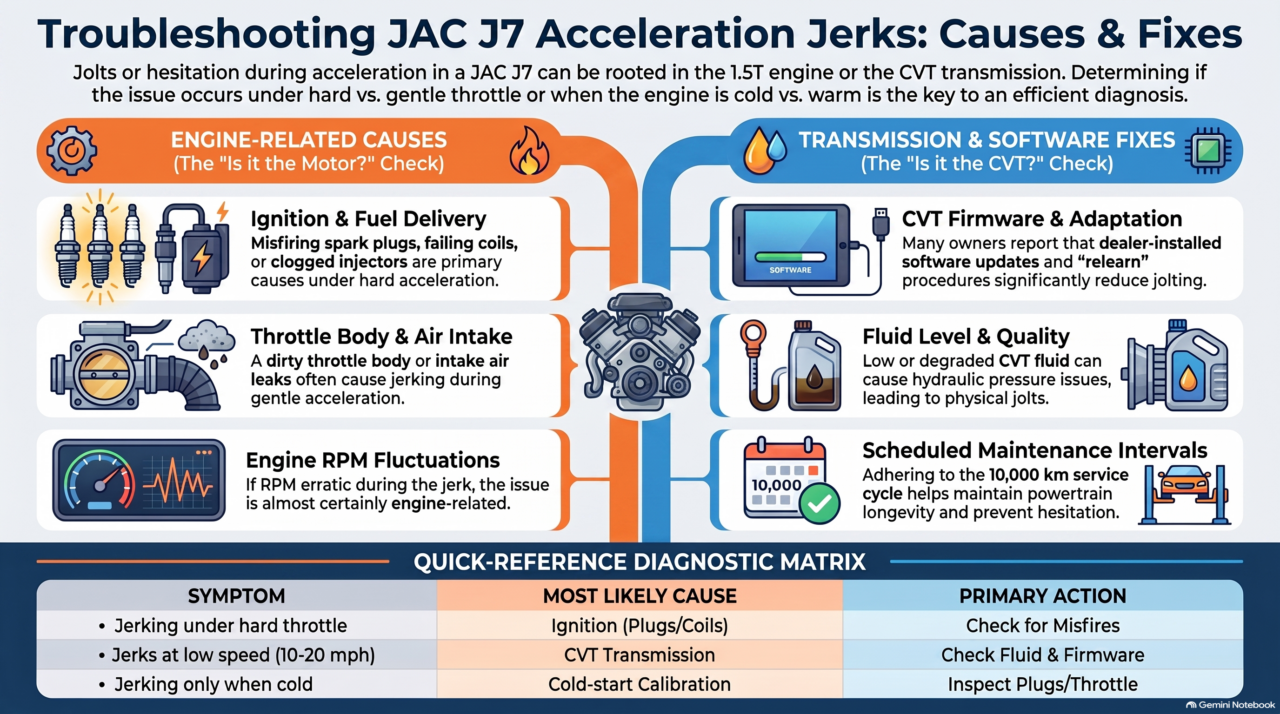 La
La