Author: Automotive expert specializing in Chinese vehicles, with hands-on experience in diagnostics, maintenance, and real-world operation of ICE, hybrid, and electric models.
The short answer: yes, it’s fine — but whether you should do it every day depends almost entirely on which battery chemistry sits under the floor of your car. LFP packs (like BYD’s Blade Battery) often need a periodic full charge, while NMC/NCA packs generally don’t. Here’s the breakdown, backed by manufacturer guidance and real owners of BYD, Zeekr and other Chinese-brand EVs.
For everyday driving, keeping the battery somewhere around 20–80% is generally a better habit than topping up to full every single night. But that guidance flips depending on the chemistry installed in your specific car.
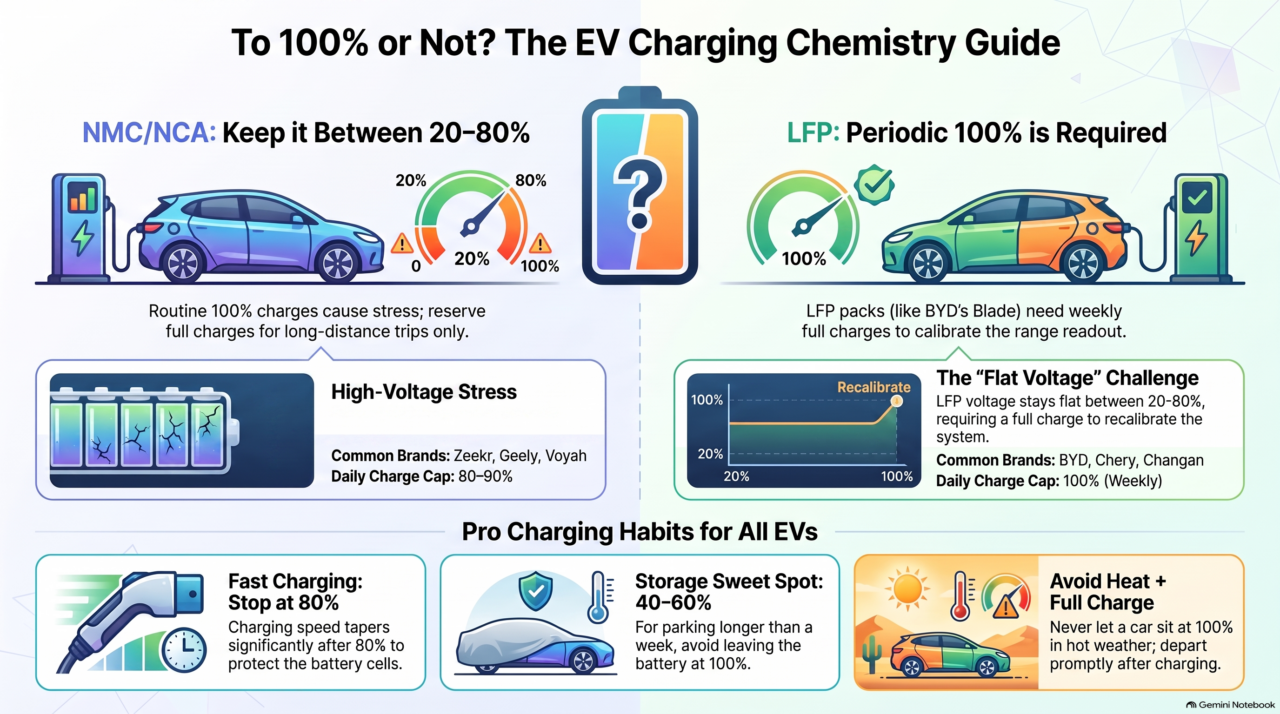
Charging to 100% routinely isn’t ideal — manufacturers typically recommend an 80–90% daily ceiling, saving a full charge for long trips
LFP (lithium iron phosphate), including BYD’s Blade Battery
Most BYD models, some Zeekr, Chery and Changan trims
A periodic full charge isn’t just tolerated — it’s often required for the battery management system to keep its state-of-charge readout accurate
A charging guide for the NMC-equipped Zeekr 7x Performance AWD notes the typical recommended daily charge limit is 80% to 90%, with a full charge reserved for longer trips, because higher states of charge carry a higher degradation risk on that chemistry. As always, check your specific trim’s owner’s manual — the same nameplate can ship with different battery packs depending on market and model year.
Why LFP packs (BYD Blade and similar) periodically need a full 100%
LFP chemistry has an unusually flat voltage curve — the difference in cell voltage between roughly 20% and 80% state of charge is tiny. That flatness is a big part of why LFP is so thermally stable and long-lived, but it also makes life harder for the battery management system (BMS), which has to estimate the real charge level largely from voltage.
Recurrent, an EV battery-data research firm, explains that with NCA batteries voltage increases fairly linearly as state of charge rises, in contrast to the flat voltage plateau found in most LFP packs — which is exactly why LFP can be charged to 100% more regularly, and why doing so periodically lets the BMS recalibrate and report range more precisely.
BYD owner, English-language forum — “why does the manual say charge to 100%?”
On the BYD Owners forum, a Dolphin owner who bought the car without a manual asked why their found copy of the documentation called for charging to 100% weekly, and separately for a full 10–100% cycle every three months, when general internet advice for EVs usually says to stay within 20–80%. Other posters in the thread clarified that this is specific to the Blade LFP pack: the chemistry doesn’t suffer the same way NMC does from sitting near full, and the periodic full cycle exists to balance the cells and keep the percentage readout trustworthy. The original poster settled on capping daily charging around 80%, while still running the manufacturer’s 10–100% cycle every few months to keep the cells balanced.
Zeekr 7X owner, Whirlpool Forums (Australia) — real-world range on an NMC pack
In a thread about the Zeekr 7X SUV, an owner runs the numbers on the AWD variant’s NMC battery: the WLTP-rated range assumes a full charge, so a routine daily cap of 80% cuts the usable range proportionally, and factoring in air conditioning and other draws reduces it further still for weekly commuting. Several posters in that same thread say they’d have preferred an LFP pack specifically because they associate it with a higher tolerated cycle count — underlining how much the “right” charging habit depends on which chemistry a buyer actually ends up with.
Why daily 100% charges aren’t ideal for NMC/NCA packs
On NMC and NCA chemistries, cell voltage climbs close to its ceiling as the pack approaches 100%, which adds electrochemical stress — especially if the car then sits fully charged in the heat for days. That’s why manufacturers using these chemistries generally recommend a 20–80% daily range and reserve a full charge for situations where you genuinely need the extra distance.
A 2026 EV charging guide summarizes the split bluntly: NMC/NCA owners should set a daily limit around 80%, while LFP owners can set the limit to 100% and stop worrying about it — one of the clearest single takeaways in the whole debate over charge limits.
🚗 Special Deals & Discounts
Latest prices on vehicles, spare parts and dealer promotions.
Does it matter for LFP too? A recent study says yes, a little
It’s tempting to treat LFP as immune to high-charge stress altogether, but that’s an oversimplification. Testing highlighted by Notebookcheck found that even Tesla’s LFP-equipped Model 3 shows somewhat faster degradation when routinely held at 100% state of charge, even though Tesla itself has long advised charging LFP-equipped vehicles to 100% at least once a week specifically for range-estimate calibration. The practical takeaway isn’t to avoid the weekly full charge — it’s to avoid letting the car then sit at 100% for days at a time, particularly in hot weather.
What about fast DC charging?
Using a fast charger doesn’t, by itself, wreck a battery. But DC fast-charging power usually tapers off well before 100% — a BYD Blade Battery charging guide notes that slow (AC) charging is the preferred method specifically for the periodic 100% calibration charge, while fast charging is best kept to the 10–80% band where it’s actually fast.
A charging-time breakdown for the NMC-equipped Zeekr 7x Performance AWD illustrates the point well: it can go from 10% to 80% on a high-power DC charger in around 16 minutes, but that last stretch to 100% takes disproportionately longer. On a road trip, it’s usually more time-efficient to stop twice at 70–80% than to wait once for a full charge.
Winter and summer: what changes
Cold weather temporarily reduces usable capacity and slows how fast a battery accepts charge — many modern EVs pre-warm the pack before a scheduled fast-charging session for this reason. A “100%” reading in winter doesn’t necessarily represent the same real-world range you’d get from the same reading in summer.
In hot weather, the risk that matters most is the combination of high charge, high temperature, and the car sitting still for an extended period. A BYD Blade Battery charging guide is specific on this point: once a charge session reaches 100%, disconnect the charger and depart promptly, since a prolonged “float” at full charge is what causes the most stress — not the full charge itself.
If you’re leaving in the morning, it’s better to schedule the charge to finish close to departure time than to leave the car sitting at 100% overnight.
Quick-reference table: charge level by situation
Situation
Recommended approach
Everyday city driving
Roughly 20–80% for NMC/NCA, or per manufacturer guidance for LFP
Need some extra range
80–90%
Long road trip
100%, timed to finish shortly before departure
LFP pack (BYD Blade and similar)
Periodic 100% for BMS calibration — weekly is common guidance, but always check your model’s manual
Extended parking (a week or more)
Don’t leave it at 100%; many manufacturers suggest roughly 40–60% for storage
Very hot weather
Avoid leaving the car parked at 100% in direct sun for extended periods
Fast DC charging on the road
70–80% is usually the efficient stopping point
These are practical reference points, not hard engineering limits — the manual for your specific model and trim always takes precedence.
What Chinese EV owners should actually do
Before settling on a charging routine, find out exactly which battery chemistry is in your car — the same model name can be sold with either an LFP or an NMC/NCA pack depending on market, trim, and model year. A large share of BYD’s range is built around its own Blade LFP technology, while many Zeekr trims (including several 7X configurations) use NMC packs with an official 80–90% daily recommendation instead.
Don’t assume the “never charge past 80%” rule applies to every Chinese-brand EV — for LFP-equipped models, it can be the wrong advice entirely. Your owner’s manual, specific to your model and year, remains the most reliable source.
Frequently Asked Questions
Is it OK to charge my EV to 100% every day?+
For NMC/NCA batteries, daily 100% charges aren’t generally recommended — an 80–90% ceiling is the usual guidance, with a full charge saved for long trips. For LFP batteries (such as BYD’s Blade Battery), a periodic full charge is often actually required so the battery management system can recalibrate its state-of-charge readout — check your model’s manual for the recommended frequency.
Why do LFP batteries need a full charge when others don’t?+
LFP chemistry has an unusually flat voltage curve — the difference between 20% and 80% state of charge is minimal, which makes it hard for the battery management system to estimate the real charge level from voltage alone. A periodic full charge gives the system a known reference point and restores the accuracy of the percentage readout.
Is it bad to leave my EV plugged in after it hits 100%?+
Most modern EVs stop actively drawing power once they reach the set charge limit, so a plugged-in cable doesn’t by itself mean continuous full-power charging. What does matter is leaving the battery sitting at a high state of charge for an extended period, especially in hot weather — that combination is what accelerates wear, not the charge session itself.
Should I occasionally run the battery down to 0%?+
No. A full discharge isn’t needed to “exercise” the battery and is generally considered harder on cell health than helpful. A 0% reading on the dashboard doesn’t mean the cells are physically empty — manufacturers keep a protective buffer that the battery management system manages behind the scenes.
This is a built-in protection: past roughly 80% state of charge, the charging station reduces power to avoid overstressing the cells near the top of the charge range. As a result, the last 20% of a charge session often takes disproportionately longer than the first 80%.
How do I find out whether my car has an LFP or NMC battery?+
The exact chemistry and the manufacturer’s charging guidance are listed in your model and trim’s owner’s manual — the same nameplate can be sold with different battery packs depending on market and model year, so a rule that applies to one trim shouldn’t be assumed to apply to another.