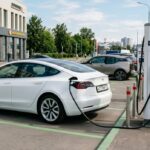
Quick summary: buying a used EV (2026)
Global EV sales are on track to hit roughly 23–25 million units in 2026, around 27–28% of all new cars sold — and as the fleet ages, the used-EV market is deeper and more varied than at any point before. The core buying question hasn’t changed: battery health, not mileage alone, determines whether a used EV is a bargain or a liability.
🔋 Battery State of Health (SoH)
- Green zone: 85–100% — a solid buy.
- Yellow zone: 75–84% — negotiate on price.
- Red zone: below 70% — high risk of a costly pack replacement soon.
❄️ Cold-weather factor
- Real-world range can drop noticeably in freezing temperatures, especially without a heat pump.
- Models with an active heat pump (many Teslas, newer Hyundai/Kia EVs, some Chinese-market EVs) handle cold far better than older passively-cooled designs.
The used-EV market has matured a lot since the early adopter years. According to the International Energy Agency’s Global EV Outlook 2026, global electric car sales are projected to reach around 23 million units this year, close to 28% of the total car market, with China, Europe and a fast-growing group of emerging markets (Southeast Asia, Latin America) all contributing. As millions of EVs sold three to five years ago come off lease or change hands for the first time, buyers now have far more choice — and far more variation in battery condition — than they did just a few years back. Is a used electric car still a smart buy in 2026? Here’s what actually matters.

⚡ Why the used-EV market keeps growing
Incentives vary a lot by country — check yours. In the United States, the federal EV tax credit ended in late 2025, so buyers there can no longer count on a federal discount and should check for remaining state- or utility-level incentives instead. In the European Union, several countries reinstated or expanded purchase subsidies in 2026, which contributed to record BEV sales in markets like the UK, France and Italy. Many countries also offer non-cash perks — reduced registration fees, free or discounted parking, and access to bus/HOV lanes — that are usually easier to keep for used-EV buyers than purchase subsidies, which are often new-car-only. Rules differ enough by country and even by city that it’s worth checking your local transport authority’s site directly rather than assuming a global default.
Charging infrastructure is expanding faster than the car parc. The IEA estimates the world added close to 1.8 million new public charging points in 2025, pushing the global public network past 7 million stations, alongside more than 43 million private (home/workplace) chargers. Growth is strongest in China and Europe — the Netherlands, Germany and France each passed 150,000+ public points — while North America’s buildout has been slower and more uneven amid funding disruptions. Practically, this means charging is now a non-issue in most cities worldwide, but rural and long-distance coverage still varies enormously by region, so route-planning still matters for road trips.
Fuel-price volatility keeps the EV math attractive, if unpredictable. U.S. regular gasoline averaged around $4.06 per gallon nationally in early August 2026, according to AAA — up sharply from roughly $2.80–3.90 earlier in the year amid Middle East-related crude price swings, with strong regional variation (from around $3.30 in parts of the Midwest to over $5.60 in California). Home electricity for charging remains cheaper than gasoline in most markets even during price spikes, though the exact savings depend heavily on local electricity rates and how often you rely on public fast charging, which typically costs several times more than charging at home.
✅ Pros of buying a used EV
1. Meaningful savings over new
Depreciation on EVs has been steep, and that works in a used buyer’s favor. As one concrete example: in the U.S., a 2026 Nissan Leaf starts around $30,000–31,500 new, while a 2018–2019 Leaf (an earlier, shorter-range generation) typically retails in the roughly $4,700–10,000 range depending on trim, battery pack size and condition. A 2026 Tesla Model 3 starts near $37,000–38,400 new; used 2019–2021 Model 3s have recently traded in the high-teens to low-$30,000s, with the broader used-Model-3 market averaging in the mid-$20,000s in early 2026. Prices outside the U.S. — and for brands not sold there, like BYD or Zeekr — follow different curves entirely, so treat these as illustrative rather than universal.
2. Low running costs
No engine oil, timing belt, spark plugs or transmission fluid to change — routine maintenance is mostly limited to tires, brakes (which last longer thanks to regenerative braking) and occasional coolant service for the battery and motor. Home charging is consistently cheaper per mile/km than gasoline in most markets, though the margin narrows wherever electricity is expensive or you rely heavily on public fast chargers.
3. Fewer moving parts, generally simpler mechanically
Electric drivetrains have far fewer moving parts than a combustion engine and transmission, which tends to reduce the number of things that can mechanically fail. Regenerative braking also reduces wear on brake components. That said, reliability varies significantly by model and generation — this is a general mechanical advantage, not a guarantee for every EV, and it’s worth checking model-specific reliability data (e.g., from Consumer Reports or J.D. Power) before buying a particular car.
4. Mature tech, sometimes still improving
Many used EVs from 2020 onward already come with driver-assistance features (adaptive cruise, lane-keeping) as standard, and some — Tesla in particular — continue to receive over-the-air software updates years after purchase, occasionally adding functionality that wasn’t there at delivery.
⚠️ Cons of buying a used EV
1. Battery degradation is the central risk
The traction battery is the most expensive component in the car, and its condition varies enormously between individual vehicles of the same year and mileage. Older passively-cooled designs (early Nissan Leaf generations, in particular) tend to degrade faster than actively thermal-managed packs (Tesla, most 2022+ Chinese and Korean EVs). Replacement costs vary widely by model: for example, a Leaf 40 kWh pack has run roughly $6,500–8,500, a 62 kWh pack roughly $8,500–11,000, and newer, larger packs can run well into five figures. Always check State of Health (SoH) — ideally 80% or higher — before buying, and don’t assume model year alone tells you the real story.
2. Cold-weather range loss
Range can drop noticeably in freezing conditions, more so on vehicles without an active heat pump. Older models (pre-2018 in many markets) may also lack support for newer, faster charging standards, which can limit their usefulness on public fast-charging networks going forward.
3. Regional gaps in parts and service
Certified high-voltage service isn’t universally available yet, and parts availability for less common brands can vary a lot by region — a Chinese EV that’s mainstream in Southeast Asia or Latin America may be a rarer, harder-to-service import elsewhere. Insurance costs can also run higher for EVs in some markets due to battery replacement costs.
4. Charging dependency
Despite rapid infrastructure growth, coverage is still uneven outside major cities in many countries. Long trips in regions with sparse fast-charging networks require more planning than a comparable gasoline car would.
🔍 How to evaluate a used EV before buying
- Check battery State of Health (SoH) — via the manufacturer’s app, a tool like LeafSpy for Nissan, or a professional diagnostic. Treat anything below ~80% as a negotiating point, not a dealbreaker in itself.
- Review the charging history if available — heavy, habitual use of DC fast charging accelerates wear more than home AC charging.
- Get a full electronic diagnostic of the inverter, motor, onboard charger and high-voltage cabling from a certified EV technician, not just a general mechanic.
- Confirm the charging standard matches your region’s infrastructure (CCS in the US/Europe, CHAdeMO on older Japanese imports, GB/T in China, NACS increasingly common on newer North American models).
- Inspect the underbody for corrosion or impact damage around the battery pack, and test-drive in cold-start conditions if possible.
- Check remaining battery warranty — many EVs carry an 8-year/100,000-mile (or similar) battery warranty that transfers to a new owner and can be worth thousands of dollars in protection.
⚙️ Reference points: what used EVs cost right now
| Model | Approx. used price (2026) | Rated range | Notes |
|---|---|---|---|
| Nissan Leaf (2018–2019, Gen 2) | ≈ $4,700–10,000 (US retail) | 151–215 mi (243–346 km) | Passively-cooled battery; check SoH carefully, especially cars from hot climates. |
| Tesla Model 3 (2019–2021) | ≈ $18,000–30,000+ (US retail, varies by trim/mileage) | 250–322 mi (400–520 km) | Active thermal management; battery health check still recommended. |
| BYD Dolphin / Atto 3 (2022–2023) | Not sold new in the US; strong used availability in Europe, LatAm and Southeast Asia | ~260–260 km (WLTP, varies by market) | Check local pricing directly — no reliable single-currency benchmark. |
| Hyundai Kona Electric / Kia Niro EV (2020–2022) | Widely available globally; typically well below new-model pricing | ~240–290 mi (385–465 km) | Active thermal management as standard; solid reliability track record. |
U.S. dollar figures reference U.S. retail listings (Consumer Reports, Kelley Blue Book) as of mid-2026 and are meant as an illustrative benchmark, not a global price guide — local taxes, import duties and market conditions shift these substantially outside the US.
💡 When a used EV makes sense — and when it doesn’t
Good fit if: most of your driving is local/urban, you have reliable access to charging at home or work, and you can store the car somewhere sheltered in cold climates.
Think twice if: you live somewhere cold with limited charging infrastructure, you regularly drive long distances through areas with sparse fast-charging networks, or you’re not prepared to budget for a possible battery-related repair down the line.
❓ FAQ
- How long does an EV battery typically last? Roughly 8–10 years or 100,000–190,000 miles (160,000–300,000 km) before noticeable capacity loss, though this varies a lot by whether the pack has active thermal management.
- How much does battery replacement cost? It varies widely by model and pack size — from a few thousand dollars for older, smaller packs up to well over $10,000 for larger, newer ones. Get a model-specific quote rather than assuming a flat figure.
- Does fast charging damage the battery? Frequent DC fast charging accelerates wear more than home AC charging. Occasional fast charging on a road trip is fine; using it as your everyday charging method is not ideal long-term.
- Do EVs really lose range in winter? Yes — expect a real-world drop, more pronounced without an active heat pump. Preconditioning while plugged in and garage storage both help.
- Are there still tax credits or subsidies for buying an EV in 2026? It depends entirely on your country — the U.S. federal credit ended in 2025, while some European countries expanded incentives in 2026. Always check your local/national program directly rather than assuming a fixed number.
- Is a Chinese-brand EV (BYD, Zeekr, etc.) a safe used buy? These brands have a large and growing global footprint, but service and parts availability still depends heavily on your specific market — check local dealer/service network coverage before buying, not just the badge’s global sales numbers.
- What’s the single most important check before buying? Battery State of Health, verified through diagnostics — not the odometer reading or model year alone.
🧭 Bottom line
The used-EV market in 2026 is bigger, more diverse and better documented than it was even two or three years ago, and infrastructure has genuinely caught up in most urban markets worldwide. That said, the fundamentals of buying one haven’t changed: the badge and the model year tell you far less than an actual battery health check does. Do that check, be realistic about your climate and charging access, and a used EV can be one of the more cost-effective ways into electric driving.
📚 Sources
- IEA — Global EV Outlook 2026, Executive Summary: iea.org
- IEA — Global EV Outlook 2026, Electric vehicle charging: iea.org
- BloombergNEF — Electric Vehicle Outlook 2026: about.bnef.com
- Reuters (via MarketScreener) — Global EV sales growth outlook, Jan 2026: marketscreener.com
- AAA — national and state gas price data, 2026: gasprices.aaa.com
- Consumer Reports — Nissan Leaf pricing by model year: consumerreports.org
- Kelley Blue Book — 2026 Nissan Leaf and Tesla Model 3 pricing: kbb.com, kbb.com
- Recharged — used Tesla Model 3 and Nissan Leaf pricing guides, 2026: recharged.com, recharged.com
- Findmyelectric — Nissan Leaf battery replacement cost breakdown: findmyelectric.com
Figures reflect available data as of August 2026 and are meant as directional benchmarks. Pricing, incentives and infrastructure availability vary significantly by country — verify local numbers before making a purchase decision.