Author: Automotive expert specializing in Chinese vehicles, with hands-on experience in diagnostics, maintenance, and real-world operation of ICE, hybrid, and electric models.
avtomir.site Editorial Team · Updated August 2026
Regenerative braking is the system that lets an electric or hybrid car’s motor act as a generator during deceleration, converting part of the vehicle’s kinetic energy back into electricity instead of losing it all as heat in the brake pads. It’s one of the defining efficiency features of modern EVs and hybrids — but a lot of the numbers repeated online about it (range gains, brake dust reduction, pad life) are quoted without their source, or rounded into round-sounding claims. This guide sticks to figures that come from published engineering studies, manufacturer technical material, or industry reporting, with links so you can check them yourself.
In a conventional car, pressing the brake pedal forces friction pads against a disc or drum, and the kinetic energy of the moving car is converted entirely into heat, which simply radiates away. In an EV or hybrid, the traction motor can be run in reverse as a generator during deceleration. Instead of just slowing the wheels, this generates current that is routed back into the battery.
Because a battery can only accept current within certain limits, cars use brake blending: an electronic control unit decides, moment to moment, how much of the requested braking force can come from the motor-generator and how much still needs the hydraulic friction brakes — for example near a full stop, when the battery is nearly full, or when the driver demands very hard braking.
How much energy does it actually recover?
This is the figure most often exaggerated. There is no single universal percentage — it depends on the measurement boundary (wheel-to-battery vs. full round-trip), motor type, software calibration, and driving style. Published research gives a wide but honest range:
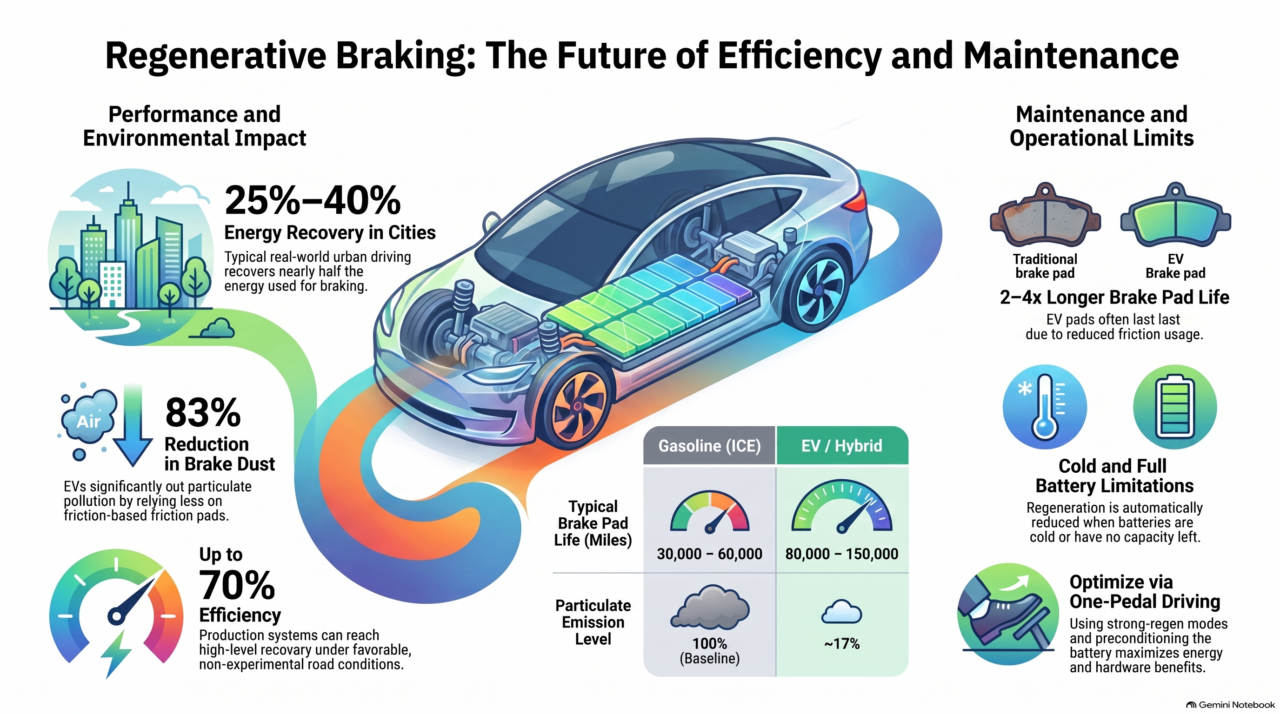
A 2024 engineering review found that in real-world urban driving, EVs typically recover 25–40% of the energy used for braking, since a large share of braking events happen at very low speed where regeneration is least effective.
Component manufacturers commonly cite up to 70% kinetic-energy recovery under favorable conditions as a rough industry figure for production systems.
Experimental systems that pair the motor-generator with supercapacitors for faster energy capture have demonstrated recovery rates as high as 92.5% in lab testing — well above what current mass-production hardware achieves on the road.
In short: expect meaningfully less than 100% recovery in everyday driving, with the top end of the range reserved for ideal conditions and the newest hardware, not a number every EV owner will see every day.
⚠ Why “range gain from regen” is hard to pin down as a single percentage Energy recovered during braking and the resulting increase in driving range are related but different metrics — recovered energy still has to pass back through charging and discharging losses, and the benefit is concentrated in stop-and-go city driving rather than sustained highway cruising. We have not found a rigorously sourced, vehicle-agnostic “X% more range” figure that holds across models and conditions, so we’re not repeating one here. If you’re comparing a specific model, check that manufacturer’s own city vs. highway range figures rather than a generic percentage.
Brake pad and rotor life
This is one of the better-documented real-world benefits. Because the motor handles most everyday deceleration, friction pads see far less use:
Vehicle type
Typical brake pad life
Gasoline (ICE) vehicle
~30,000–60,000 miles (roughly 48,000–97,000 km)
EV with regenerative braking
~80,000–150,000 miles (roughly 129,000–241,000 km), sometimes the life of the vehicle
That works out to roughly 2–4x longer pad life in typical use — a figure repeated consistently across independent automotive-service sources, though it depends heavily on driving style and whether the driver actually uses strong regen or one-pedal driving modes. A caveat worth knowing: because friction brakes are used so rarely, EV rotors are more prone to surface rust and corrosion in humid or salted-road climates, which can force earlier rotor service even when the pads themselves are barely worn.
Brake dust and air quality
Brake dust is a real, measurable source of urban particulate pollution, separate from tailpipe emissions. A 2025 study by EIT Urban Mobility, covering London, Milan, and Barcelona, found that battery-electric vehicles cut brake-dust emissions by roughly 83% compared with gasoline cars, with hybrids and plug-in hybrids showing smaller but still meaningful reductions. A separate UK Department for Transport-commissioned study by Ricardo reached a broadly consistent conclusion, measuring EV brake particulate output at roughly a third to a half of ICE-vehicle levels and confirming that regenerative braking’s benefit outweighs the effect of EVs’ extra battery weight. A peer-reviewed simulation study published in 2023 put the potential reduction in brake-wear particulate matter even higher, at 64–95% depending on vehicle class and driving style.
🚗 Special Deals & Discounts
Latest prices on vehicles, spare parts and dealer promotions.
Regenerative braking is genuinely weaker in two common situations, and this is well documented by manufacturers and independent service sources rather than being a myth:
Cold battery: lithium-ion cells have higher internal resistance when cold and can’t safely accept large charging currents, so the car automatically reduces regen and leans more on friction brakes until the pack warms up.
Near-full battery: if the battery has little spare capacity, there’s nowhere for recovered energy to go, so regen is tapered or disabled — this is why a “regenerative braking reduced” message often appears right after a full charge or on a cold morning.
Preconditioning the battery (warming it while still plugged in) is a widely recommended way to restore more regen capability sooner in cold weather, though the exact amount of range or braking power restored varies by vehicle and is not something we can responsibly reduce to one universal number.
Pros and cons
Pros
Cons
Recovers energy otherwise lost as heat
Recovery rate varies widely; not a fixed guaranteed percentage
Substantially longer brake pad and rotor life in typical use
Reduced effectiveness when the battery is cold or nearly full
Friction brakes still required for full stops and emergencies
Enables one-pedal driving for smoother, lower-effort city driving
Rotors can corrode from under-use in humid/salted climates
📩 A note on real-world owner experience We deliberately have not included invented owner quotes or “expert technician” anecdotes in this article — the specific mileage, city, and cost figures that often circulate in regen-braking articles online cannot be verified and shouldn’t be treated as fact. If you own an EV or hybrid and want to share your own documented experience with regenerative braking (with a link to your own writeup, forum post, or logbook), we’re happy to reference it here with proper attribution.
Getting the most out of it
Use one-pedal or strong-regen modes where available — most of the pad-life and energy benefit comes from actually using stronger regen settings, not just having the hardware.
Precondition the battery in cold weather, ideally while still connected to a charger, so regen availability recovers sooner into the drive.
Don’t expect much benefit from regen on sustained highway driving — the technology is most valuable in stop-and-go city traffic, where braking events are frequent.
Still get brakes inspected on schedule — reduced pad wear doesn’t mean rotors, calipers, and brake fluid can be ignored, particularly in humid or winter climates.
Frequently Asked Questions
No. Friction brakes are still required for full stops, emergency braking, and holding the car in place, and the two systems work together through electronic brake blending.
Published studies put real-world urban recovery around 25–40% of braking energy, with up to roughly 70% cited for production systems under favorable conditions and over 90% shown only in experimental lab hardware.
Yes — this is one of the most consistently documented benefits. EV brake pads commonly last 80,000–150,000 miles versus 30,000–60,000 miles on a comparable gasoline car, roughly 2–4 times longer.
Cold battery cells have higher internal resistance and can’t safely accept large charging currents, so the car automatically reduces regen strength and relies more on friction brakes until the battery warms up.
Yes, indirectly: by cutting reliance on friction brakes, it substantially reduces brake-dust particulate emissions — a 2025 European study measured an 83% reduction for battery-electric vehicles versus gasoline cars.
Most EVs let you choose between regen strength levels, and some allow a low or near-off setting for a more conventional coasting feel, though this typically reduces energy recovery and pad-life benefits.
All figures above are attributed to the specific study or source that produced them; where sources disagreed or a commonly repeated number could not be traced to a credible study, we noted the disagreement or omitted the figure rather than presenting a single unverified number as fact. Last verified August 2026.
🔧 Need car repair or diagnostics?
Discounts on maintenance, diagnostics, and spare parts for Chinese cars at official dealers and trusted services.