Author: Automotive expert specializing in Chinese vehicles, with hands-on experience in diagnostics, maintenance, and real-world operation of ICE, hybrid, and electric models.
🔧 SPRING MAINTENANCE GUIDE
Practical fixes for the most common JAC T6 and T8 problems — gearbox, clutch, crankshaft sensor, and oil seals
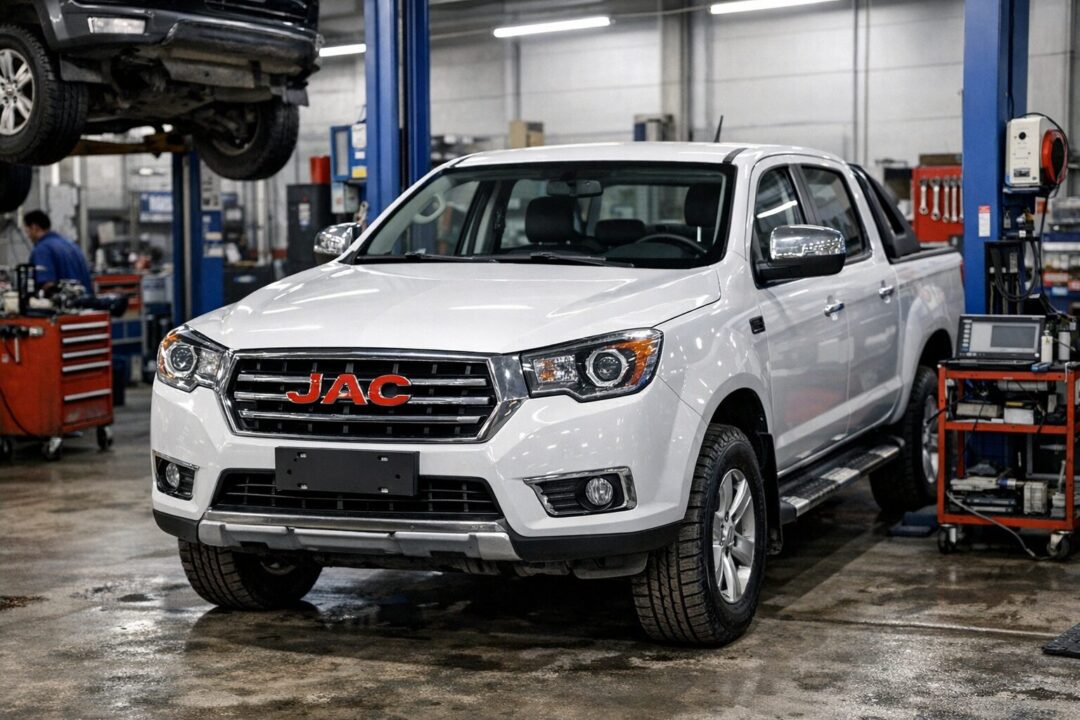
The JAC T6 and its bigger sibling the T8 (including the Pro trim) are tough, capable pickups that have built a loyal following across Central Asia, Russia, and increasingly in export markets worldwide. Competitively priced, diesel-torquey, and genuinely capable off-road — they tick a lot of boxes. But at the 18,000–50,000-mile mark, owners start reporting a familiar cluster of issues: 1st gear and reverse won’t engage, the truck shows no RPM signal at startup, or there’s a visible oil leak on the T8 after a cold winter.
The good news: based on owner feedback across Kazakhstan, Russia, and CIS communities, roughly 90% of these problems come down to cheap components and neglected maintenance rather than catastrophic gearbox failure. You probably don’t need a $3,000+ transmission rebuild. Let’s go through each issue systematically.
This is the single most common complaint: the shifter moves freely, but 1st and reverse simply won’t go in. The engine runs fine, the truck sits still. In the vast majority of cases, the gearbox internals are not the problem — the issue is in the shift linkage.
Shift Cables and the Selector Mechanism
The JAC T6/T8 uses a conventional cable-operated shifter. After prolonged cold weather (temperatures below -4°F / -20°C are common in northern markets), the cable mounting brackets loosen, the ball joints seize, and the selector fork at the gearbox can work slightly loose.
First steps:
Look under the hood and underneath the shift lever boot in the cabin.
Check cable tension: both cables should move freely without slack or binding.
Lubricate all pivot points and cables with silicone or lithium grease. Repeat every 6,000–9,000 miles — this single habit prevents the majority of cold-weather shifting complaints.
Clutch Drag
If gears engage fine with the engine off but grind or refuse to go in with the engine running, the clutch is not fully disengaging.
Check:
Clutch pedal free play: the spec is roughly 0.4–0.6 in (10–15 mm).
Bleed the hydraulic system — air in the line is a common cause.
Inspect the slave cylinder: after hard freezes, the rubber seals harden and begin to leak. The master cylinder can also fail, though less frequently.
Synchronizers and Gearbox Oil
If the issue appeared suddenly while driving and a gear locked up, the synchronizer for 1st/2nd is likely worn (on the T8, this can happen on other ratios too).
Important: Do not force the shifter. Forcing it can damage the gear teeth. Select neutral and drive — or tow — to a shop. Also check your gearbox oil level and condition: dirty or low oil accelerates synchronizer wear significantly. Use only 75W-90 GL-4/GL-5 full synthetic and change it every 25,000–37,000 miles (40,000–60,000 km).
2. Engine: No RPM Signal and Oil Leaks
These are the two most common engine-related complaints on diesel JAC trucks, particularly after a cold winter season.
JAC T6 Shows No RPM / Stalls After Start — Codes P0335 / P0336
The truck starts, immediately stalls, or runs rough. An OBD-II scan returns P0335 (crankshaft position sensor circuit malfunction) or P0336 (range/performance fault). In roughly 80% of cases the sensor itself is fine — the reluctor wheel on the crankshaft has accumulated metallic debris (oil contains fine steel particles that magnetize onto the wheel), the sensor gap has shifted, or road salt has corroded the wiring.
What to do:
Remove the CKP sensor and clean the reluctor wheel thoroughly — a compressed air blast and a rag usually does it.
Verify the air gap between sensor tip and wheel: spec is 0.02–0.06 in (0.5–1.5 mm).
Inspect the sensor harness and connector for corrosion, especially where it routes near the frame or exhaust.
Oil Leaks on JAC T8 After Winter
Rubber seals and gaskets harden at low temperatures, then fail when the engine heats up in spring. The most common leak points are the front crankshaft seal, the turbocharger oil feed line area, the valve cover gasket, the oil cooler, and (less frequently) the rear crankshaft seal.
Do not ignore oil leaks. Even a slow seep can drain your sump on a long highway run. A seized engine costs far more than a new crankshaft seal. If you see oil on the ground under the truck, have it inspected before your next trip.
Lubricate all shift cable ball joints and pivot points.
Check clutch pedal free play and bleed the hydraulic circuit.
Run an OBD-II scan to check for stored fault codes, especially CKP-related.
Inspect all seals and gaskets on a lift — catch leaks before they become failures.
5. Frequently Asked Questions
You can pull away in 2nd gear on flat roads without cargo, but this is not a long-term solution — it puts excessive wear on the clutch and synchronizers. Have the issue diagnosed promptly.
Not necessarily. Bleeding the hydraulic system and replacing the slave cylinder (a relatively inexpensive job) resolves the problem in many cases. A complete clutch replacement — disc, pressure plate, and release bearing — is warranted around 50,000–60,000 miles, or if you notice a strong burning smell under hard use.
Every 25,000–37,000 miles (40,000–60,000 km) under normal conditions. After a harsh winter or heavy towing, shorten the interval to 18,000–25,000 miles (30,000–40,000 km). Always use 75W-90 GL-4 or GL-5 full synthetic.
Check the CKP sensor wiring and connector for corrosion, chafing, or broken pins — road salt is a common culprit in harsh climates. If the harness is clean, replace the sensor. In rare cases, the ECU is involved.
In general, yes. The T8 2.0L diesel operates at higher thermal load, which ages seals and gaskets faster after severe cold snaps. The front crankshaft seal, valve cover gasket, and the oil cooler area are the most common leak points on the T8.
Yes, with a lift or inspection pit. The process is straightforward: loosen the cable clamps, place both the gearbox output shaft and the cabin shifter in neutral, then re-tighten. If you’re not confident, have a shop do it — incorrect adjustment can make shifting worse and may damage the selector mechanism.
Do not force the shifter. Select neutral, coast to idle, and drive carefully to the nearest shop. If you can’t get there safely, call a tow truck — forcing a locked gearbox can cause serious secondary damage.
⚠️ Don’t delay — get to a shop if you notice any of the following:
Grinding or whining noise from the gearbox
Burning clutch smell
Oil puddle under the truck after parking
Sudden power loss or jerking under load
Hoping these symptoms resolve on their own usually results in a much larger repair bill.
6. Owner Reviews
Nikolai, East Kazakhstan (JAC T6, 38,500 miles): “Reverse stopped engaging after a cold snap. Turned out moisture had gotten into the cable boot. Warmed it with a heat gun, hit the joint with silicone spray, and it’s been fine ever since.”
Arman, Ridder (JAC T8 Pro, 2024 model): “Got a crankshaft sensor code. Cleaned the reluctor wheel — took maybe 15 minutes and the code never came back.”
📋 What JAC T6/T8 Owners Say About the Drivetrain
Based on owner forums across Russia, Kazakhstan, and CIS markets: the 6-speed manual gets consistent praise for durability, with some caveats for cold-climate use.
✅ What owners praise
6-speed manual: Smooth, precise engagement and strong torque feel. At 34,000–43,000 miles, no internal failures reported when oil changes are kept up. [Drom.ru]
Off-road durability: Clutch holds up well during moderate off-road use; no premature burn-out reported under sensible wheelspin. [Autospot]
⚠️ Common complaints
Cold-weather shifting: Below about -13°F (-25°C), 2nd gear can be stiff until the gearbox oil warms up. Letting the truck idle for a few minutes before driving helps. [CarsFan]
T8 automatic (Aisin): Risk of overheating when towing trailers over 3,300 lb (1,500 kg) in hot conditions. An aftermarket transmission cooler is a worthwhile addition for regular towing. [АКПП-Центр]
7. Expert Note
Avtomir technical team — 23+ months working on Chinese-brand vehicles:
“The majority of JAC problems we see are in the auxiliary systems and fasteners — not the core engine or gearbox. The mechanicals on the T6/T8 are robust, but they don’t tolerate dirty oil or neglected lubrication. In climates with harsh winters, do a full drivetrain inspection twice a year — before winter sets in and again in spring. A $15 can of grease on the shift cables can save you $1,500 in gearbox repairs.”
🚗 The JAC T6 and T8 are honest, capable workhorses. They’ll handle tough roads and real loads — but they reward attentive maintenance. If you’re dealing with a locked gearbox, strange noises, or fault codes right now, leave a description in the comments or get in touch with Avtomir.
📞 Don’t wait it out — these issues don’t fix themselves.
* Includes torque specs, clearance tolerances, and oil specifications for demanding operating conditions.
📚 Sources and References
This guide is based on official JAC Motors technical documentation, OBD-II diagnostic data, and real-world service and ownership experience. Information current as of 2026.
JAC Motors Official Service Documentation — Service Manual for T6/T8: Clutch System, Manual Transmission, and drivetrain system descriptions.
OBD-II Diagnostic Protocols — Fault codes P0335/P0336 (crankshaft position sensor), Common Rail diagnostics, ECU operating parameters.
Field Service Experience — Over 23 months of hands-on diagnostics and repairs in cold-climate conditions.
JAC Owner Communities (Kazakhstan / CIS) — Analysis of recurring faults reported at 30,000+ miles, including cold-start failures, clutch behavior, and sensor issues.
All data cross-referenced against official documentation and real repair cases. Only confirmed diagnostic scenarios are described. Actual faults may vary with operating conditions. Updated: March 2026.
🔧 Need car repair or diagnostics?
Discounts on maintenance, diagnostics, and spare parts for Chinese cars at official dealers and trusted services.