Author: Automotive expert specializing in Chinese vehicles, with hands-on experience in diagnostics, maintenance, and real-world operation of ICE, hybrid, and electric models.
avtomir.site Editorial Team · updated: September 2026
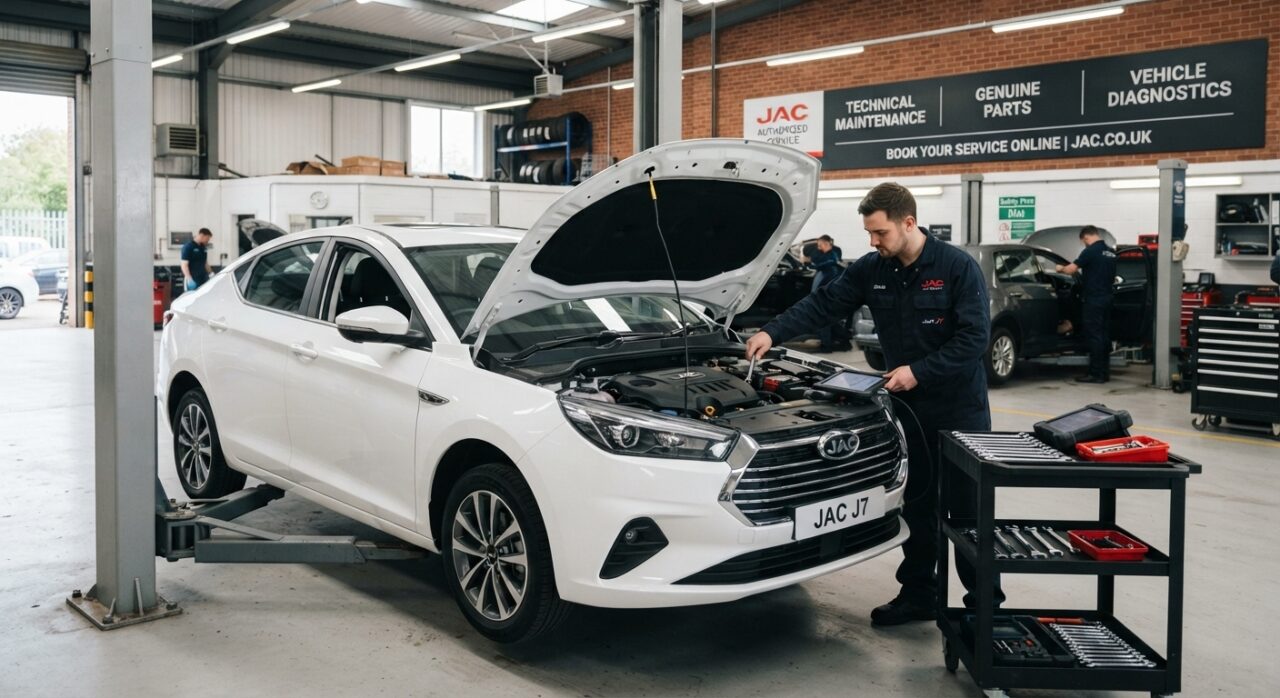
The JAC J7 — sold in different markets under related names such as JAC J7, JAC J7 Plus, or Sehol/JAC A5 — carries a large number of electronic systems, so a Check Engine light, a transmission warning, an ABS warning, or another system alert can leave a diagnostic trouble code (DTC) stored in the car’s memory.
This guide covers the most common fault codes you’re likely to see when diagnosing the J7’s engine, CVT transmission, ABS, electronic throttle, turbo boost system, sensors, and CAN bus.
Important. There is no single code list that matches every JAC J7 worldwide. The exact codes present depend on model year, market, engine, transmission, and electronic-module software version. Generic codes (P0xxx/C0xxx/U0xxx) are defined by a shared industry standard (SAE J2012 / ISO 15031-6) and read the same across every make. Manufacturer-specific codes (P1xxx, and some Bxxx/Cxxx codes) are a different story — their meaning can vary even between models from the same maker, so always cross-check them against JAC’s own service documentation or a dealer-level scan tool rather than a generic database.
P0700 — the engine control module received a message about a transmission control system fault.
A single code doesn’t always point to one specific broken part. P0700, for instance, doesn’t necessarily mean the CVT itself has failed — it only tells you the engine module received a fault request from the transmission module asking it to turn on the warning light. To find the actual cause, you need to pull the additional codes stored directly in the TCM (transmission control module).
Engine Fault Codes (1.5T)
Across the markets where it’s sold, the JAC J7 uses a turbocharged 1.5-liter petrol engine (commonly rated around 148 hp / 110 kW in export markets), paired with either a 6-speed manual or a CVT depending on trim and region — so a meaningful share of its diagnostic codes relate to fuel injection, ignition, engine sensors, boost, and air-fuel mixture. The codes below are standard generic OBD-II codes defined by the industry standard and are not brand-specific.
Possible causes: a dirty sensor, an air leak downstream of the sensor, wiring damage, a poor connector contact, a failed MAF sensor itself, or a sensor power-supply issue.
🚗 Special Deals & Discounts
Latest prices on vehicles, spare parts and dealer promotions.
Symptoms: weaker acceleration, rough idle, higher fuel consumption, or the engine entering a limited (limp) mode.
Don’t replace the sensor right away — first check the connector, the wiring, look for air leaks, and read the actual MAF values with a scan tool.
P0115–P0119 — Coolant Temperature Sensor
Code
Meaning
P0115
Coolant temperature sensor circuit malfunction
P0116
Signal range/performance problem
P0117
Signal too low
P0118
Signal too high
P0119
Signal intermittent
If the control module receives incorrect coolant-temperature data, it can affect starting behavior, fuel mixture, fan operation, and fuel economy. Possible causes: a failed sensor, a damaged connector, an open/short in the wiring, power-supply issues, or a poor contact.
P0120–P0124 — Throttle Position / Pedal Position
Code
Meaning
P0120
Throttle position sensor circuit malfunction
P0121
Signal range/performance problem
P0122
Signal too low
P0123
Signal too high
P0124
Signal intermittent
Codes in the P0220–P0229 range, related to the accelerator pedal position sensors, can also appear alongside these. With these faults present, the car may respond poorly to the accelerator, lose power, have its revs limited, or enter a fail-safe mode. Don’t just clear the code — check the actual pedal-position and throttle-position values first.
P0171 — System Too Lean
Possible causes: an air leak, an unsealed intake system, clogged injectors, insufficient fuel pressure, MAF/MAP problems, a leaking crankcase ventilation system, or a failed oxygen sensor.
Symptoms: hard starting, rough idle, loss of power, higher fuel consumption, or hesitation under acceleration.
The most common mistake with P0171 is replacing the oxygen sensor right away. First confirm whether the mixture is actually lean, and why.
P0172 — System Too Rich
Main causes: a faulty injector, excessive fuel pressure, incorrect MAF/MAP readings, a failed temperature sensor, crankcase ventilation issues, or a failed oxygen sensor. If this code appears together with misfires, also check the spark plugs and ignition coils.
P0300–P0304 — Misfire Codes
Code
Meaning
P0300
Random/multiple cylinder misfire detected
P0301
Cylinder 1 misfire
P0302
Cylinder 2 misfire
P0303
Cylinder 3 misfire
P0304
Cylinder 4 misfire
Avoid continued hard driving with a strong, noticeable misfire: unburned fuel can pass into the exhaust system and overheat the catalytic converter.
What to check: spark plugs, ignition coils, injectors, fuel pressure, compression, air leaks, wiring, and general engine condition. If code P0301 “moves” to a different cylinder after you swap that coil to another cylinder, that’s a strong sign the coil itself is at fault.
Turbo/Boost System Codes
The turbocharged engine relies on boost-pressure sensors and a turbine control system.
Code
Meaning
P0234
Turbo/supercharger overboost condition
P0235
Boost pressure sensor circuit malfunction
P0236
Boost pressure sensor signal implausible
P0237
Boost pressure sensor signal too low
P0238
Boost pressure sensor signal too high
P0240–P0242
Boost sensor “B” circuit/signal faults
Possible causes: a damaged intake hose, an unsealed intake, a failed MAP sensor, wastegate/actuator control problems, wiring damage, software faults, or issues with the boost-control strategy. A boost-related code doesn’t automatically mean the turbo needs replacing — first check actual vs. commanded pressure, hoses, sensors, and actuator control.
Oxygen Sensor Codes
Depending on engine version and diagnostic system, codes in the P0130–P0167 range may appear — these relate to the oxygen sensors, their circuits, heaters, and signals.
Possible causes: a failed sensor, wiring damage, a failed heater element, an air leak, fuel-system issues, or a failed catalytic converter.
Note that an oxygen sensor is often a symptom rather than a root cause — for example, misfires can throw off oxygen sensor readings on their own.
EVAP System Codes
The EVAP system controls fuel vapor. Possible codes include P0440, P0441, P0442, P0455, and P0456 — these can point to leaks or control problems in the fuel vapor capture system.
What to check: the fuel filler cap, hoses, the purge valve, system connections, wiring, and overall system sealing. With small leaks, the car may run perfectly normally while the Check Engine light stays on.
CVT (Continuously Variable Transmission) Codes
This is one of the most important parts of diagnosing a J7 — but only on CVT-equipped cars. Some markets and trims offer the J7 with a 6-speed manual gearbox instead, in which case none of the codes in this section apply. On CVT models, faults typically involve fluid pressure, temperature, speed sensors, solenoids, and the transmission control module. The codes below are standard generic P07xx/P08xx OBD-II definitions and apply, in principle, to any car with an electronically controlled CVT/automatic transmission, including the J7.
Applicability disclaimer. We were unable to locate a publicly published, JAC-specific DTC table for the J7’s CVT. Some online sources for other makes misattribute manufacturer-specific P1xxx codes across brands — for example, part of the P1xxx “governor pressure sensor” and “12V supply relay control” code family actually belongs to Chrysler/Jeep transmissions, not JAC’s CVT. For that reason, this section lists only generic P07xx/P08xx codes and does not publish a table of brand-specific P1xxx codes without confirmation from JAC’s own service documentation. For an exact reading of any P1xxx code on your specific J7, contact an authorized JAC dealer with dealer-level scan equipment.
P0700 — Transmission Control System Malfunction (general)
P0700 simply reports that there’s a problem somewhere in the transmission control system. It isn’t a final diagnosis — to find the actual cause you need to pull the additional codes stored directly in the TCM.
P0710 — Transmission Fluid Temperature Sensor
P0710 indicates a circuit fault in the transmission fluid temperature sensor. Since fluid temperature is used by the transmission control strategy, this code matters for CVT diagnosis.
Possible causes: a failed sensor, wiring damage, a poor contact, a control-module issue, or a genuine CVT temperature problem.
P0730–P0736 — Incorrect Gear Ratio
This group covers a mismatch between the expected and actual gear ratio.
Possible causes: clutch/belt slippage, insufficient pressure, transmission fluid problems, failed speed sensors, hydraulic faults, or electronic control faults. With these codes, it’s especially important to review live data rather than simply clearing the code.
P0740–P0749 — Transmission Control
Codes in this group can relate to solenoids, pressure control, and their electrical circuits. Depending on the exact code, check the solenoid, wiring, connector, pressure, fluid condition, and the CVT control module.
P0868 — Transmission Fluid Pressure Low
P0868 is a generic code meaning transmission fluid pressure is below the expected value. Across different makes with a CVT/automatic, this can range from a low or contaminated fluid level to a more serious pump or valve-body problem.
Possible causes: low fluid level, incorrect fluid type, contamination, a pump problem, a failed valve body, or an internal transmission fault.
Don’t authorize a transmission replacement based on P0868 alone. A full check of fluid pressure and fluid condition should come first.
P0811 — Clutch Slippage
A generic code indicating slippage of a friction element inside the transmission. Diagnosis typically involves checking fluid level and type, performing a relearn/adaptation procedure on the control module, and, if needed, inspecting the valve body.
Why a JAC J7 Might Jerk or Hesitate Under Acceleration
Jerky acceleration doesn’t necessarily mean the CVT has failed mechanically. If you’re dealing with hesitation or jerkiness on acceleration, check: engine codes, TCM codes, CVT temperature, fluid pressure, fluid condition, speed sensor readings, adaptation values, and the transmission control module’s software version. We haven’t found verified, publicly linkable owner case studies for the J7 describing a confirmed root cause for this symptom — if you have a link to a documented real-world case (forum thread, owner blog), share it in the comments and we’ll add it.
ABS Codes
Codes in the C0xxx range relate to the chassis and ABS/ESP systems.
Possible causes: a wheel speed sensor, wiring damage, a contaminated tone ring, a failed wheel bearing, ABS module issues, or a CAN communication fault.
CAN Bus Codes
Uxxxx codes deserve special attention — they point to communication problems between control modules.
Code
Possible meaning
U0100
Lost communication with the ECU/engine control module
U0121
Lost communication with the ABS module
U0140
Lost communication with the body control module (BCM)
U0155
Lost communication with the instrument cluster
U0001/U0002
High-speed CAN bus faults
For CAN-bus faults, avoid blindly replacing control modules. The real cause is often: a weak battery, a poor ground connection, a corroded connector, damaged wiring, a CAN High/CAN Low fault, a temporary voltage drop, or a genuinely failed module.
Why Several Fault Codes Can Appear at Once
This is a fairly common situation on modern cars. A weak battery or poor ground connection alone can trigger several messages at the same time: Check Engine, ABS, ESP, a transmission fault, and CAN errors. A high number of stored codes doesn’t necessarily mean there are that many separate faults.
Recommended check order: battery voltage → module power supply → grounds → CAN bus → then the individual systems.
Can You Just Clear a JAC J7 Fault Code?
Yes — a scan tool can erase stored DTCs. But clearing a code isn’t the same as fixing the problem: if the underlying cause is still there, the code will come back. Also, right after clearing codes, the diagnostic system may not have enough data yet to properly assess the status of some systems. It’s worth taking a test drive after clearing codes and rechecking module memory afterward.
How to Properly Diagnose a JAC J7
For a thorough diagnosis, use equipment that can read not just the engine module but the car’s other control modules too.
1. Read All Fault Codes
Don’t stop at the engine Check Engine code — check the ECU, TCU, ABS/ESP, BCM, and any other available modules.
2. Record Freeze Frame Data
If your scan tool supports Freeze Frame, save the parameters recorded at the moment the fault occurred: rpm, temperature, speed, load, voltage, pressure, and other values.
3. Check Live Data
For the engine: coolant temperature, MAF/MAP, throttle position, fuel trims, boost pressure, rpm, supply voltage.
For the CVT: fluid temperature, input/output shaft speed, pressure, commanded vs. actual values, solenoid states, and adaptation values.
4. Only Then Start Looking for the Faulty Part
A code points you toward a system, not always toward one specific part.
Summary Table of Generic JAC J7 Fault Codes
Code
System
What it means
What to check
P0100–P0104
Engine
MAF sensor circuit
MAF sensor, wiring, power supply
P0115–P0119
Engine
Coolant temperature sensor
Sensor, wiring
P0120–P0124
Engine
Throttle position sensor
Throttle body, connector
P0130–P0167
Engine
Oxygen sensors
Sensor, wiring, catalytic converter
P0171
Engine
Lean mixture
Air leaks, fuel supply, MAF/MAP
P0172
Engine
Rich mixture
Injectors, fuel pressure
P0234–P0242
Turbo
Boost pressure
Turbo, actuator, MAP sensor
P0300–P0304
Engine
Misfire
Spark plugs, coils, injectors
P0440–P0456
EVAP
Fuel vapor leak
Purge valve, hoses, seal integrity
P0700
CVT/TCM
Transmission fault requested
Read codes from TCM
P0710
CVT
Fluid temperature sensor
Sensor, wiring
P0730–P0736
CVT
Incorrect gear ratio
Pressure, speed sensors
P0868
CVT
Low transmission fluid pressure
Fluid, pump, valve body
P0811
CVT
Clutch slippage
Fluid, adaptation procedure
C-codes
Chassis
ABS/ESP
Wheel speed sensors, ABS module
U0100
CAN
Lost communication with ECU
CAN bus, power supply, ECU
U0121
CAN/ABS
Lost communication with ABS
CAN bus, ABS module
U0140
CAN/BCM
Lost communication with BCM
CAN bus, BCM
Which JAC J7 Fault Codes Are the Most Serious
Not every code means you need to stop the car immediately.
You can usually drive carefully to a service center with EVAP faults, minor sensor faults, or minor electronic system issues — though the car should still be diagnosed.
You should stop driving for: strong, persistent misfires; engine overheating; serious transmission faults; low oil pressure; CVT overheating; reduced braking effectiveness; ABS/ESP faults; a sudden loss of power; or hard shocks/slipping from the transmission.
What to Do When the Check Engine Light Comes On
Don’t panic. A Check Engine light by itself doesn’t mean the engine needs an overhaul.
Don’t clear the code before diagnosing. Save the fault information first.
Read codes from every available module — especially if engine and transmission warnings appeared together.
Check the battery and supply voltage. Low voltage alone can generate a large number of secondary codes.
Review live data. The same code can have very different root causes.
Fix the root cause first, then clear the code and re-run diagnostics.
An Important Note for JAC J7 Owners
If a scan tool shows a fault code, don’t buy a replacement part based on the code name alone. For example:
P0236 doesn’t necessarily mean the MAP sensor is bad;
P0171 doesn’t necessarily mean the oxygen sensor is bad;
P0700 doesn’t necessarily mean the CVT is broken;
U0121 doesn’t necessarily mean the ABS module is bad.
A diagnostic code is a starting point for troubleshooting, not a finished diagnosis.
Where to Find a JAC J7 Owner’s Manual
Owner’s manual availability depends on your local market — check with your regional JAC/Sehol distributor’s website first. As an example, JAC’s official Kazakhstan distributor publishes owner’s manuals for the J7 and other JAC models on its site (linked below, in Russian).
Summary
JAC J7 fault codes tell you which system has a problem: engine, fuel system, turbo, transmission, ABS, or the car’s electronic network. During diagnosis, it’s worth paying particular attention to these groups:
P0100–P0104 — air flow;
P0115–P0119 — engine temperature;
P0120–P0124 — throttle;
P0171/P0172 — fuel mixture;
P0234–P0242 — turbo boost;
P0300–P0304 — misfires;
P0440–P0456 — EVAP;
P0700–P08xx — transmission (CVT models only);
Cxxxx — ABS and chassis;
Uxxxx — CAN bus and inter-module communication.
The key rule: don’t treat a DTC as a finished diagnosis. It points you toward where to look. To pin down the actual cause, you need to weigh the car’s symptoms, Freeze Frame data, live parameters, and any additional codes from other modules.
If your JAC J7 has thrown a specific code — say, P0700, P0710, P0171, P0300, P0234, or P0868 — leave it in the comments and we can walk through the likely causes and diagnostic steps for that code.
Frequently Asked Questions
Can I just clear a fault code on a JAC J7 without fixing the cause?
Technically, yes — a scan tool can erase the stored DTC. But that isn’t a repair: if the underlying cause is still present, the code will come back, and for a while after clearing codes the system may not have enough data to properly assess some components. A test drive and a recheck of module memory afterward is recommended.
What does code P0700 mean on a JAC J7?
P0700 is a generic signal that the engine control module received a fault message from the transmission module. On its own it doesn’t indicate the CVT is broken — the actual cause is shown by additional codes read directly from the TCM.
Is it dangerous to keep driving with a P0868 CVT code?
P0868 points to reduced transmission fluid pressure. It’s a potentially serious code that calls for a prompt check of fluid level and condition, but it isn’t grounds to replace the transmission outright without first checking pressure and the valve body.
How should I properly diagnose a JAC J7 with the Check Engine light on?
Read codes from every available module (ECU, TCU, ABS/ESP, BCM), save Freeze Frame data, check live parameters and battery voltage, and only then start looking for the faulty component — the code points you toward where to look, not a finished diagnosis.
General (non-brand-specific) explanation of code P0868, “Transmission Fluid Pressure Low”: CarParts.com
Trade-press background on P0868-family codes on CVT platforms: Gears Magazine
Generic P0xxx/C0xxx/U0xxx codes follow the shared industry standard SAE J2012 / ISO 15031-6, common to every OBD-II-equipped make. Brand-specific P1xxx codes for the JAC J7 are intentionally not published in this article without confirmation from official JAC documentation — see the disclaimer in the CVT section above.
🔧 Need car repair or diagnostics?
Discounts on maintenance, diagnostics, and spare parts for Chinese cars at official dealers and trusted services.