Author: Automotive expert specializing in Chinese vehicles, with hands-on experience in diagnostics, maintenance, and real-world operation of ICE, hybrid, and electric models.
avtomir.site Editorial Team · Updated: October 17, 2026
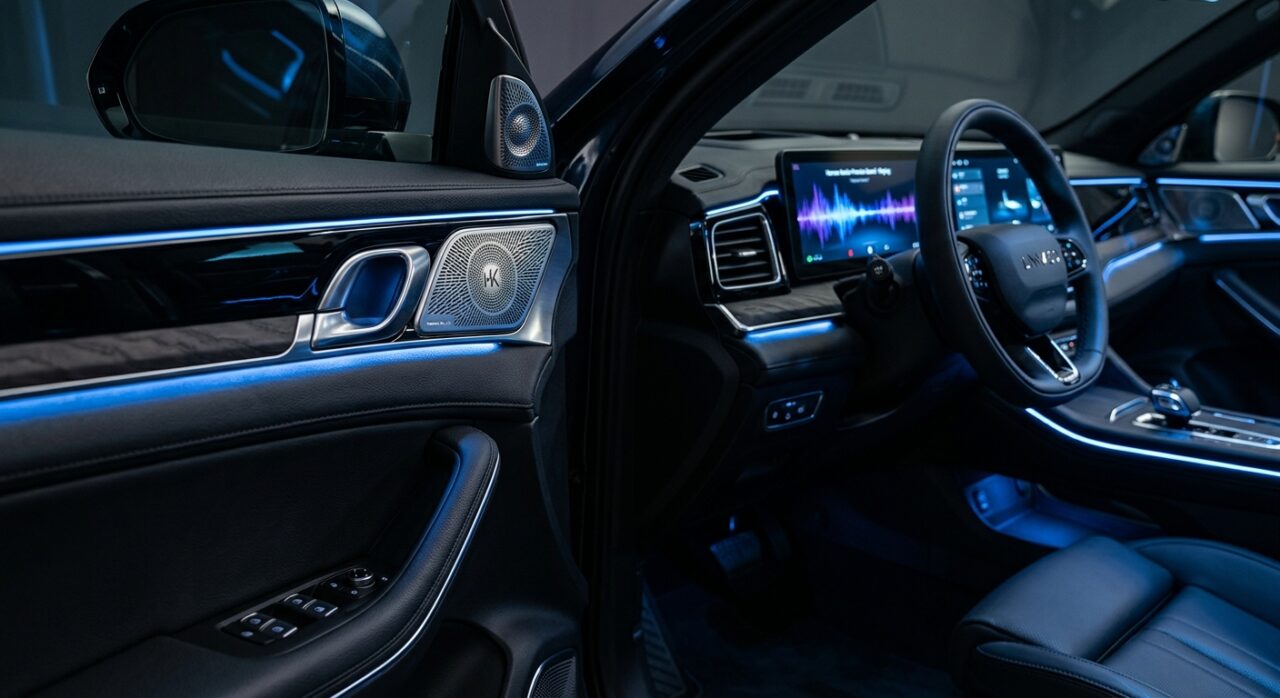
Chinese carmakers are advancing quickly well beyond engines, electronics and infotainment. They now pay real attention to acoustic comfort too, fitting large displays, multichannel audio systems and speakers with branded sound tuning. But a modern infotainment system does not automatically mean the music will actually sound good.
In some models the bass is deep and controlled and vocals sound natural. In others there is hardly any low end, the treble is harsh, and distortion creeps in at higher volume. The difference comes not only from the speakers, but also from the amplifier, the acoustic design of the doors, the software signal processing and the body’s sound insulation.
This article explains how factory audio works in Chinese cars, which problems come up most often, how systems differ between brands, and what you can do to improve the sound, from adjusting the equalizer to adding an external amplifier.
In short
Speaker count is not sound quality: the amplifier, processor tuning and the condition of the doors matter just as much.
The same model can have a different number of speakers and a different system depending on the country and trim level.
Upgrade in stages: settings, then source, then vibrations, then speakers, then amplifier and subwoofer.
Before buying, play familiar tracks at several volume levels and from different seats.
A modern audio system is not just a set of speakers wired to a stereo. It consists of several linked components, and the weakest link limits the result of the whole system.
The head unit. In most modern Chinese cars the role of the car stereo is played by a touchscreen infotainment system. It handles music playback, equalizer settings, smartphone connectivity and the audio signal itself.
Speakers. Depending on the trim, the cabin may use full-range, coaxial or component speakers, as well as separate tweeters, a center speaker and a subwoofer. The number of drivers alone does not determine sound quality: their specifications, placement and how well they are matched to the rest of the system are what count.
The amplifier. In basic systems the amplification is built into the head unit. Higher trims may use a separate multichannel amplifier, sometimes combined with a digital audio processor. For example, listings for the Changan UNI-K in the UAE show a Sony system with 12 speakers, including a headrest speaker, a center-channel speaker, a subwoofer and a power amplifier.[5][6]
🚗 Special Deals & Discounts
Latest prices on vehicles, spare parts and dealer promotions.
Digital sound processing. Software algorithms adjust tone, distribute sound between the speakers, correct time delays and compensate for the cabin’s acoustics. Poor factory tuning can hold the bass back or make the treble overly prominent.
Cabin acoustics. Doors, trim panels, seals and sound-deadening materials all affect how the speakers perform. Even good drivers sound mediocre if a door panel resonates or the door shell is not rigid enough.
What “N speakers” really means: examples from real trims
Manufacturers like to quote the speaker count, but that number says little about quality. It is telling how much systems differ even within a single model range. Below are examples from public sources. The data refers to specific markets and trims and may change with the model year.
12-speaker Infinity system with headrest speakers[7]
UAE
BYD Seal
Dynaudio, 12 speakers, subwoofer, 775 W stated system power[8]
New Zealand
This table is not a ranking. The sources contain no comparative sound measurements, so it cannot tell you which system is “better”. It only shows that equipment depends on the market and the trim level.
The main takeaway: before comparing cars by their audio specifications, confirm the equipment of the exact trim you are being offered, with an official dealer in your own country.
Why factory speakers can sound mediocre
Poor sound does not necessarily mean the manufacturer fitted low-quality speakers. The cause can lie in the settings or in the design of the whole system.
1. Weak bass
One of the most common complaints from owners of cars with a basic audio package is a lack of low frequencies. Music sounds flat, drums lose their impact and electronic tracks fail to deliver the expected effect.
Possible causes:
small diameter and limited capability of the factory speakers;
no separate subwoofer;
software limiting of the low frequencies;
insufficient sealing of the door as an acoustic enclosure;
reduced speaker output at low frequencies.
Raising the bass in the equalizer sometimes helps, but not always. At high volume the amplifier or speakers can be overdriven, and instead of deep bass you get boom and distortion.
2. Harsh treble
If vocals sound too bright and cymbals and sibilant consonants are tiring to listen to, check the treble settings. Sometimes the cause is the position of the tweeters, the character of the speakers themselves or the factory digital processing.
Try turning the treble down slightly and listen to several familiar tracks. If the sound becomes more natural, there is no need to change the speakers right away.
3. Distortion at high volume
If the music starts to rasp or lose detail as you turn it up, there are several possible causes: an overloaded built-in amplifier, insufficient power handling in the speakers, incorrect equalizer settings or a faulty component.
It is important to check whether the distortion appears on every source. If it only appears when playing from your smartphone, the cause may be the app settings, the quality of the source recording or the signal level.
4. Rattling doors and plastic panels
Sometimes owners think the speakers are producing poor bass when in fact the door trim, decorative inserts or parts of the trunk are vibrating.
To find the source of the noise, play a bass-heavy track at moderate volume. If the rattle is localized to one part of the cabin, check the fasteners, trim clips and condition of the seals.
Caution: only remove door panels yourself if you have the right skills. Doors can contain side airbags, wiring and sensors.
5. A vague soundstage and uneven sound across the cabin
Sometimes a system is loud and bass-heavy, yet vocals seem pinned to one door and the rear seats sound noticeably different from the driver’s seat. Possible causes include factory delay and balance settings, speaker placement, and the different acoustic surroundings of the front and rear seats. Start by checking balance and front/rear fade in the infotainment settings.
How audio systems differ between Chinese brands
There is no universal answer to which Chinese brand has the best car audio. Even within one manufacturer, equipment varies considerably with the model, model year, market and trim level.
Geely. The Monjaro for the UAE market is described with a 12-speaker Infinity system that includes headrest speakers.[7] Equipment for the same model in other countries may differ, so when assessing a specific car, check the speaker count, whether there is a separate amplifier and what the equalizer allows in your trim.
Chery. Sony-branded systems appear in several markets, but the details vary: Chery UK lists a 12-speaker Sony system for the Tiggo 8,[3] while a South African listing for the Tiggo 8 Pro Max mentions an 8-speaker Sony system.[4] Before buying, check vocal quality, bass and the sound at high volume.
Haval. In Australia the GWM Haval Jolion starts with four speakers in the Premium variant,[1] and listings for 2025 show four- and six-speaker systems across the range.[2] When choosing a Haval, pay attention not only to the stated speaker count but also to how evenly the sound is spread through the cabin, as well as to road noise.
Changan. For the UNI-K, UAE listings describe a Sony system with 12 speakers, including headrest speakers, a center-channel speaker, a subwoofer and a power amplifier.[5][6] Changan infotainment systems often combine many vehicle controls, so when testing the audio, find out which settings are available to the driver and passengers.
BYD. According to a New Zealand installer, BYD models use branded systems at different levels: the Atto 3 has 8 speakers with Dirac HD Sound, the Sealion 6 has 10 speakers with Infinity, and the Seal, Sealion 7 and Shark 6 come with Dynaudio systems of 11 or 12 speakers.[9] A New Zealand retail listing gives the BYD Seal as having Dynaudio, 12 speakers and a subwoofer.[8] This is New Zealand data; equipment may differ in other markets. In electric and hybrid cars, the quiet powertrain makes acoustic flaws more noticeable: the absence of engine noise does not guarantee perfect sound, and road noise, panel vibration and speaker characteristics still matter.
These examples are not a brand ranking. To compare audio fairly, look at specific models and trims, not just the manufacturer.
How to check the audio before buying a Chinese car
It is better to judge the sound system before you sign the contract, especially if music quality matters to you.
Bring familiar tracks. Choose several recordings with vocals, acoustic instruments, pronounced bass and demanding high frequencies. This makes it easier to notice the system’s character. Use good-quality files rather than heavily compressed recordings.
Test several volume levels. At low volume the speakers may sound perfectly acceptable, but turning it up exposes distortion and resonance.
Listen from different seats. The driver’s seat does not always give an objective picture of how the rear seats sound. Check how evenly the sound is distributed.
Evaluate the equalizer. Find out whether you can adjust bass, mids and treble, left/right balance and front/rear fade. Turn off sound “enhancers” and compare with and without them.
Test several sources. Compare the built-in app, Bluetooth and any available wired connection. If quality changes, the problem may lie with the source or the way the signal is transferred.
Listen for unwanted noise. Rattles, clicks and rasping can point to resonating trim or to a faulty speaker.
Compare with other cars. If possible, play the same tracks in two or three competitors. Back-to-back listening reveals differences better than judging one car in isolation.
If the salesperson claims the car has a premium audio system, ask for the name of the system, its configuration and whether there is an external amplifier. A marketing label on its own does not guarantee any particular level of sound.
How to improve the sound in a Chinese car
You do not always need to replace the factory system entirely. It makes more sense to start with the simplest and most affordable fixes.
Step 1. Adjust the equalizer
Start from neutral settings. Turn off extra effects if they noticeably distort the sound, then adjust frequencies in small steps.
Do not push the bass to maximum right away: heavy low-frequency boost overloads the speakers and reduces volume headroom. A moderate correction often gives cleaner, better balanced sound.
Step 2. Check the music source
The quality of the recording and the volume level in the app both affect the result. For comparison, use several good audio files or streams with good transmission quality.
With a Bluetooth connection, the result depends on the supported codecs, your phone’s settings and the infotainment system. If the car supports a wired connection, compare both options.
Step 3. Eliminate vibrations
If the door trim rattles at low frequencies, treating the problem areas locally can make a noticeable difference. Sound deadening should be done carefully, without interfering with the window regulators, drain holes and factory wiring.
An excessive amount of material does not always improve the result. It is more important to identify the source of the resonance correctly and use suitable materials.
Step 4. Replace the speakers
If the factory speakers really are limiting the sound quality, you can consider better models. Before buying, check:
mounting dimensions and mounting depth;
speaker impedance and compatibility with the amplifier;
connector type and whether adapters are needed;
power handling and sensitivity;
that the car’s factory functions are preserved.
Simply swapping the speakers does not guarantee an improvement. If the factory amplifier is power-limited, or the digital processor heavily shapes the signal, the result may be more modest than expected. A New Zealand installer notes that on BYD models with Dynaudio systems the factory speakers are often kept and the amplification is upgraded instead.[9] That is an installer’s opinion rather than an independent measurement, but the logic applies to other brands as well: sometimes the limit is the power feeding the speakers, not the speakers themselves.
Step 5. Add an external amplifier or a subwoofer
An external amplifier can provide more volume headroom and better control of the speakers if the factory system is genuinely limited by its built-in amplification. Multichannel amplifiers with a digital processor let you tune each speaker separately.
A subwoofer is mainly for those who miss deep low frequencies. For everyday use a compact solution that does not take over most of the trunk is often enough.
Before installing, find out whether a clean audio signal can be taken from the factory system, whether the factory settings can be preserved and how to avoid conflicts with the car’s electronic control units.
Recommended order of work
Step
What to do
Move on when
1
Adjust the equalizer and turn off unnecessary effects
The sound is still flat or distorted
2
Check the source and connection method
The problem persists on every source
3
Find and eliminate rattles
There is no unwanted noise, but the bass is still weak
4
Replace speakers, checking compatibility
You lack volume and control
5
Add an amplifier and/or subwoofer
You need power headroom and deep bass
Common mistakes when upgrading car audio
Maximum bass in the equalizer. It leads to overload and rasp instead of depth.
Buying speakers “by size” without checking compatibility. The mounting diameter matches, but the depth, impedance or connector does not.
Ignoring rattles. Often the “bad bass” is simply vibrating trim.
Excessive sound deadening. Extra layers can interfere with the door mechanisms and do not always improve the sound.
Tapping into the factory wiring yourself. This risks faults and warranty problems.
Judging the sound from a single track. Use several tracks from different genres.
Can you upgrade the audio without losing the warranty?
It depends on the car’s design, the nature of the modification and the terms of the manufacturer’s or seller’s warranty, which also differ from country to country.
Adjusting the factory equalizer normally does not involve any change to the hardware. Fitting extra components is more complicated: connecting to the factory wiring, changing the power supply or poor installation can cause faults and complicate a warranty claim.
Take particular care with hybrids and electric cars. They can contain high-voltage components, complex electronics and specific power-management logic. The audio system normally runs from the low-voltage onboard network, but that does not mean every connection is safe.
Before any serious upgrade, check the warranty terms and equipment compatibility with an official dealer or a qualified installer. Do not connect audio components to high-voltage circuits and do not interfere with safety systems.
Why car audio sounds different in an electric car
An electric car lacks the familiar sound of a running combustion engine. As a result, music, tire noise, wind noise and cabin vibrations are perceived differently than in a conventional car.
In a quiet cabin, faint speaker artifacts, background noise and resonances in plastic parts become more noticeable. At the same time, road noise at speed can still mask quiet musical detail.
When choosing an electric car, test the audio not only while parked but also during a safe drive over different road surfaces. This will show how well the system copes with real-world conditions.
Frequently asked questions
It depends on the model, model year, market and trim level. Entry-level versions can have a simple four-speaker setup, while higher trims may add a separate multichannel amplifier and branded tuning. A test listen is the most reliable way to judge a specific car.
Common causes are small factory speakers, no subwoofer, factory limits in the digital signal processing, or door resonance. Check the equalizer first and rule out rattling trim, and only then consider replacing hardware.
In many cases yes, but you need to check mounting dimensions, mounting depth, connectors and compatibility with the amplifier. In cars with a separate factory amplifier and digital processor, the result may be more modest than expected.
Not necessarily. If you are happy with the bass of the factory system, a subwoofer is optional. If you miss deep low frequencies, a compact powered subwoofer is often the most noticeable single upgrade.
Yes, when the right materials are chosen and fitted carefully. Treating the doors reduces vibration and gives the speakers better working conditions, but it will not fix the limits of the amplifier or the factory tuning.
No, it is only one factor. Speaker quality, amplifier power and channel count, processor tuning, speaker placement and the condition of the doors all matter. An eight-speaker system can sound better than a twelve-speaker system with poor tuning.
Usually not. Start with the settings and the music source, then deal with vibrations, and only then move on to speakers, an amplifier or a subwoofer, judging the result after each step.
Often it is easier, because a quiet cabin means less noise to overcome with volume. But road and wind noise at speed still mask musical detail, so test the sound during a real drive.
Conclusion
Chinese car audio cannot be judged by the brand of the car, the number of speakers or the size of the infotainment screen alone. Music quality depends on the acoustic components, the amplification, the digital signal processing, the cabin design and the system settings. Examples from real trims show that even within one model, equipment can differ greatly.
The best approach is to check the factory audio first and fix the simple shortcomings, then move on, if necessary, to sound deadening, new speakers, an amplifier or a subwoofer.
If you are choosing a Geely, Chery, Haval, Changan, BYD or another Chinese car, spend a few minutes listening to music before you buy. It will help you understand what the system can really do and avoid unnecessary upgrade costs.
Sources
Speaker counts and audio brands are taken from public sources and refer to the markets and model years indicated. Equipment changes over time, so confirm the exact trim with an official dealer before buying. Material from installers and dealers reflects their own assessments and is not independent measurement.