Author: Automotive expert specializing in Chinese vehicles, with hands-on experience in diagnostics, maintenance, and real-world operation of ICE, hybrid, and electric models.
The Jetour Dashing is sold with two turbocharged petrol engines — the 1.5T and the 1.6T — and what counts as a genuine problem versus normal turbo-engine behaviour depends a lot on which one is under the hood, and which market the car was built for. This guide walks through the typical symptoms, likely causes, and a sensible diagnostic order, plus what owners and reviewers in markets where the Dashing is actually sold are reporting — with sources linked throughout.
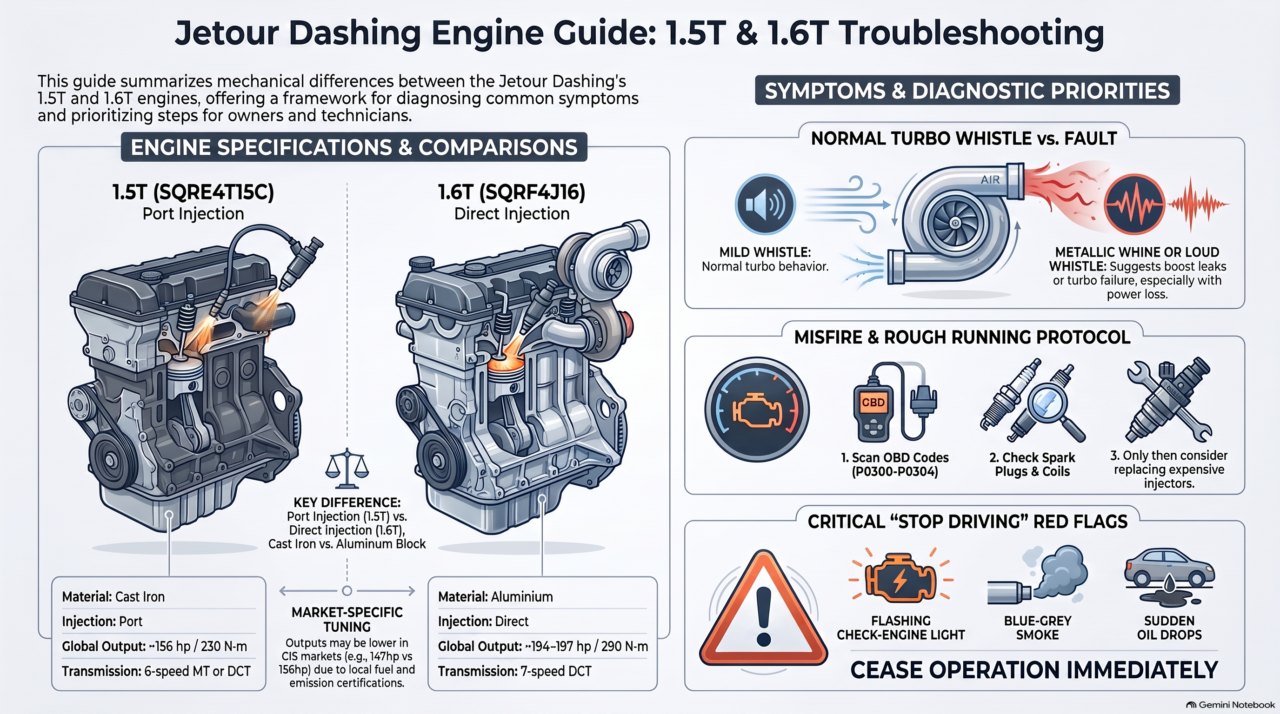
Before diagnosing anything, it’s worth confirming exactly which engine variant is fitted — via the vehicle documents or the engine code stamped under the hood — because power figures and injection type differ meaningfully between the 1.5T and 1.6T, and even more so between markets.
Parameter
1.5T (SQRE4T15C)
1.6T (SQRF4J16)
Displacement
1.5 L, 4-cylinder turbo
1.6 L, 4-cylinder turbo, DOHC
Power (global-spec markets)
~156 hp (115 kW)
~194–197 hp (145 kW)
Torque (global-spec markets)
~230 N·m
~290 N·m
Injection
Port injection
Direct injection
Transmission
6-speed manual or 6-speed DCT
7-speed DCT (some markets offer 8-speed AT with AWD)
Block material
Cast iron
Aluminium
Both engines belong to Chery’s ACTECO family, co-developed with the Austrian engineering firm AVL, and the same units appear across other Chery-group models — Omoda C5, and the Tiggo 4/7/7 Pro/8, among others.
A market-specific detuning note. The power figures above reflect the global-spec calibration reported by regional distributors in markets such as the Philippines and Saudi Arabia. In some markets — notably Russia and other CIS countries — the same engines are certified at somewhat lower output: roughly 147 hp for the 1.5T and 186–190 hp for the 1.6T. This isn’t a defect; it typically reflects local fuel-quality assumptions, emissions certification, or ECU calibration for that market. Always confirm the exact output for your specific market and VIN rather than assuming global-spec figures apply everywhere.
An honest reliability caveat. The Dashing is still a young nameplate in most of its export markets — it only reached showrooms outside China from 2023 onward, with local assembly in Indonesia starting as late as October 2024. That means there isn’t yet a large pool of high-mileage cars to draw firm reliability conclusions from. Reviewers in the UAE and South Africa who tested early 2022–2023-built units generally describe teething issues concentrated in infotainment software and build quality rather than the engine itself, with later production runs reported as improved — but this is early-adopter feedback, not long-term statistics.
Oil consumption on the Jetour Dashing
Rising oil consumption is usually the first symptom owners notice on a turbocharged engine.
A small drop in level between services is not automatically a fault. But if you’re topping up regularly, the level drops noticeably, or blue-grey smoke appears from the exhaust, the engine needs to be checked.
Possible causes of oil consumption
gasket and seal leaks;
a faulty crankcase ventilation (PCV) system;
worn or stuck piston rings;
worn valve stem seals;
oil being drawn into the intake;
oil passing through a worn turbocharger;
sustained high-load driving.
Pay particular attention to the boost pipework and intercooler. A light oily film inside the charge-air system isn’t automatically a turbo fault — a small amount of oil mist from normal crankcase ventilation is expected. But a heavy oil deposit combined with a falling sump level is a reason to have the turbocharger inspected.
What’s known about turbo oil consumption on the related 4T15C engine. Drom.ru, a Russian-language automotive outlet, reported that on the closely related ACTECO 4T15C engine used across other Chery/Jetour models in the Russian market, some turbochargers were replaced under warranty after starting to consume oil before 60,000 km. (Russian-language source, describing CIS-market vehicles specifically — not confirmed as a widespread issue on the Dashing itself.) It’s not evidence of a systemic problem on the Dashing, since the model is too new for solid mileage statistics, but it’s a reason to act on early oil-consumption symptoms and raise a warranty claim promptly rather than waiting for the problem to become obvious.
If you notice oil consumption, don’t just top up and move on — find out exactly where the oil is going: past gaskets externally, into the combustion chamber via rings or valve seals, or through the turbo.
What oil goes into a Jetour Dashing
The correct oil depends on the exact engine and gearbox combination, and — importantly — on your market’s spec sheet, since recommendations can differ by region. As a general reference point, an owner-logged maintenance record for the 1.5-litre manual variant (engine code E4T15C) in the Russian market cited API SN-grade 5W-40 at roughly 4.7 ± 0.2 L, while the 1.6-litre DCT variant (SQRF4J16) called for ACEA C3-grade 5W-30 at roughly 5 ± 0.2 L. (Russian-language source.) Treat these as a starting reference only — always confirm the current recommendation against your own service book, since manufacturer guidance is occasionally updated and can vary between markets.
🚗 Special Deals & Discounts
Latest prices on vehicles, spare parts and dealer promotions.
If the power loss appeared suddenly and the check-engine light came on at the same time, a full OBD scan should be the first step.
It’s worth reading live data as well as stored fault codes — boost pressure, fuel trims, misfire counters, coolant temperature, and any other parameters the scanner exposes.
Rough running and misfires
A rough-running engine typically feels like vibration, an unstable idle, hesitation on acceleration, or jerking under load.
What to check first
spark plugs;
ignition coils;
connectors and wiring;
injectors;
fuel quality;
fuel pressure;
vacuum/air leaks;
compression.
If misfires appear mainly under hard acceleration, focus on the ignition system first — a marginal plug or coil can behave fine at idle and misfire badly under load.
If the engine started running rough right after refuelling, don’t rule out poor fuel quality.
With persistent misfires, it’s worth limiting how the car is driven in the meantime — unburned fuel reaching the exhaust can overload the catalytic converter.
Spark plugs and ignition coils
Spark plugs work under fairly demanding conditions, especially on a turbocharged engine.
An incorrect gap, fouling, electrode wear, or the wrong plug type can lead to:
hard starting;
an unstable idle;
hesitation on acceleration;
increased fuel consumption;
misfires;
reduced power.
Coils can also fail partially — sometimes the fault only shows up once the engine is warm or under load.
If the scanner shows a misfire on a specific cylinder (codes P0301–P0304), check that cylinder’s plug and coil first rather than replacing parts across the board.
Injectors and fuel system issues
Injector condition directly affects mixture quality. Diagnosis differs between the 1.5T and 1.6T because the SQRE4T15C in its common configuration uses port injection, while the SQRF4J16 uses direct injection.
Injector problems can show up as:
hard starting;
an unstable idle;
misfires;
increased fuel consumption;
reduced responsiveness;
a fuel smell;
fuel trim corrections.
Don’t jump straight to buying new injectors on these symptoms alone — first check fuel pressure, fuel trims, misfire data, and other parameters.
Turbo whistle or unusual noise
A turbocharger naturally makes some noise as it spools up, so a mild whistle by itself isn’t a fault.
Warning signs
a sudden increase in noise;
a metallic sound;
a whine that wasn’t there before;
whistling combined with power loss;
heavy oil in the intake;
smoke from the exhaust;
unstable boost pressure.
The cause isn’t always the turbo itself. A damaged or loose boost pipe can produce a very similar whistle as pressure rises, so the whole tract from the compressor to the intake manifold should be checked before replacing the turbocharger.
Signs of a turbocharger fault
The most telling combination is power loss + a change in turbo sound + boost-related fault codes.
Also watch for:
reduced acceleration past a certain rpm;
the engine not delivering its usual torque;
a new whistle or whine;
smoke;
increased oil consumption;
a check-engine light;
boost pressure that doesn’t match the target;
the car periodically entering a reduced-power mode.
It’s important to distinguish an actual turbo failure from a leak in the boost system. A cracked intercooler hose or a loose connection can produce symptoms that look almost identical to a failing turbo — so proper diagnosis should start with a boost-leak test.
Engine overheating
Overheating is especially risky on a turbocharged engine.
Causes can include:
low coolant level;
a coolant leak;
a faulty thermostat;
a cooling fan problem;
a failing water pump;
clogged radiators;
a faulty sensor;
disrupted coolant circulation.
If the temperature gauge starts reading higher than usual, avoid continuing under heavy load. It’s especially risky to ignore an overheating event just because the engine cooled back down afterward — repeated overheating episodes need the root cause found, not just a coolant top-up.
Cold starting the Jetour Dashing
A poor cold start after the car has sat overnight can come from either the fuel side or the ignition side.
When diagnosing a cold-start issue, check: battery condition, spark plugs, coils, injector operation, fuel pressure, temperature sensors, air/vacuum leaks, crankcase ventilation, and fuel quality.
If the engine runs fine once warm but struggles specifically on a cold morning start, it helps to compare cold-engine parameters against what a healthy car should show. Incorrect readings from the coolant temperature sensor, for instance, can throw off the mixture calculation during cold start.
Worth noting: Drom.ru’s technical review reported that a direct-injection Dashing variant started reliably in testing at around −38°C. (Russian-language source, describing testing conditions specific to the Russian market.) That suggests the engine design itself isn’t inherently cold-sensitive — a specific car’s cold-start trouble is more often down to battery condition, spark plugs, or fuel quality than a basic engine flaw.
Fuel quality matters
A turbocharged engine is sensitive to fuel quality, especially under sustained high load.
Problems after refuelling with poor-quality fuel can show up as: knock/detonation, loss of pulling power, rough running, higher consumption, hard starting, misfires.
That said, don’t automatically blame fuel for every fault. If a problem keeps recurring across different filling stations, there’s a technical cause to find.
For your specific Dashing, always check the owner’s manual and the fuel specification for your market and engine — the minimum octane requirement can differ between variants and regions.
How to narrow down the search yourself
It’s more useful to think in symptom combinations than in isolated symptoms.
Symptom combination
What to check first
Rough running + check-engine light
Misfire codes, spark plugs, coils, injectors, fuel system
Power loss + whistling
Boost pipes, intercooler, intake seal, boost control
Power loss + oil consumption
Turbocharger, crankcase ventilation, general engine condition
Don’t keep driving a Jetour Dashing under load if any of the following appear together:
a loud metallic engine noise;
pronounced overheating;
a flashing check-engine light;
strong, persistent misfires;
a sudden drop in oil level;
blue-grey smoke;
a sharp turbo whistle combined with power loss;
a coolant or oil leak.
Continuing to drive in these conditions can significantly increase the eventual repair bill.
What to check when diagnosing the Jetour Dashing engine
Scan OBD codes. Don’t stop at the fault code itself — check stored freeze-frame data and the conditions under which it triggered.
Check fluid levels. Oil and coolant should be within the acceptable range.
Do a visual inspection. Look for oil or coolant traces, and damaged connectors or hoses.
Check the ignition system. Spark plugs and coils matter most for rough running and misfires.
Check the fuel system. Measure fuel pressure and test injector operation if needed.
Check the boost system. Inspect hoses, connections, the intercooler, and boost control components.
Check the cooling system. Especially if running temperature has been higher than normal.
Go deeper if nothing external is found. Compression, cylinder condition, and other mechanical parameters can be checked at this stage.
What owners are actually saying
Below is a paraphrased summary — not a verbatim quote — of real reviews and reporting on the Dashing from markets where it’s actually sold. These are individual experiences, not model-wide statistics, but they’re useful for grounding the theory above in real-world feedback.
A used-car reliability review from the UAE covering 2022–2023-built Dashing units describes a strong turbo engine and generous warranty coverage as standout positives, while flagging infotainment software glitches (resolved via dealer updates) and inconsistent panel gaps on some early cars as the main early-build complaints. The review notes that later production runs show improved build quality, and separately flags that heavy city driving can accelerate brake pad wear, requiring replacement roughly every 30,000 km.
A South African first-drive review of the 1.5T Dashing was notably more critical of the drivetrain than of the engine’s raw output, describing the transmission response as falling short of expectations and noting that real-world fuel consumption undercut the car’s initial value proposition. The reviewer’s overall impression of the exterior and interior remained positive, with the drivetrain singled out as the weak point of the ownership experience.
A Dubai-based repair-shop guide to common Jetour issues describes engine-performance complaints on the brand’s lineup as generally centred on stalling, sluggish acceleration, and rough idling, most often traced back to the fuel system or ignition components rather than deep mechanical faults. The same source notes that Dubai’s hot climate can make automatic-transmission shifts feel harder or slip more often, and recommends regular transmission fluid changes as a preventive measure.
Drom.ru’s technical review of the Dashing on the Russian market reports that, over the model’s first year of local sales, neither dealers nor specialised owner forums were widely reporting serious engine problems — most owner complaints centred on the transmission, electronics, and dealer service quality rather than the engine itself. The same outlet notes that a direct-injection Dashing started reliably in cold-weather testing at around −38°C.
What isn’t confirmed yet. At the time of writing, no verifiable owner-documented turbo replacement or major engine rebuild specifically on a Dashing — as opposed to related Chery/Jetour models sharing the same engine family — turned up in the sources reviewed for this article, across any of the markets checked (UAE, South Africa, Philippines, Russia). That could reflect genuine reliability at current mileages, or simply that the model hasn’t been on sale long enough anywhere to generate that kind of data. If you have documented experience with an engine repair on a Dashing, sharing a link to your review or forum post in the comments would help keep this page current.
Bottom line
The Jetour Dashing 1.5T and 1.6T shouldn’t be diagnosed off a single symptom. Power loss can come from the turbo, an intake leak, spark plugs, coils, injectors, or fuel quality. Likewise, a whistle under the hood doesn’t automatically mean the turbocharger needs replacing.
The symptoms worth taking seriously are a sharp rise in oil consumption, persistent misfires, overheating, a new and noticeably louder turbo sound, visible smoke, and a sudden loss of power.
If any of these show up, it’s worth running a full diagnostic before a minor fault turns into an expensive repair. And because specs, power output, and service intervals vary by market, always check them against your car’s actual year, engine code, market of sale, and VIN rather than assuming figures from another region apply to your car.
Related reading on avtomir.site
Jetour Dashing: Weak Points, Common Problems and Fault Codes
Jetour Dashing 7-Speed DCT: Known Issues and Quirks
They’re different in character rather than simply better or worse. The 1.5T is mechanically simpler (port injection, cast-iron block) and generally cheaper to service, while the 1.6T is more powerful and responsive but mechanically more complex (direct injection). The right choice depends on whether you prioritise running costs or performance.
There’s no official published figure specific to this model, and there isn’t yet enough high-mileage data to establish one. As a general rule for turbo engines: a small drop between services is normal, but needing to top up more often than the service interval, or a noticeably falling level, warrants a diagnostic check.
A mild whistle under boost is normal turbo behaviour. Red flags are a sudden increase in noise, a metallic sound, or a new whine — especially combined with power loss. The cause is often a leaking or loose boost hose rather than the turbo itself, so check that first.
Scan for OBD codes first — P0300 indicates a general misfire, P0301–P0304 point to a specific cylinder. Then check that cylinder’s spark plug, coil, injector, and fuel supply. If the rough running started right after refuelling, poor fuel quality is worth ruling out first. With persistent misfires, limit driving until it’s diagnosed, since unburned fuel can damage the catalytic converter.
The exact requirement depends on the market and variant, so check your owner’s manual. As a general principle for turbocharged engines, it’s not worth economising on octane rating — higher-quality fuel reduces the risk of detonation under load.
There’s no universal figure. Russian-language technical press has reported isolated warranty turbo replacements on the related 4T15C engine in other Chery/Jetour models before 60,000 km, but there isn’t yet confirmed, model-specific data for the Dashing itself — the nameplate is too new in most markets for solid long-mileage statistics.
More often than not, the cause isn’t the engine itself but the battery, spark plugs, or fuel quality. Cold-weather testing has shown the direct-injection variant starting reliably down to around −38°C, so the base engine design isn’t especially cold-sensitive — look at the supporting systems first.
Yes. With persistent misfires, unburned fuel reaches the exhaust and burns off inside the catalytic converter, overheating and gradually damaging it. That’s why sustained rough running is worth diagnosing promptly rather than putting off a service visit.
avtomir.site Editorial Team. This article is an independent regional adaptation of our Russian-language coverage of the Jetour Dashing, not a direct translation — specifications, market context and owner sourcing were re-verified for an international audience. It draws on real, linked sources only, with no invented statistics or fabricated owner accounts. Figures and trim availability vary by market; always confirm against your vehicle’s VIN and local specification sheet.
🔧 Need car repair or diagnostics?
Discounts on maintenance, diagnostics, and spare parts for Chinese cars at official dealers and trusted services.