Author: Automotive expert specializing in Chinese vehicles, with hands-on experience in diagnostics, maintenance, and real-world operation of ICE, hybrid, and electric models.
Updated for 2026
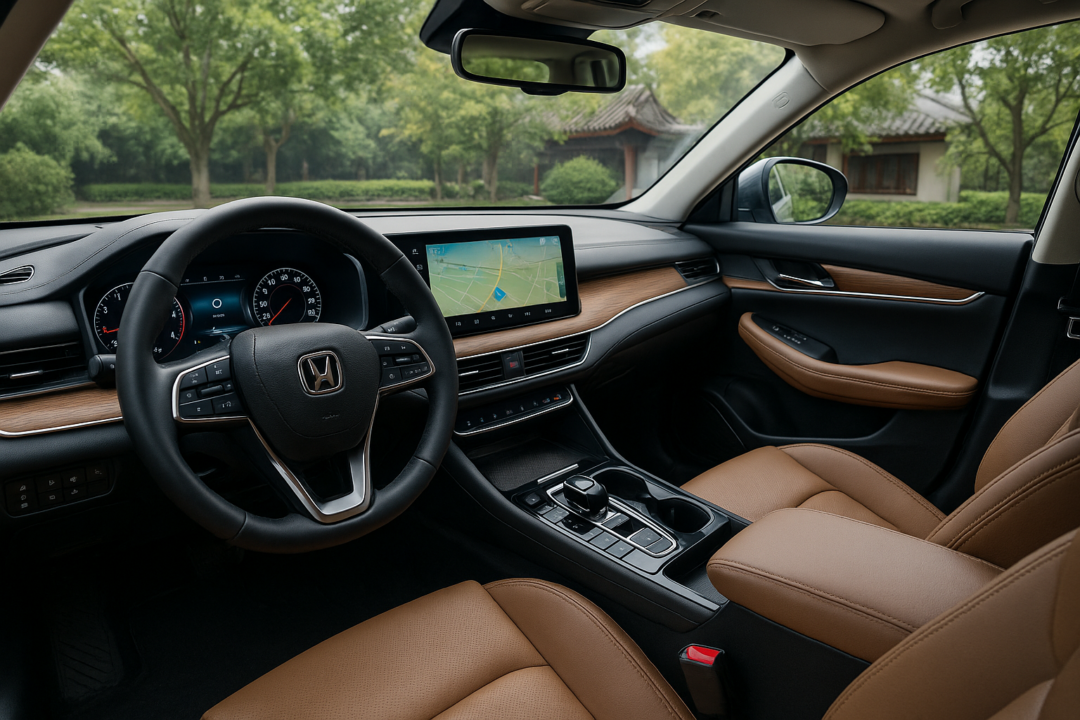
Chinese automakers — Geely, Chery, Haval, Changan, GAC, Tank, Jetour, and Exeed among them — have moved from budget alternatives to genuine technology leaders in just a few years. Buyers shopping in Kazakhstan, Russia, and the wider CIS region now regularly cross-shop these brands against European and Korean competitors, and the reason often comes down to equipment: features that used to be reserved for luxury cars are now buried in the settings menus of mid-range SUVs.
This updated guide walks through the hidden and semi-hidden features you’re most likely to find in a modern Chinese car — from cabin fragrance systems to autonomous-driving indicator lights — and points out which ones are now standard rather than exotic.
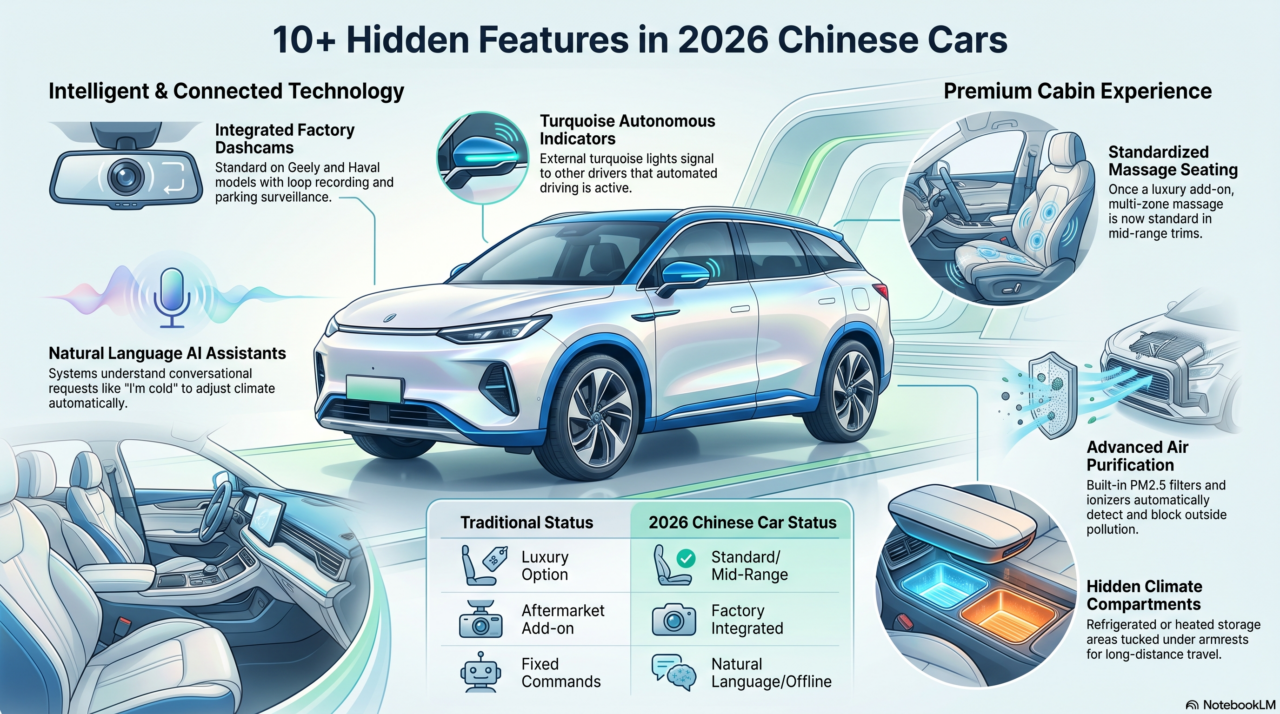
A built-in dashcam is no longer a novelty — it’s close to a segment standard on Geely, Chery, and Haval models sold in 2026, including budget-oriented trims of the Coolray and Jolion. Typical functionality includes:
Continuous loop recording, often to a microSD card or onboard storage
Parking surveillance / sentry mode that activates when the car is stationary
Direct playback through the central infotainment screen, no phone app required
Paired with a 360° surround-view camera system — now common even outside top trims — this removes the need to buy an aftermarket dashcam, which is standard practice on many European and Japanese models at this price point.
2. AI Voice Assistants With Natural Language Understanding
Voice control in Chinese cars has moved well past simple fixed commands. Brands like Chery, Geely, and Huawei-backed platforms (used in Avatr and AITO) now run assistants that understand conversational, multi-step requests and retain context across a short exchange. Examples of the kind of phrasing that works:
“I’m a bit cold” → the system raises cabin temperature without you specifying a number
“I’m tired, put something relaxing on” → dims ambient lighting and switches to a calmer playlist
“Crack the sunroof halfway” → precise, partial sunroof control rather than just open/close
Many of these assistants also work offline for core vehicle functions, which matters in areas of Kazakhstan and Russia with patchy mobile data coverage.
3. Cabin Air Purification and Ionization
PM2.5 filtration, automatic outside-air-quality sensing, and negative-ion generators remain common in the Chinese segment, and by 2026 they’ve trickled down into more mid-range trims rather than staying a flagship-only feature. Some systems will automatically switch to recirculation mode when they detect elevated pollution outside, without any driver input — a quiet feature most owners never notice until they check the settings menu.
4. Massage Seats — Now Standard, Not a Luxury Add-On
This is one of the biggest shifts since last year: massage seating, once a flagship-only perk, is now included in base or near-base trims of vehicles like the Tank 300, where the driver’s seat comes with massage function as part of the standard equipment list rather than an optional extra. The Exeed VX, Jetour models, and Geely Monjaro extend multi-zone massage, heating, and ventilation further into the lineup, frequently paired with seat memory settings that most owners discover only after digging into the touchscreen menus.
5. Hidden Cooling and Warming Compartments
Refrigerated or heated storage under the center armrest or in the rear console is still a distinguishing feature versus similarly priced European and Korean rivals. A handful of 2026-model-year SUVs in this segment now offer small dedicated fridge compartments in addition to the more common cooled/warmed cubbies — useful for road trips across the long distances typical of Kazakhstan and southern Russia.
6. Cabin Fragrance (Aromatization) Systems
A feature that’s become noticeably more common in 2025–2026 model years: built-in cabin fragrance diffusers, sometimes with multiple scent cartridges and app or voice control. Owners of models like the Exeed VX and several Tank and GAC trims mention this as one of the equipment details they didn’t expect at the price point — it’s often tucked into the glovebox or center console rather than advertised on the spec sheet.
7. Gesture Control for Windows, Sunroof, and Media
Gesture-based control — a wave or swipe near the center console to adjust the sunroof, skip a track, or crack a window — continues to appear on higher trims of NIO, Changan, and Avatr models with advanced driver-assistance packages. It’s rarely a headline feature in marketing materials, which is exactly why many owners don’t discover it until well after purchase.
8. Smart Digital Rearview Mirrors
Digital rearview mirrors that display a live HD camera feed instead of (or in addition to) a reflective surface remain a distinguishing feature on select Chinese models, particularly useful at night or with a fully loaded rear cargo area blocking the view. Many also double as a rear dashcam and offer parking-guidance overlays — functionality that’s easy to miss since it looks like an ordinary mirror until activated.
9. App Ecosystem Integration and Phone-as-Digital-Key
WeChat integration remains common on China-market infotainment systems, though it’s typically disabled or replaced with local equivalents on cars sold in the CIS. What has expanded since last year is phone-as-digital-key functionality — using a smartphone or NFC card to lock, unlock, and in some cases start the car — now appearing on more mid-range trims rather than only flagship EVs.
10. Ambient Lighting With Hidden Mood Modes
Beyond simple color selection, many infotainment systems hide preset “mood” combinations that pair lighting with sound and even climate settings — a calming blue-toned setting for highway driving, or a warmer tone paired with seat heating in winter. These are usually buried two or three menus deep rather than on the main ambient lighting screen.
11. Driver Fatigue and Health Monitoring
Camera-based drowsiness detection — tracking eye movement, blink rate, and head position — has become standard on more models, moving beyond the basic lane-departure-linked fatigue warnings of a few years ago. Some higher-end models pair this with seat or steering-wheel micro-vibration alerts rather than just an audible chime.
12. Turquoise Autonomous-Driving Indicator Lights
A new and easy-to-miss detail on 2026 model-year vehicles with higher-level driver-assistance systems: an emerging Chinese industry convention uses turquoise-colored exterior lighting (in headlights or taillights) to signal to other road users that the car is operating in an automated driving mode. It’s not yet universal, but it’s showing up on enough new models that it’s worth knowing if you see it on a car around you.
13. Over-the-Air (OTA) Updates for More Than Infotainment
Where a few years ago OTA updates on Chinese cars mostly meant map or app refreshes, many current models now push meaningful updates to driver-assistance behavior, battery management, and even ride comfort settings — the kind of update cycle that used to take dealership visits on other brands. This is worth checking in your car’s settings menu, since it’s easy to have updates paused or disabled without realizing it.
14. Battery Swap Instead of Charging (EV Models)
For readers considering a Chinese EV rather than a combustion or hybrid model, battery-swap technology — pioneered by NIO’s Battery-as-a-Service program — lets owners exchange a depleted battery pack for a charged one at a dedicated station in a few minutes rather than waiting to charge. It’s not relevant to every buyer, but it’s one of the more overlooked ownership-model differences between Chinese EV brands and traditional charging-only competitors.
Final Thoughts
Chinese automakers are no longer just competing on price — in 2026 they’re setting the pace on software updates, cabin comfort features, and driver-assistance technology that legacy brands are still catching up to. Many of these features aren’t advertised prominently because they’ve simply become expected equipment rather than headline selling points.
If you’ve recently bought or test-driven a Chinese car, it’s worth spending twenty minutes in the infotainment settings and the owner’s manual — there’s a good chance you’ll find at least one function on this list that you didn’t know your car had.
🔍 Frequently Asked Questions (FAQ)
Do Chinese cars come with built-in dashcams?+
Yes. Factory-installed dashcams with loop recording, parking surveillance mode, and infotainment-screen playback are now close to standard on many Geely, Chery, and Haval models, rather than a rare extra.
Can I control the car’s functions using voice commands?+
Yes. Modern Chinese cars use voice assistants that understand natural, conversational phrasing rather than fixed commands, and many core functions work offline.
Are massage seats really standard equipment now?+
On some models, yes — the Tank 300, for example, includes driver-seat massage as part of its base or near-base equipment rather than as a paid option, which was unusual for this class of vehicle just a couple of years ago.
What is the cabin fragrance system some new models have?+
It’s a built-in scent diffuser, sometimes with swappable cartridges and app or voice control, that has become more common on 2025–2026 model-year Chinese SUVs, including some Exeed and Tank trims.
What do the turquoise lights on some new Chinese cars mean?+
It’s an emerging convention where turquoise-colored exterior lighting signals that the vehicle is operating in an automated driving mode, helping other road users understand the car’s state.
Do Chinese cars have air purification systems?+
Yes. Many models include PM2.5 cabin filters, automatic pollution detection, and negative-ion generators, and this equipment has spread into more mid-range trims recently.
How can I find hidden features in my car?+
Check the owner’s manual and go through every level of the infotainment settings menu — many features are grouped under advanced or secondary menus and aren’t mentioned in the marketing brochure.
This article reflects publicly available information on 2025–2026 model-year Chinese vehicles as of mid-2026. Equipment varies by market, trim, and model year — always confirm exact specifications with an official dealer for the specific car you’re considering.
Author: Egor Bespalov — Mechanical Engineer, 10 years of experience with Chery, AvtoMir Service, expert on Chinese cars. Writes about repair, diagnostics, and ownership experience of Haval, Chery, Geely, and Changan models.